

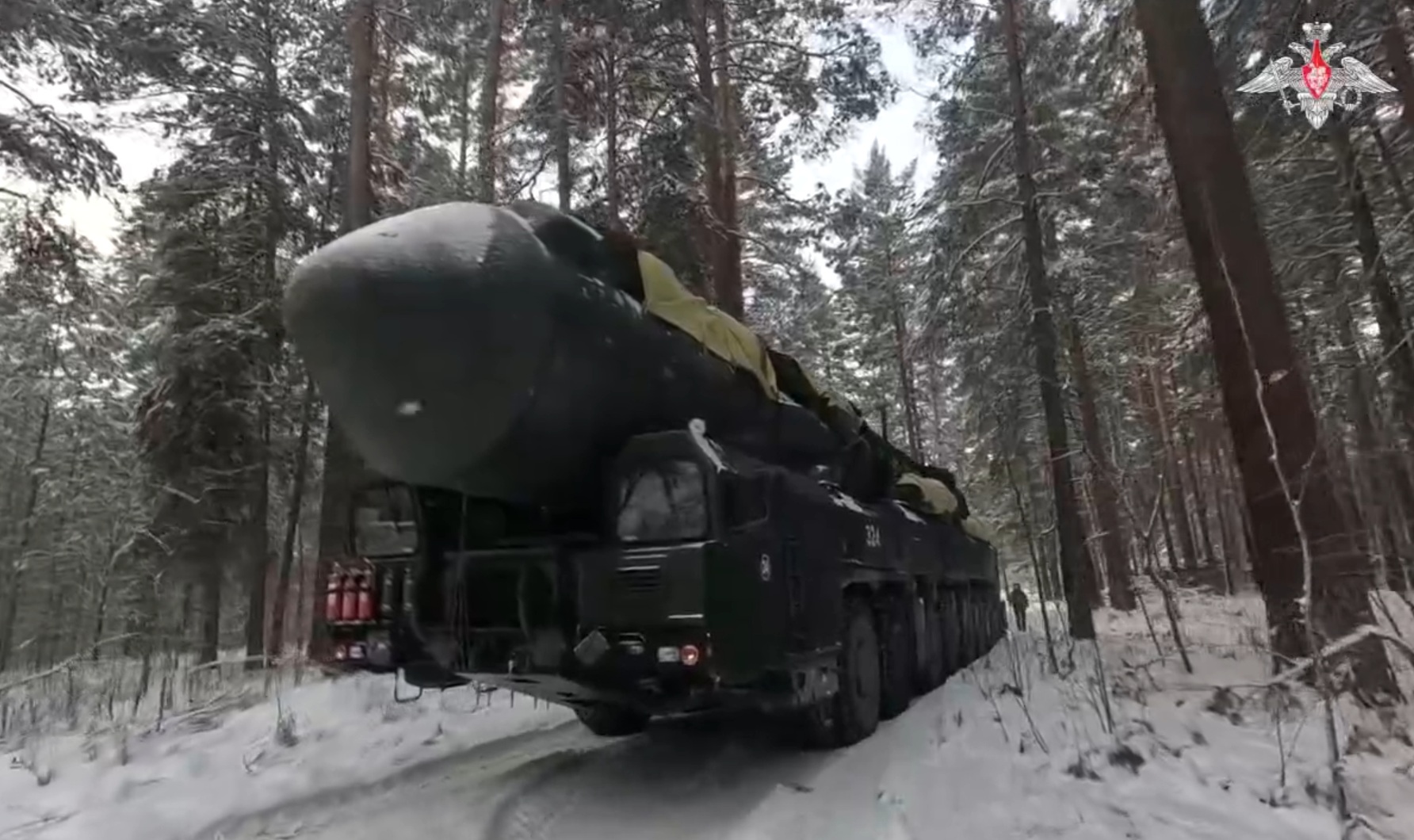
Russian President Vladimir Putin asserted on Wednesday that the country’s nuclear forces now maintain the highest share of modern systems in the world, reaffirming Moscow’s emphasis on its nuclear deterrent amid ongoing tensions with the West.
Speaking during a defense meeting focused on the implementation of Russia’s state armament program, Putin said that 95 percent of the country’s strategic nuclear arsenal now consists of “modern weapons and equipment.”
“Right now, the share of modern models of weapons and equipment in the strategic nuclear forces stands at 95%,” Putin said, according to state-run news agency TASS. “This is a good indicator—essentially the highest among all nuclear powers in the world.”
The Russian president directed officials to maintain a focus on strengthening the nuclear triad, which includes land-based intercontinental ballistic missiles, submarine-launched ballistic missiles, and strategic bombers. According to Putin, the triad remains central to safeguarding Russia’s sovereignty.
Putin’s remarks arrive at a time when Russia’s conventional forces continue to be stretched by the war in Ukraine, now in its third year. Western sanctions, battlefield attrition, and industrial bottlenecks have eroded the country’s ground force readiness. In contrast, Russia’s nuclear arsenal remains one of the few areas where the Kremlin continues to claim superiority.
The nuclear posture has also featured more prominently in Kremlin rhetoric since the beginning of the full-scale invasion in February 2022. Putin has repeatedly referenced Russia’s nuclear capabilities in the context of escalating tensions with NATO, though officials in Washington have cautioned against interpreting the statements as indicators of imminent use.
Moscow has publicly showcased advanced systems such as the RS-28 Sarmat ICBM, the Avangard hypersonic glide vehicle, and nuclear-capable submarines like the Borei-A class. However, the extent to which these systems have been fully deployed across operational units remains uncertain.
In the broader strategic picture, Russia’s reliance on its nuclear forces reflects a narrowing range of options. With limited access to high-end Western technology and constrained economic tools, the Kremlin’s ability to project power increasingly rests on legacy systems and doctrinal threats.
Still, Putin appears determined to use the nuclear portfolio to assert Russia’s role as a global power. Whether this posture will deter adversaries or further isolate Moscow remains uncertain.