

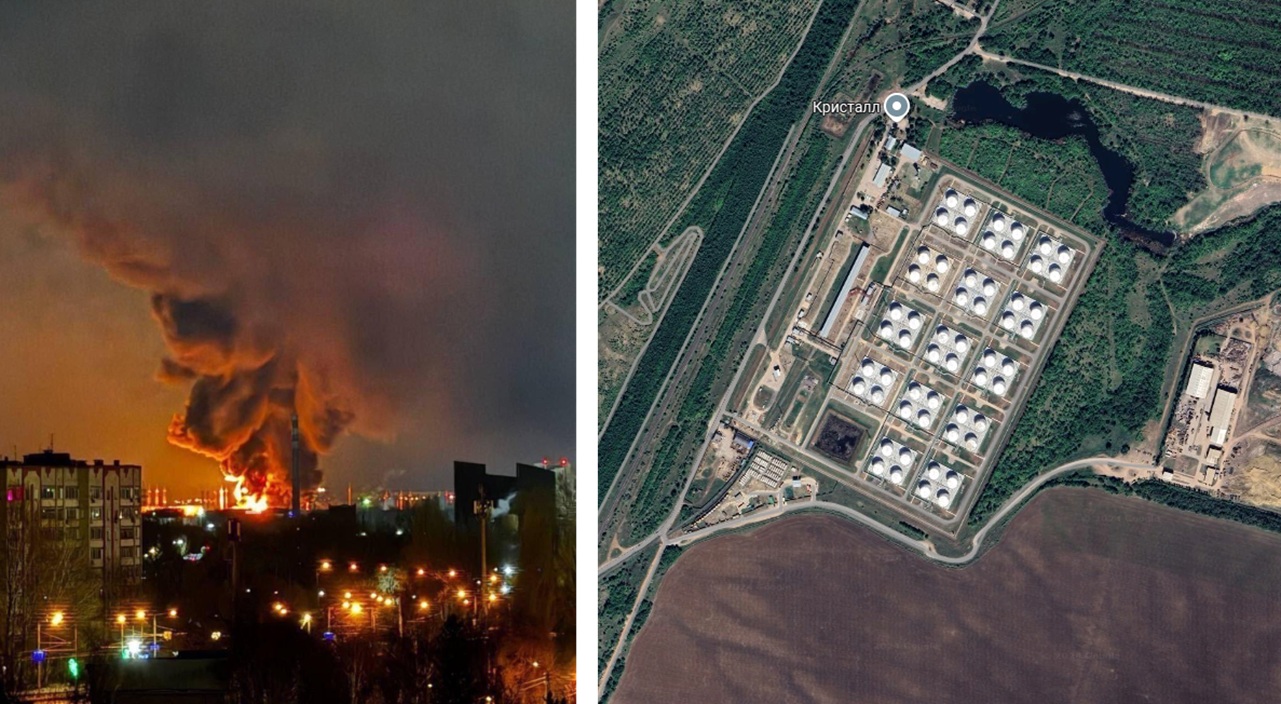
A Ukrainian long-range drone strike on the night of January 8 targeted a highly strategic military site in Russia’s Saratov region, reportedly hitting a fuel depot linked to the Engels airbase, home to Russia’s strategic bombers.
The attack struck the “Kombinat Kristall” facility, which stores specialized aviation fuel for bombers stationed at the Engels airbase. The airbase is known to house the Tu-95MS and Tu-160 bombers of Russia’s 22nd Heavy Bomber Division.
Local governor Roman Busargin confirmed that drone debris hit an industrial site, though images and videos circulating on social media depict a large-scale fire engulfing parts of the facility’s storage tanks.
Defense Express reported that the fire, visible in videos from the scene, is consistent with a direct hit on the fuel depot. Local authorities have acknowledged the strike, attributing it to Ukrainian long-range drones.
The depot is believed to store T-8V aviation fuel, a high-density, specialized type required for the Tu-160 bombers. Unlike standard aviation fuels used by the Tu-95MS, T-8V fuel is produced through a complex refining process at only a few facilities in Russia. Historically, this type of fuel was manufactured in limited quantities during the Soviet era at plants in Angarsk and Orsk.
If T-8V fuel reserves were destroyed in the strike, it could reduce the operational readiness of Russia’s Tu-160 bombers. Although these bombers have seen limited use in the war against Ukraine, their strategic importance in Russia’s arsenal remains high. The last recorded use of Tu-160s in strikes on Ukraine occurred on November 17, 2024, after a 550-day hiatus.
This strike underscores Ukraine’s ability to target critical infrastructure deep within Russian territory, disrupting logistics and potentially limiting Russia’s capacity for strategic aviation missions. The Engels airbase, already a focal point of multiple drone strikes in recent months, remains a key target in Ukraine’s strategy to weaken Russia’s long-range aerial capabilities.