

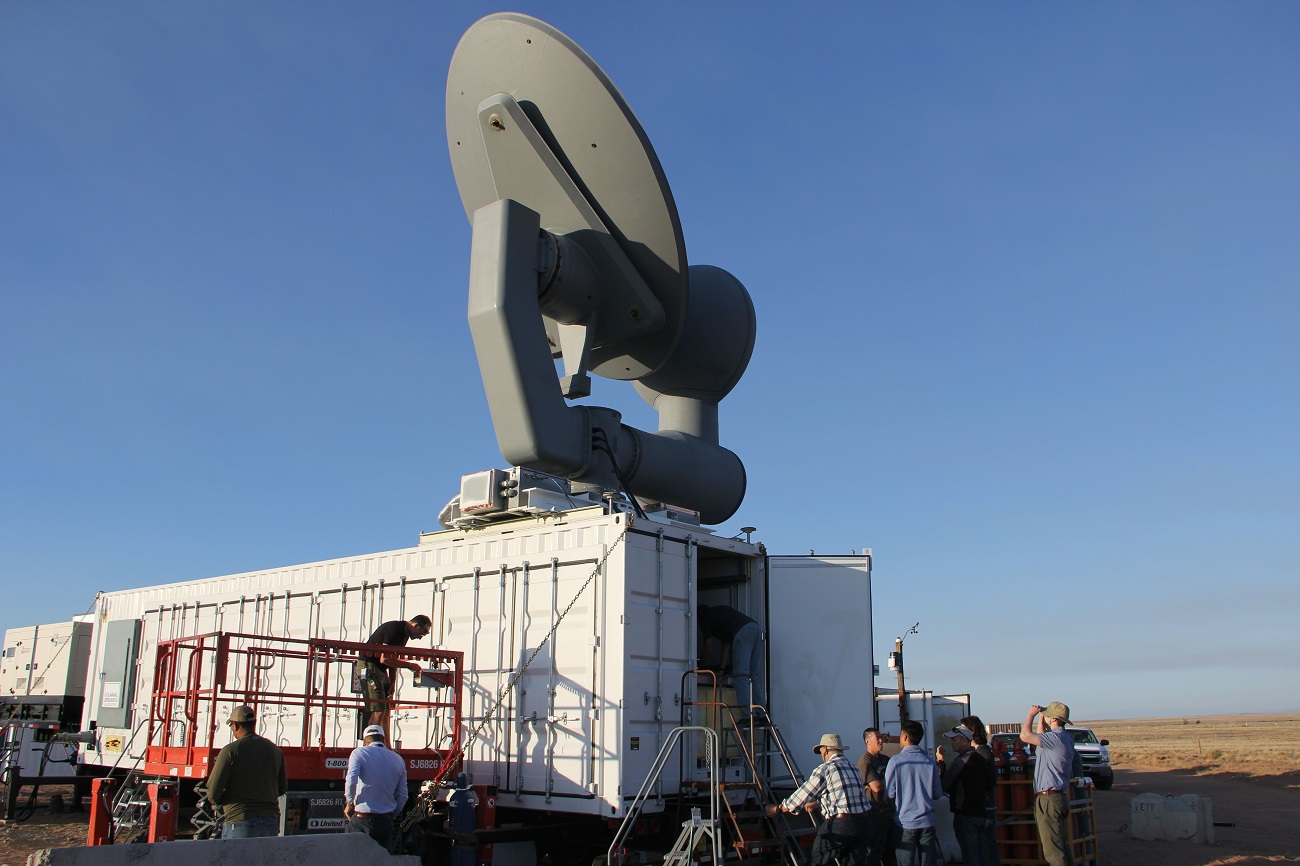
The U.S. Air Force Research Laboratory and Raytheon, an RTX business, have successfully completed a three-week field test of the CHIMERA high-power microwave (HPM) weapon at White Sands Missile Range in New Mexico.
According to a press release from RTX, during the test, CHIMERA applied directed energy to multiple static target variations and demonstrated end-to-end fire control by acquiring and tracking aerial targets and maintaining tracking for the entire flight path.
The Counter-Electronic High-Power Microwave Extended-Range Air Base Defense system, known as CHIMERA, was built to fire highly concentrated radio energy at multiple middle-to-long-range targets. The ground-based demonstration system wields more power than other HPM systems to defeat airborne threats at the speed of light.
“High-power microwave systems are cost-effective and reliable solutions that play an important role in layered defense by increasing magazine depth and giving warfighters more options to defeat adversaries quickly,” said Colin Whelan, president of Advanced Technology at Raytheon. “The successful test of CHIMERA is a testament to the strong partnership between Raytheon and the AFRL, and our commitment to developing non-kinetic solutions that can counter increasingly sophisticated threats.”
CHIMERA is part of the Directed Energy Front-line Electromagnetic Neutralization and Defeat (DEFEND) program, which is a joint service effort to design, build and test HPM systems for front-line deployment. Raytheon is partnering with experts at the AFRL, Naval Surface Warfare Center Dahlgren Division and the Undersecretary of Defense for Research and Engineering to complete this work.
“This is what the power of government and industry partners can achieve: critical technology that can be inserted in an integrated mission architecture alongside other directed energy tech and kinetics. It is imperative that AFRL, in partnership with industry and academia, continue to innovate and feed these architectures now and in the future,” said Dr. Shery Welsh, director, Directed Energy Directorate, Air Force Research Laboratory.