

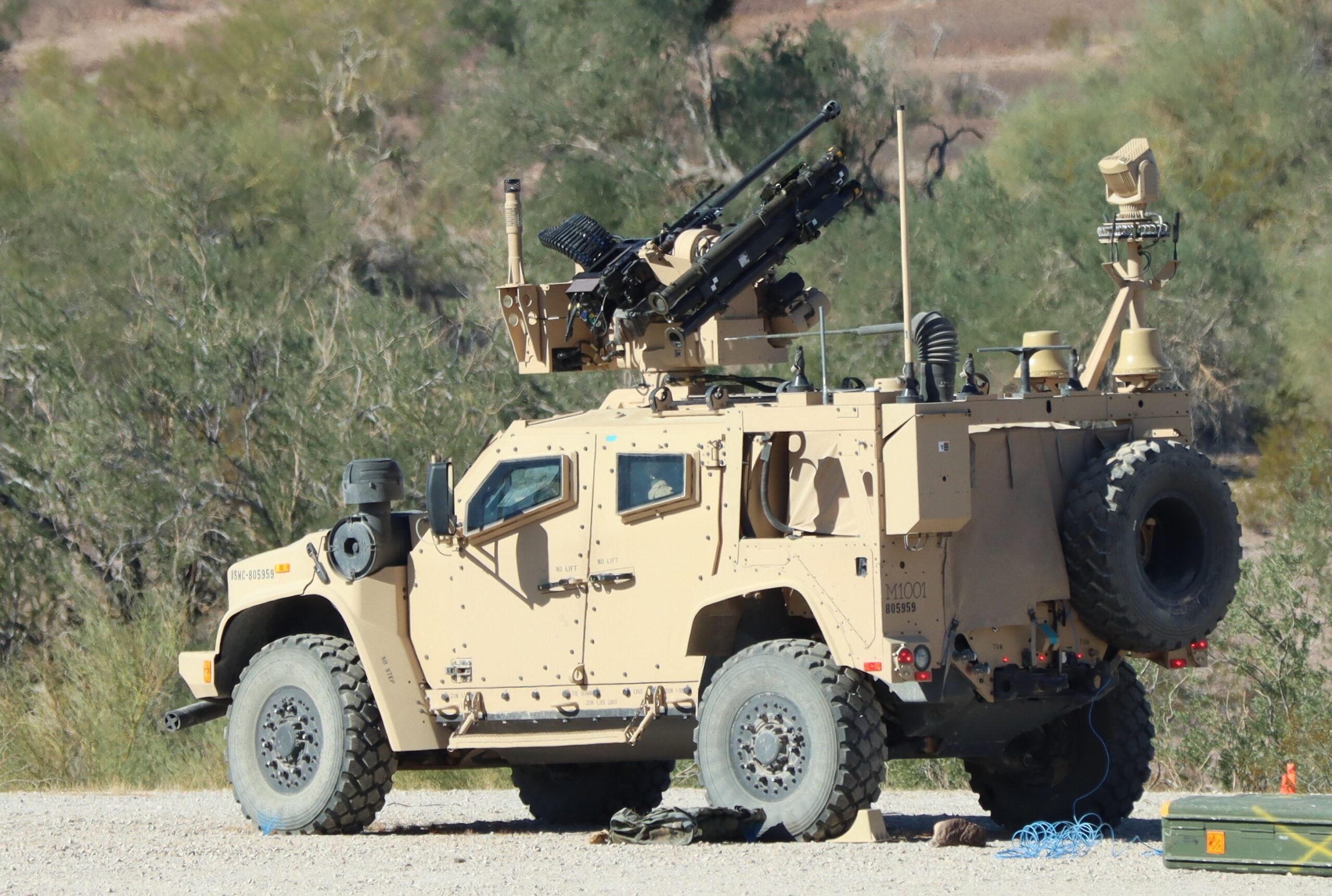
The U.S. Marine Corps has taken a significant stride in countering unmanned aircraft systems (UAS) with the successful live-fire test of the Marine Air Defense Integrated System (MADIS) low-rate initial production model.
Conducted in December at the Yuma Proving Ground in Arizona, the test demonstrated MADIS’s capability to detect, track, identify, and defeat launched drones, marking a crucial development in the Marine Corps’ air defense strategy.
Colonel Andrew Konicki, the program manager for Ground Based Air Defense, emphasized MADIS’s pivotal role in completing the entire kill chain, enhancing mission success, and increasing the Marines’ ability to neutralize airborne threats. The live-fire test simulated actual battlefield scenarios, validating MADIS’s effectiveness in real-world conditions.
MADIS, a short-range, surface-to-air system, is mounted aboard two Joint Light Tactical Vehicles, forming a complementary pair to deter and neutralize unmanned aircraft systems as well as fixed-wing and rotary-wing aircraft. Comprising multiple disparate systems, including radar systems, surface-to-air missiles, and command and control elements, MADIS operates by detecting threats and executing targeted attacks.

In response to the persistent threat posed by drones, especially with the proliferation of commercial off-the-shelf products, MADIS utilizes real-time communication and coordination to destroy or neutralize low-altitude aerial threats in defense of the Marine Air Ground Task Force.
Colonel Konicki highlighted the critical importance of countering UAS threats, emphasizing MADIS as a key solution. The system successfully tracked and hit multiple targets during the test, employing Stinger missiles and a 30mm cannon. Information flowed through the Common Aviation Command and Control System to the deployed vehicles, showcasing the system’s effectiveness in executing engagements while monitoring additional UAS targets.
The integration of various commercial and government off-the-shelf technologies into MADIS represents a novel capability for the Marine Corps. Maj. Craig Warner, the product manager for Future Weapons Systems, revealed that additional live-fire testing is planned for new equipment training, system verification testing, and initial operational test and evaluation in FY24. The 3rd Littoral Anti-Air Battalion is slated to be the first in the Marine Corps to receive MADIS, marking a significant advancement in the Marine Corps’ air defense capabilities.