

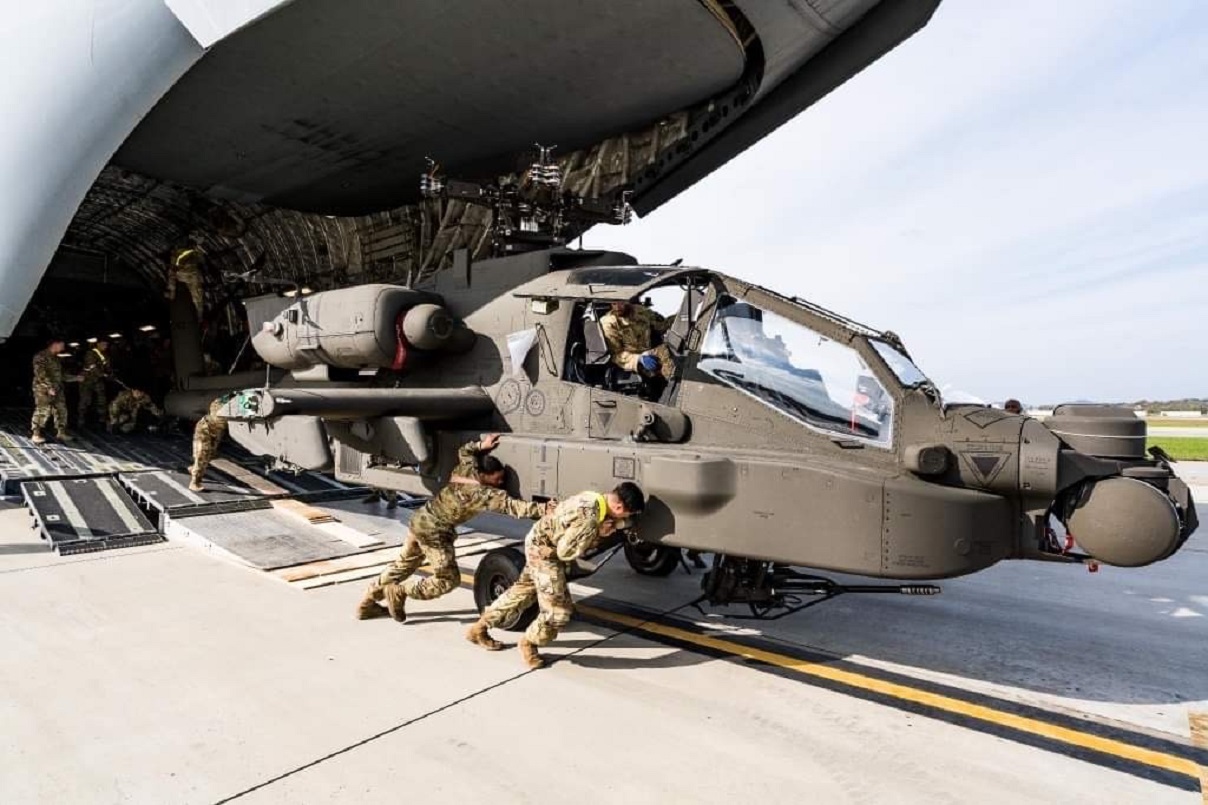
The U.S. Army last month deployed the latest version of the Apache helicopter to Osan Air Base, South Korea.
According to a recent service news release, the 4th Battalion (Attack), 2nd Aviation Regiment (4-2 AB) at Camp Humphreys, South Korea, is being outfitted with the newest AH-64 Version 6 (V6) helicopter. This is the first OCONUS unit to receive the V6 aircraft.
Fielding began in November, and the unit has since received 12 of 24 aircraft.
Members of the Program Executive Office for Aviation’s Apache project office were on hand when the aircraft arrived in the country via Air Force C-17 from manufacturing facilities in Mesa, Ariz. While there, they assisted the unit with inspecting their aircraft, assembling and then flying them from Osan Air Base to Camp Humphreys.
“The fielding of the new AH-64E V6s Apache aircraft is a turning point for 4-2 Attack Battalion and we are thrilled to deploy this airframe. The upgraded aircraft integrates modern technology for both the aviator and maintainers in our battalion,” Capt. Timothy Iuchs, D Company commander, said. “For our maintainers, the new systems onboard allows them better diagnostic capability and decreases the downtime of the aircraft. While for the aviator, AH-64E provides an overall increased situational awareness with an upgraded sensor suite, level 4 manned-unmanned teaming, and an upgraded drive system which is a vast improvement over the Delta variant of the model.”
The V6 is equipped with the latest in communications, navigation, sensors and for the first time a cognitive decision aiding system (CDAS). These systems provide a major path forward in the Apache program and a key aspect to the Apache’s role in joint all-domain operations and for our international partners.
The Version 6 AH-64E model of the Apache is the final planned modernization of the aircraft, replacing the AH-64D Apache attack helicopters. The V6 enhances the Apache’s fundamental mission: to search and destroy. They include:
• An improved cockpit map display that will allow pilots to use digital map images to see terrain and other topographical features, increasing pilot situational awareness.
• Multiple upgrades to the Modernized Target Acquisition Designation Sight/Pilot Night Vision System (MTADS/PNVS) provides improved resolution and acuity allowing pilots to pick up targets more clearly at longer distances on their display screens.
• A GEN3 Day Sensor Assembly (GEN3 DSA), which doubles the sensor’s field of view and increases resolution while adding color imagery to improve target detection and identification.
• Link 16 communications, which allows the Apache “to switch network connections on the spot, and merge different networks for an operational picture,” resulting in improved real-time situational awareness in the aircraft’s cockpit.
• Manned-Unmanned Teaming E\eXpanded (MUMT-X) software designed to allow Apache pilots to directly control other Army unmanned aerial systems, and receive UAS video in the cockpit while directing their flight path and controlling their sensors.
Whether a new pilot or a seasoned one, operating the AH-64E V6 requires extensive mission equipment and flight training. The Program Executive Office for Aviation Apache project office’s New Equipment Training (NET) team provides critical instruction to ensure operators are prepared to safely operate and take full advantage of the many upgrades in the V6 aircraft. The 4-2 AB pilot training began in September 2021 and runs through Sep 2022; the Maintenance training started in August and ends in July 2022.
The Apache NET team uses a combination of classroom training, Longbow Crew Trainer (LCT) sessions and training flights to familiarize pilots with the upgraded version. The operator training consists of four different course types: Aircraft Series Transition Course (ASTC), Aircraft Version upgrade training (Differences), the Maintenance Test Pilot (MTP) Series Transition Course and the MTP version upgrade training.
Stronger sensors, improved situational awareness, and a better information flow—all of these improvements have made the new iteration of the Apache far more versatile and lethal. “The implementation and utilization of these aircraft will have a long lasting and far reaching impact on our mission to support and defend the Republic of Korea and to ‘Fight Tonight’,” Iuchs said.
Fielding of the aircraft is projected to be completed in February 2022.