

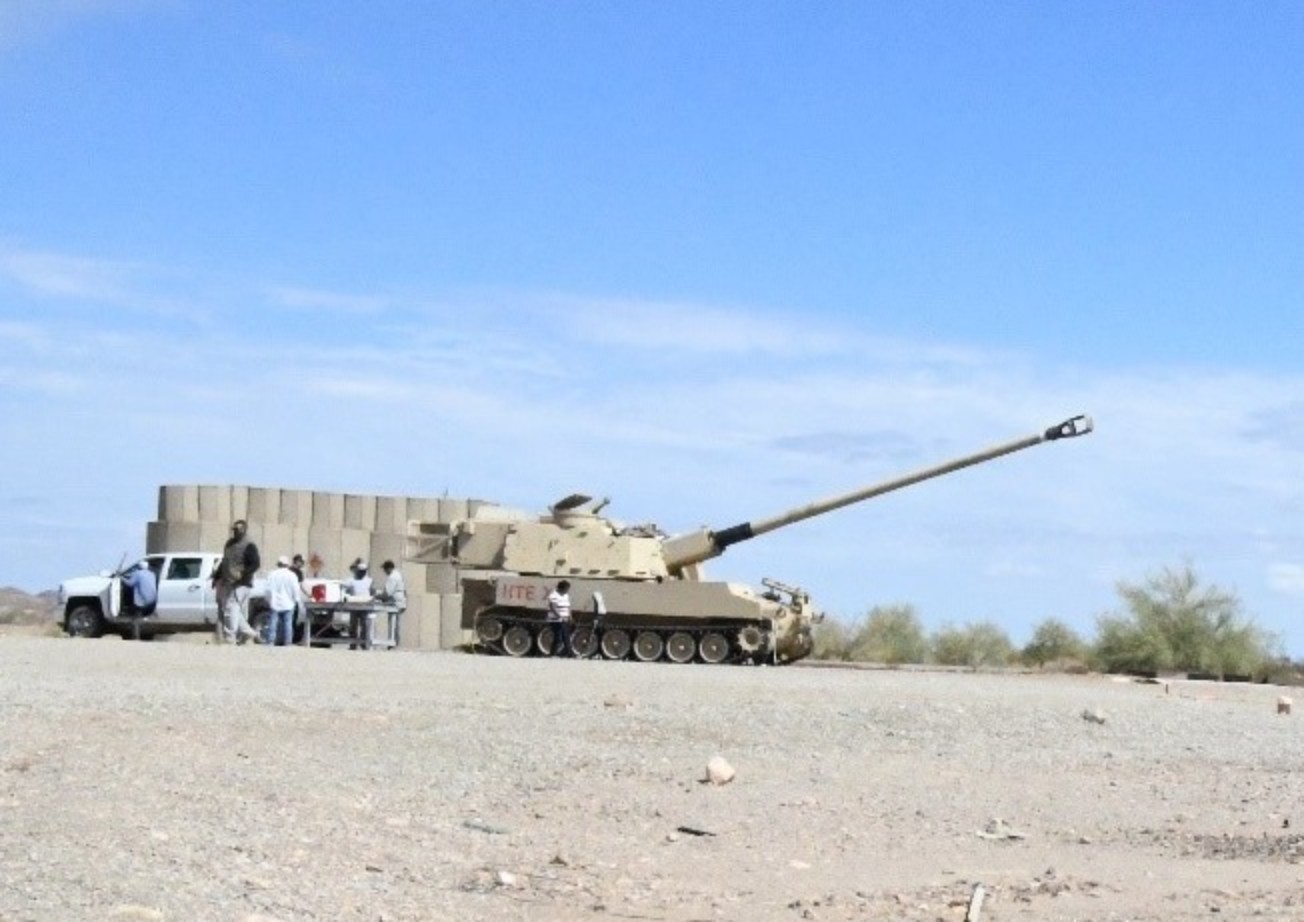
The U.S. Army has reported that its new artillery system, developed under the Extended Range Cannon Artillery (ERCA) program, has broken the record for firing highest velocity.
According to a press release issued Thursday by service, in early August the ERCA weapon system made history by firing at the highest velocity on record with this program at Yuma Proving Ground (YPG).
While shooting far distances is desirable and part of the Army’s modernization strategy, firing at a high-velocity is also a vital element to eliminating threats through Multi Domain Transformation, in this case, increasing the range, speed, and convergence of cutting edge technologies.
“We want to get this projectile in the air and to its target as fast as possible because the targets are getting faster,” explains Paul Henderson, lead hypervelocity propulsion engineer with the Combat Capabilities Development Command-Armament Center (DEVCOM-AC).
In general, artillery systems can be more cost efficient compared to using missiles and rockets. An artillery round can potentially complete the same mission at a fraction of the cost.
Henderson led the effort of designing and building the propelling charge for this high-velocity test. The YPG Ammunition Plant personnel constructed the propelling charge specific to this project based on historical data collected from the DEVCOM-AC team.
Henderson said the team determined that they needed to see what happens to the propellant in the gun during ignition. Since the charge is inside the gun chamber when fired and unable to be observed visually, the team developed a ballistic simulator (BSIM) to aid propulsion development and emplaced it at YPG. The BSIM tube is transparent and bursts at a low pressure, but the few milliseconds of video data before it bursts is critical to the design of the propelling charge.
“We come up with different configurations of the propelling charge, and we fire it in the ballistic simulator and we study the video. We see the transport phenomenon, we get an idea of the temperature, speed of ignition, the turbulence and we conceptualize how we can control the burning. Our goal is to have uniform burning to minimize pressure waves which damage the gun and projectile.”
Leading up to gun tests, the team used various ballistic computer simulations to project the outcome based on different configurations. These models help during the developmental stage and also provide insight during test fires.
“We go through iterations, then we fire, then we meet, then we do mathematical modeling, check our predictions, do BSIM work and then fire in the gun again until the loop is complete and we meet our mission objectives,” said Henderson.
All this work is for a propelling charge design with a predictable and optimized pressure profile to enhance the projectiles performance, a key factor to achieve this is a design that approaches uniform ignition. The ignitor, which is part of the ignition system, is behind the propelling charge, which sits behind the projectile. The force of the propellant gas on the projectile is what causes the round to shoot out of the cannon, when optimized breakthroughs in projectile velocity are achieved.
To develop a projectile for these high velocities, the projectile engineering team used a finite element analysis model. Test and Evaluation Engineer Mike Caulfield explained more about the physics- based model.
“Essentially we are simulating what the forces are behind the projectile, and we can see what the stresses inside the rounds are and see how much deformation may or may not occur.”
During test fires, the YPG team collects data such as high-speed video, pressure, and muzzle velocity. The projectile team monitors the projectiles then compares the data collected at the test site against the data of the model.
“The whole infrastructure of data collection is really critical,” remarked Henderson. He gives much credit to Yuma Proving Ground for the success of this test.
“This could not be done without YPG. Without the test directors, charge builders, gunners, the team, and the creativity and the responsiveness, we wouldn’t be able to do it.”