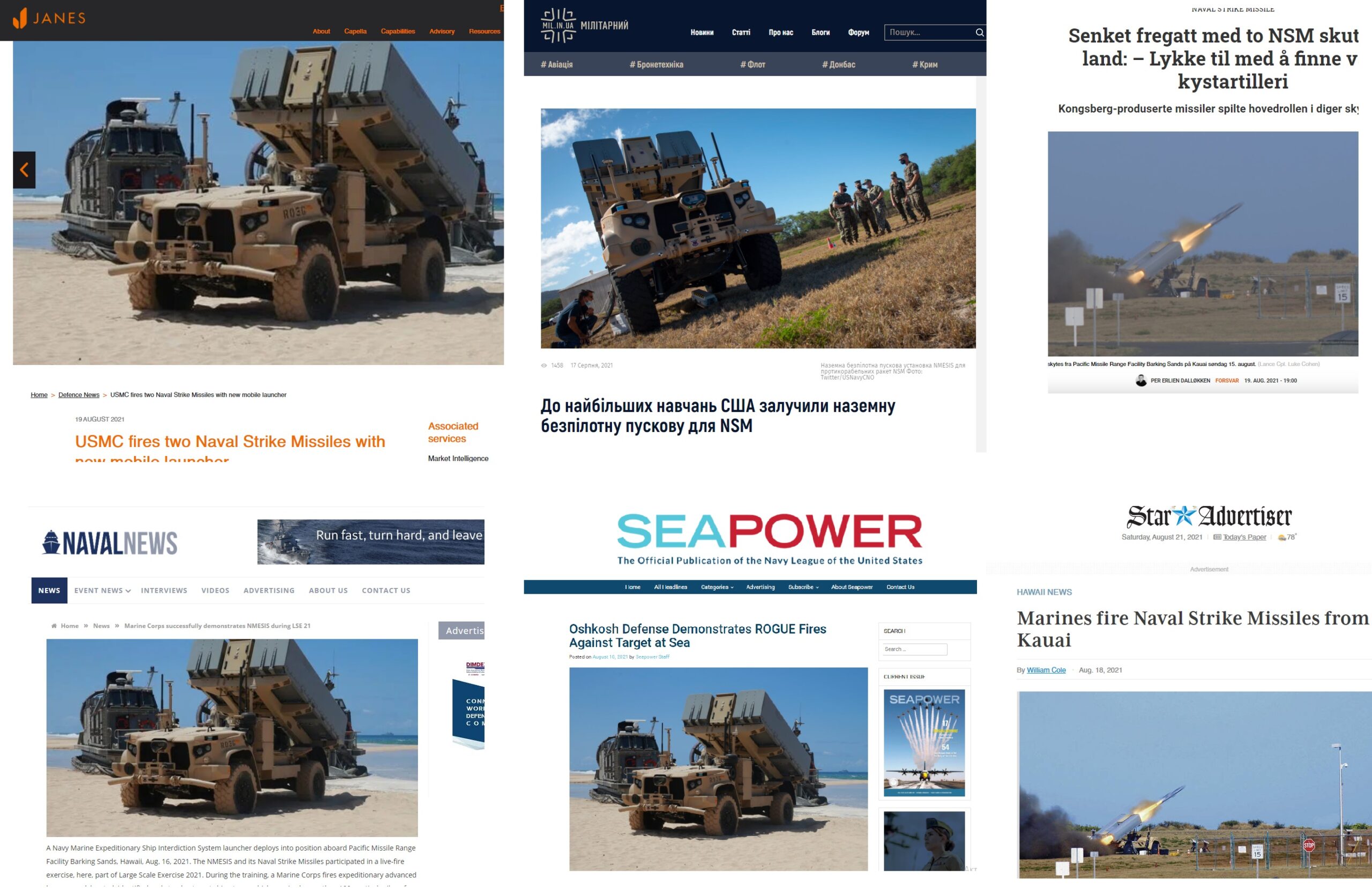
A new robotic vehicle equipped with two Naval Strike Missiles has become an “internet sensation” after Large Scale Exercise in Hawaii.
The newest robotic combat vehicle has become the hero of news reports around the world and footage from the exercises has circulated on social media, where users are surprised by its appearance.
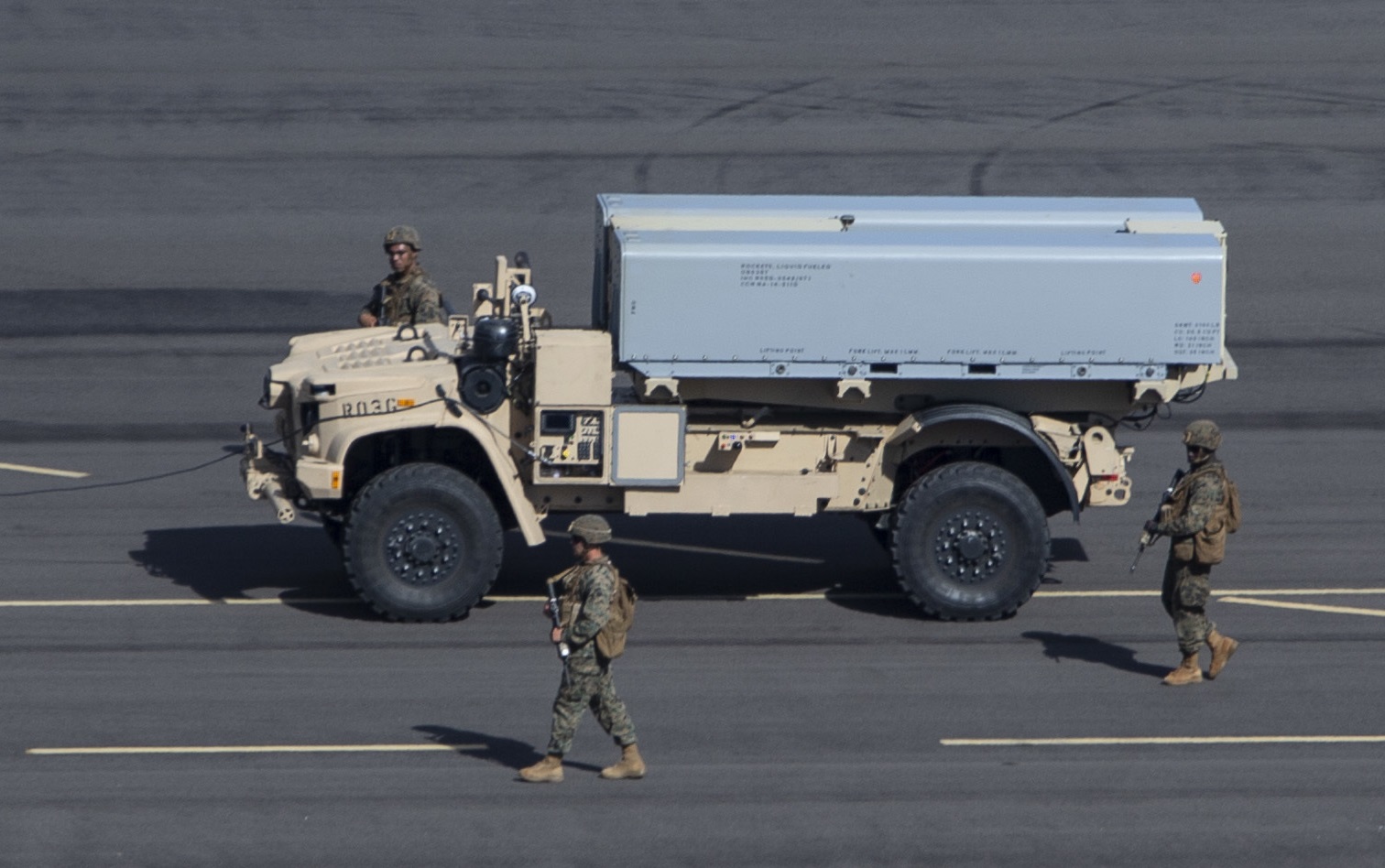
This unfamiliar new vehicle with the ability to be remotely controlled by a distant operator looked like a JLTV but without a cab, equipped with an assortment of sensors and cameras, and topped with a launcher for a multi-mission cruise missiles.
The new vehicle is called the Navy/Marine Expeditionary Ship Interdiction System (NMESIS). NMESIS integrates ROGUE Fires unmanned ground vehicle (UGV) that leverages the JLTV’s extreme off-road mobility and payload capacity.
“ROGUE Fires was purpose-built and leverages next-generation capabilities from several proven Oshkosh Defense vehicle platforms and technologies,” said Pat Williams, Vice President and General Manager of U.S. Army and Marine Corps Programs. “Much like the JLTV itself, ROGUE Fires is tailorable to the mission at hand. The flexible design allows for the integration of scalable weapon system payloads to offer the combatant commanders flexibility based on the mission’s requirements.”
As part of the demonstration, a NMESIS launcher successfully launched a Naval Strike Missile (NSM) and scored a direct hit on a target at sea. The NSM is designed to destroy heavily defended maritime and land targets. It is a multi-mission cruise missile developed by Raytheon and Kongsberg.
“It’s impressive to me how the Marine Corps is advancing our long-range precision fire capabilities, both from how we target and process missions to how we engage them with the NMESIS platform,” said Lt. Col. Richard Neikirk, 1/12’s commanding officer. “The capabilities within a fire direction center now rival those previously found in a combat information center aboard ship.”
These new systems and capabilities represent a major change for the artillery community as it shifts focus to implement Force Design 2030 concepts and refine its support to distributed maritime operations.