

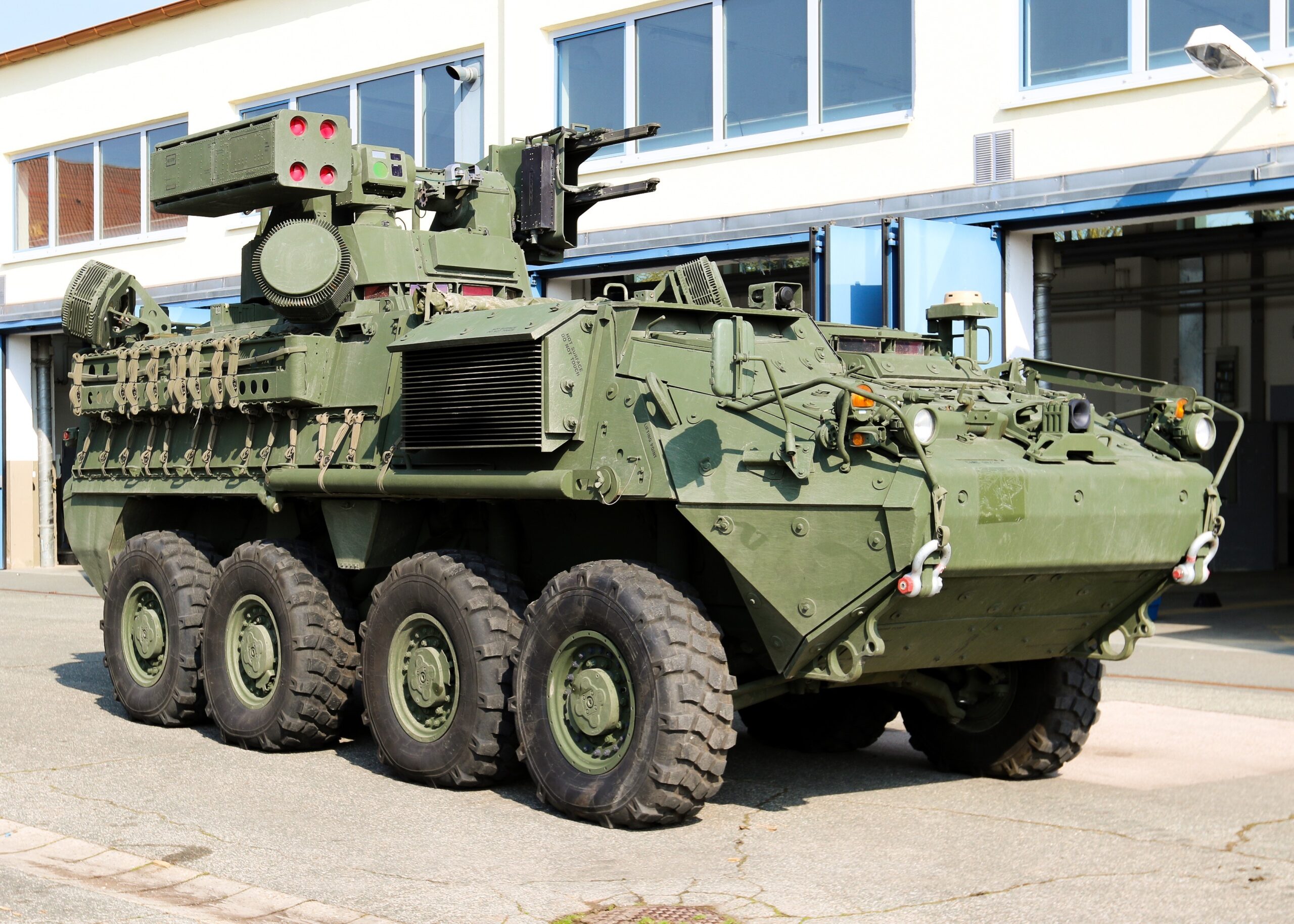
On Friday, the U.S. Army announced that in continuing efforts to revitalize and update the U.S. Army’s Air and Missile Defense forces and systems, the 5th Battalion, 4th Air Defense Artillery Regiment (5-4 ADA), a subordinate unit under the 10th Army Air and Missile Defense Command, is the first battalion in the Army to test, receive, and field the Mobile Short Range Air Defense (M-SHORAD), on the Stryker vehicle platform.
The M-SHORAD, which integrates existing guns, missiles, rockets and sensors onto a Stryker A1 vehicle, is the Army’s newest addition in a variety of modernization efforts. The system is designed to defend maneuvering forces against unmanned aircraft systems, rotary-wing and residual fixed-wing threats.
The 10th Army Air and Missile Defense Command is U.S. Army Europe and Africa’s executive agent for all theater air and missile defense operations and force management. Since activating the battalion in 2018, 5-4 ADA has played a major role in supporting Allies and partners through their involvement in various joint and multinational training exercises across the European theater.
“This is truly a testament to our Army’s commitment to increase air and missile defense capability and capacity to the joint force, and especially here in Europe,” said Brig. Gen. Gregory J. Brady, Commander of the 10th Army Air and Missile Defense Command. “Just under 3 years ago 5-4 ADA was the Army’s first SHORAD battalion activated in almost 13 years, and now they are proud again to be the first to lead the Army’s Air and Missile Defense modernization initiatives with M-SHORAD. The 10th AAMDC is proud to be a part of this Team effort and remains engaged, postured and ready to assure, deter, and defend the maneuver force in an increasingly complex Integrated Air and Missile Defense environment, shoulder to shoulder with our NATO Allies.”
The Army utilized a rapid prototyping strategy to accelerate the timeline for M-SHORAD initial operating capability by four years, resulting in the delivery of a prototype system in approximately one year. In 2020, 18 Air and Missile Defense crewmembers from 5-4 ADA were selected to undergo a 6-month initial operational assessment with the prototype systems at White Sands Missile Range, New Mexico.

“I developed a passion for this system,” said Spc. Andy Mendoza, one of the crewmembers from 5-4 ADA to assess the first prototypes. “We learned how to operate in every position on these, but also how to take care of them. Being one of the gunners selected to be part of that, it was really a huge honor. I’m really proud to be able to bring what I learned back home to the rest of the crew.”
“There’s really no comparison to anything I’ve operated in my career,” said Sgt. Andrew Veres, an Air and Missile Defense crewmember with 5-4 ADA. “Everything in these systems is an improvement – the survivability, mobility, dependability, off road ability – it gives us the ability to stay in the fight longer.”
The addition of the Stryker-based M-SHORAD system will provide better protection of maneuver forces at increased ranges and with improved mobility, allowing a stronger defense of U.S. forces, Allies and partners against adversary air threats. The unit initially received four systems in April, and is expected to receive more later this year, beginning its transition from an Avenger-based battalion to the first fully-operational M-SHORAD battalion in the U.S. Army.
“Our adversaries have invested heavily from their indirect fire up to their strategic missile assets, necessitating the modernization of our air and missile defense capabilities,” said Brady. “M-SHORAD is a critical part of the Army’s comprehensive dedicated Air Defense Artillery capacity and augmented combined arms approach to be able to provide a multi-layered defense against all aerial threats.”
The Army’s modernization strategy ensures continued overmatch in a fundamentally different future environment, part of which includes prioritizing the development of Air Defense systems to ensure a more capable force.
“All modernization efforts are focused on our ability to fight and win as a joint force – along with our allies and partners,” said Gen. John M. Murray, Army Futures Command commanding general. “If we do not have the capability to fight and win, we do not have the capability deter. The speed through which our Army can deliver effects and get the right equipment to Soldiers in the field is critical.”
The Army intends to field the M-SHORAD system to four additional Air and Missile Defense battalions beginning in 2021. Future development of follow-on M-SHORAD systems will incorporate technology insertions, to include directed energy and improved missiles, utilizing a mix of complementary DE and kinetic interceptor systems to protect maneuver forces.
“The Army’s air and missile defense force structure is growing and modernizing significantly to meet the threats of peer competitors and our obligation and commitment to providing air and missile defense forces to the joint fight,” Murray said.