

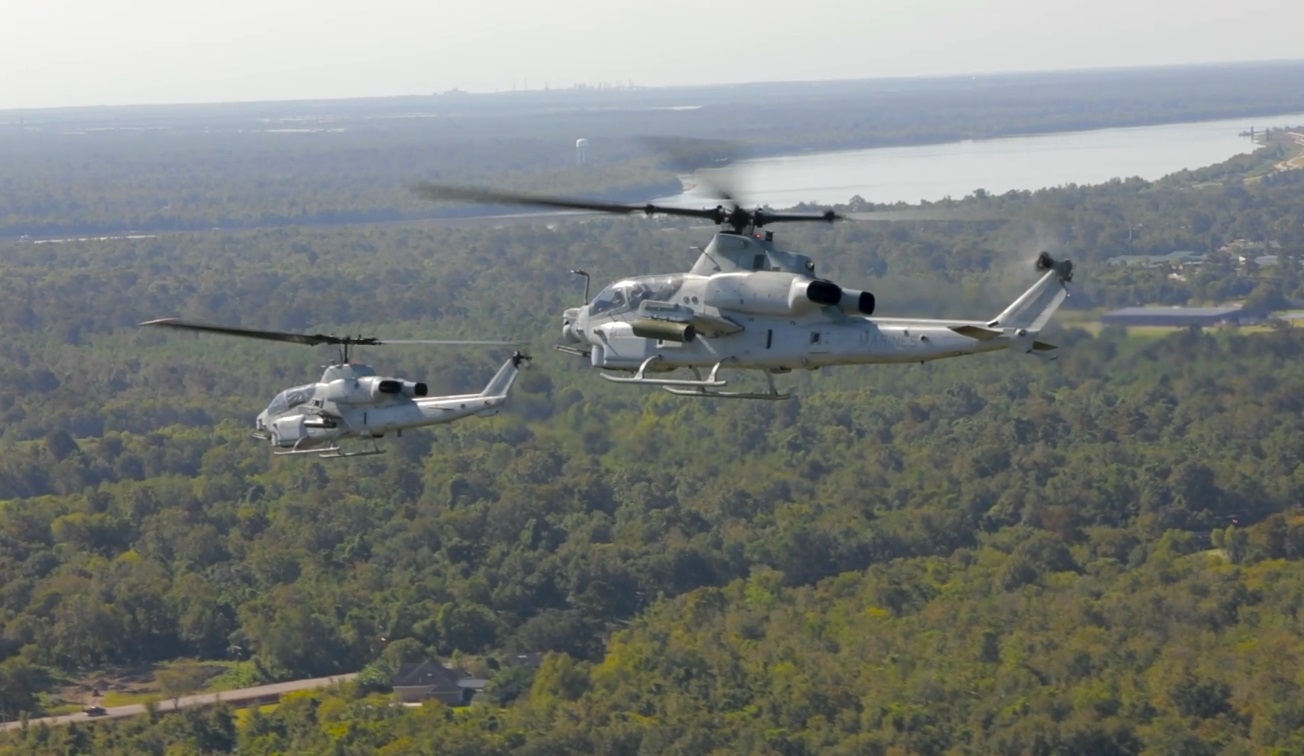
The United States Marine Corps have officially retired the Bell AH-1W “Super Cobra” from their ranks after more than 30 years of dependable service, according to a recent service news release.
According to a USMC statement, after 933,614 flight hours over a 34-year career, the AH-1W “Whiskey” Super Cobra flew its last flight over the City of New Orleans passing its legacy and mission to the “Zulu” variant, the AH-1Z Viper.
The iconic dual-blade aircraft served as the dedicated attack helicopter for the Marines through multiple campaigns, including Operation Desert Storm, Iraqi Freedom, and Enduring Freedom.
“The AH-1W Super Cobra has served admirably and leaves a remarkable legacy of on-time, on-target attack helicopter support for our Marines,” said Col. David Walsh, the program manager for Light/Attack Helicopter Programs (PMA-276). “Although the AH-1W chapter is closing, the AH-1Z Viper stands ready with even greater capability to support our Marines for years to come.”
Originally designated as the AH-1T+, the Super Cobra first flew on November 16, 1983 at Bell’s Flight Research Center in Arlington, Texas. Bell delivered the first AH-1Ws to the Marines on March 27, 1986 and delivered the final aircraft in 1999, for a domestic fleet of 179 attack helicopters. Through August 2020, the USMC flew the Super Cobra for 933,614 hours.
“We are tremendously proud of the capabilities the AH-1W has brought to the United States Marines for the past 34 years,” said Michael Deslatte, H-1 Bell Program Manager. “The Super Cobra’s tremendous legacy is a testament to the excellence and dedication the men and women at Bell put into these platforms for generations and we look forward to continuing that legacy for years to come.”
AH-1Ws remanufactured into AH-1Z Vipers will continue to serve in the United States Marines. The four-bladed Viper replaces the Super Cobra as the successor to the modern attack helicopter platform and provides fully-integrated air-to-air and anti-armor capabilities designed to successfully accomplish the broadest array of contemporary missions.