

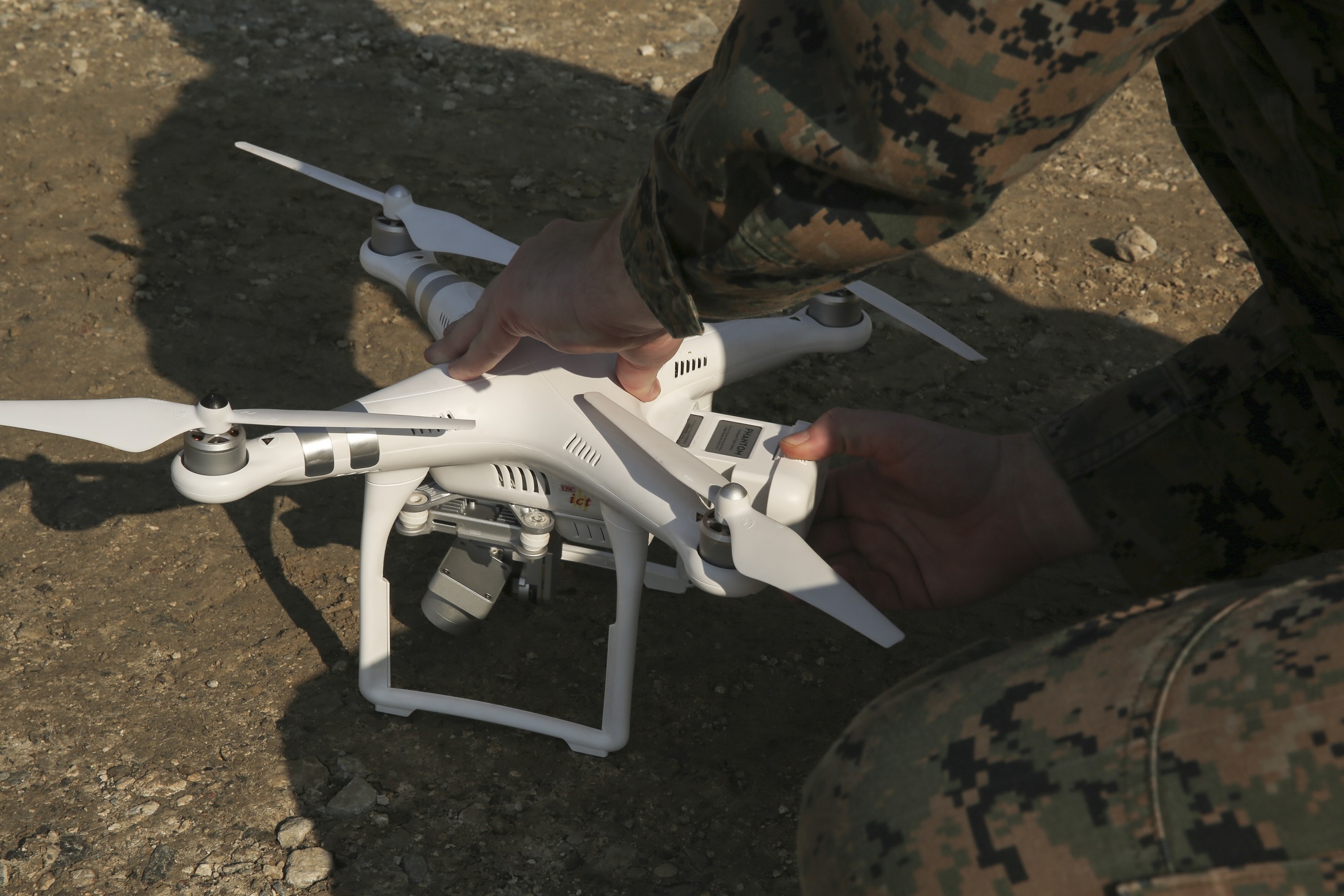
The U.S. Army News Service has announced that the Department of Defense is slated to release its counter-small unmanned aircraft systems strategy next month, bringing an open-system architecture and enterprise approach to the military’s capabilities.
The Army-led Joint C-sUAS Office, or JCO, has worked to align current and future counter-drone technologies to support operational requirements at home and abroad, said Maj. Gen. Sean A. Gainey, the program’s director.
The increased threat posed by drones, combined with a lack of dependable networked capabilities to counter the unmanned threat, has created a concerning “tactical development” within U.S. Central Command’s area of responsibility, Gainey said, paraphrasing a recent statement made by its commander.
Classification of unmanned aircraft systems is divided into five category groups. The defense secretary appointed the Army as the executive agent for counter-small UAS groups one through three, said Col. Richard Wright, the JCO deputy director.
These first three categories represent smaller, low-cost drones, whose rapid proliferation can threaten personnel and critical assets, or impact the military’s ability to conduct various operations. Groups four and five identify larger UASs typically controlled by state-actor threats, according to JCO officials.
Close to 90% of the military’s counter-drone capabilities are electronic warfare-type systems, Gainey said. Many of these weapons use lasers or microwave-signal propagation to disrupt the communications link between user and device.
“However, the threat is evolving,” Gainey added, as the joint force now has to account for swarm and autonomous drones, in addition to off-the-shelf technology. Further, an increased number of threats in an airspace can potentially overwhelm a C-sUAS system’s operator.
This shift led the JCO to revise the Defense Department’s C-sUAS requirements and build a networked systems approach. Officials are also considering artificial intelligence and machine learning options to help discriminate and track possible threats.
The Army also plans to incorporate its C-sUAS capabilities into the Integrated Air and Missile Defense Battle Command System, Gainey said. The new command system is currently going through the evaluation process by AMD entities and Army Futures Command.
Along with improving capabilities, leaders have identified the need to bolster training to improve the military’s counter-drone capabilities, Gainey said.
The Fires Center of Excellence at Fort Sill, Oklahoma, is expected to build a Joint C-sUAS academy by fiscal year 2024. The Fires CoE supports current training operations out of Yuma Proving Ground in Arizona.
“We can start to institutionalize this capability and integrate it with our air and missile defense systems,” Gainey added. “Having a synergy at the schoolhouse will help the force understand how to get after this problem from a DOTmLPF-P [or doctrine, organization, training, materiel, leadership and education, personnel, facilities and policy] perspective.”
Moving forward, the JCO will continue to work with the Army Rapid Capabilities and Critical Technologies Office to ensure the timely and proper fielding of C-sUAS systems, Gainey said.
To help industry partners understand the DOD’s emerging requirements and encourage competition, both the RCCTO and JCO are scheduled to conduct a C-sUAS virtual open house on Oct. 30. The JCO also plans to organize future industry demonstration days to identify and assess technologies against emerging threats, Gainey said.