

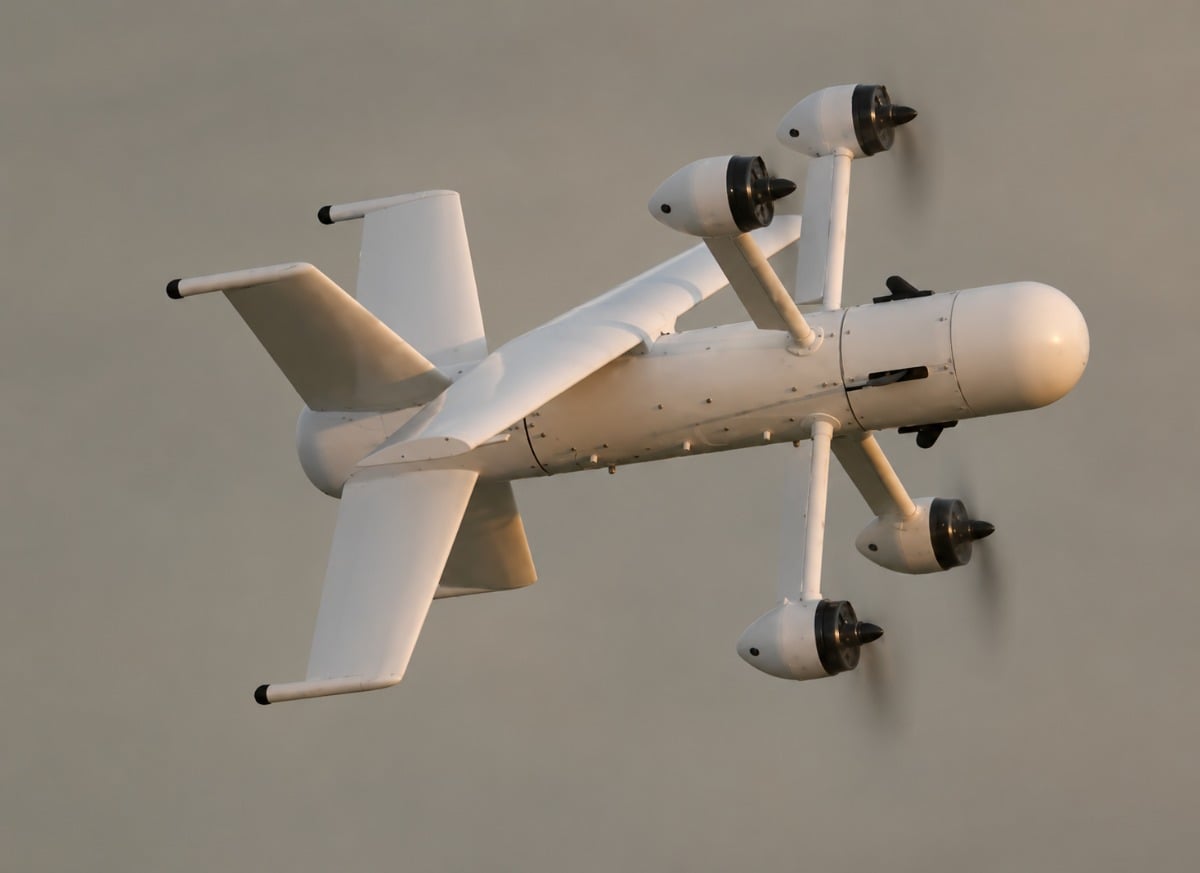
- Lockheed Martin unveiled MORFIUS X-Rotor at the Farnborough International Airshow, a reusable airborne system that can neutralize more than 50 drones per flight.
- The system uses high-power microwave technology and builds on earlier MORFIUS variants that have flown in testing since 2017.
Lockheed Martin unveiled MORFIUS X-Rotor at the Farnborough International Airshow, an airborne counter-drone system built around a high-power microwave weapon that the company says can neutralize an entire swarm of hostile drones in a single mission, then land, get recovered, and fly again.
A high-power microwave weapon, commonly shortened to HPM, works by blasting a concentrated burst of electromagnetic energy at a target, frying its internal electronics rather than physically striking it with a bullet, missile, or laser. That approach gives MORFIUS a critical advantage against drone swarms specifically, since a single microwave burst can potentially disable multiple drones caught within its energy field at once, rather than requiring one interceptor per target the way traditional kinetic counter-drone weapons typically operate. Lockheed Martin is marketing the system as a one-to-many defense, meaning a single MORFIUS unit launched into a swarm attack can take out dozens of drones rather than trading one interceptor for one incoming threat, a distinction that matters enormously given how cheap and numerous modern attack drones have become on battlefields from Ukraine to the Middle East.
MORFIUS X-Rotor is not an entirely new weapon system built from scratch and the platform builds directly on earlier MORFIUS variants that have flown in testing since 2017, originally developed as a tube-launched interceptor and later demonstrated by the Defense Advanced Research Projects Agency, or DARPA, as part of its Mobile Force Protection program, an effort aimed at giving ground troops a mobile, layered defense against drone attacks. Lockheed Martin has continued refining the same family of high-power microwave effectors across those years of development, and the company says that lineage has already proven the technology can defeat difficult targets while limiting collateral damage to nearby friendly systems or civilian infrastructure, a critical requirement for any weapon meant to operate near populated areas or friendly troops.
Rather than functioning as a single-use interceptor that gets destroyed alongside its target, MORFIUS X-Rotor is designed for field recovery, meaning operators can retrieve the aircraft after a mission, refurbish it, and send it back out again, a design choice Lockheed Martin says keeps the cost per drone kill significantly lower than deploying an expendable, one-time-use interceptor missile against every incoming threat. The system is also what the company calls sensor and command-and-control agnostic, meaning it doesn’t require a dedicated, proprietary sensor system to guide it toward a target and can instead plug into whatever command-and-control network a customer already operates, removing the need for a completely separate targeting infrastructure just to field this one weapon.
Randy Crites, vice president and general manager of Lockheed Martin Missiles and Fire Control Advanced Programs, framed the system as a direct answer to the economics driving modern drone warfare.
“MORFIUS sets a new benchmark for counter-drone capability, delivering a high kill rate while keeping the cost per kill low,” Crites said. “By leveraging a lightweight, field reusable high-power microwave architecture, we provide the most effective, low-cost solution on the market today and demonstrate Lockheed Martin’s ability to field innovative, affordable technologies at the speed our American and allied troops need.”
The company conducted flight, intercept, and lethality testing across ranges in Arizona, California, and Oklahoma, evaluating not just whether the aircraft could fly reliably but whether its microwave payload could actually disable real drone targets under realistic conditions. Lockheed Martin says it is now accelerating prototype production of both the MORFIUS airframe and its microwave payload while planning its next round of flight tests, a pace the company frames as directly supporting the Department of War’s 2025-2028 Rapid Response Counter-UAS Roadmap, the Pentagon’s own strategic plan for rapidly fielding affordable defenses against the drone threat.
Lockheed Martin unveiled MORFIUS X-Rotor at the same Farnborough Airshow where the company separately introduced PAC-3 ACE, a lower-cost Patriot missile interceptor, and where the smaller manufacturer X-Bow Systems unveiled its own sub-$100,000 Buckler interceptor, underscoring just how urgently the industry is racing to solve the same basic problem from multiple technical directions at once.
Lockheed Martin has not disclosed exactly how much a single MORFIUS X-Rotor unit will cost or when the system might reach actual military units in the field, and the company’s claim that it can neutralize more than 50 drones in a single flight has not yet been independently verified outside the company’s own testing program. But the underlying pitch, a small, reusable aircraft that can disable dozens of enemy drones at once and then fly home to do it again, describes exactly the kind of scalable, affordable counter-drone capability that militaries watching drone swarm attacks multiply around the world have been asking the defense industry to deliver, and MORFIUS X-Rotor represents one of the more ambitious answers to reach a public airshow floor so far.