

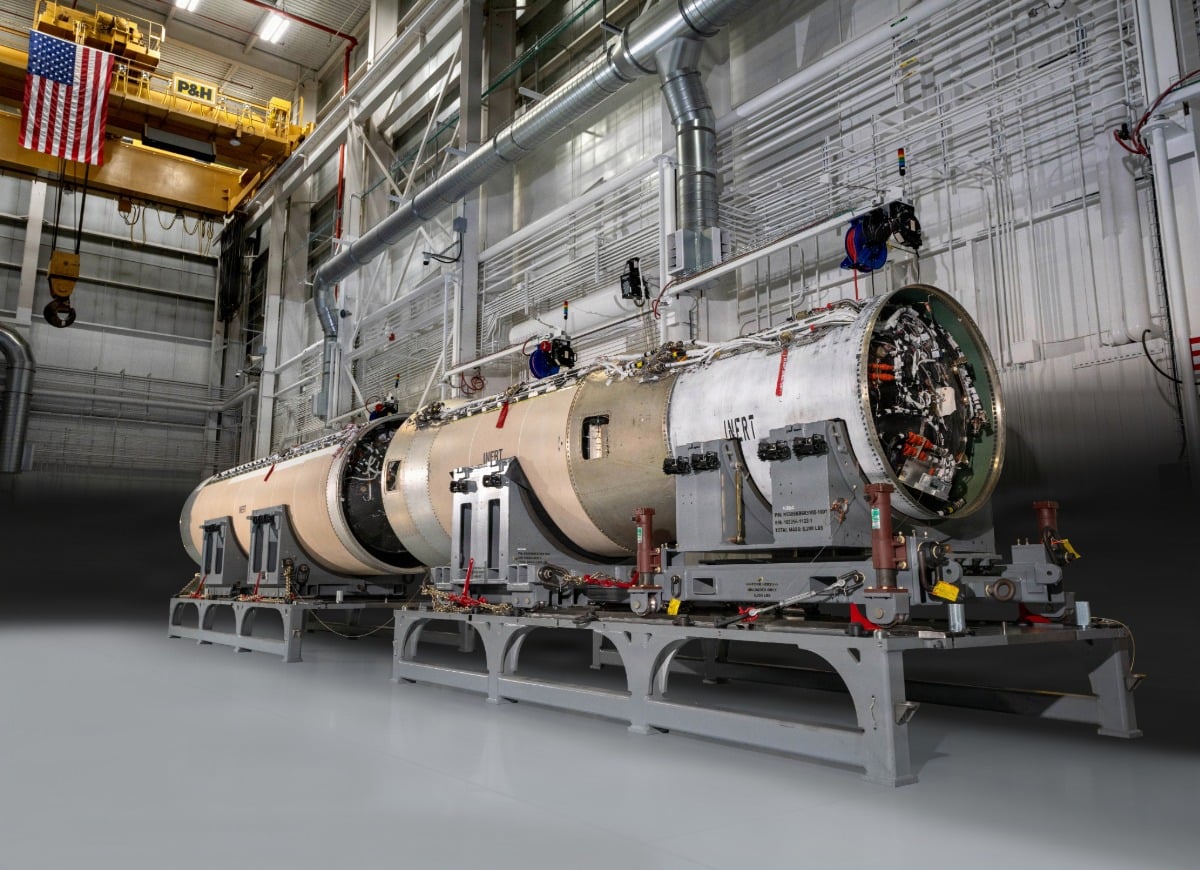
- The U.S. Air Force awarded Johns Hopkins University's Applied Physics Laboratory a $199,268,833 contract for engineering support on the Sentinel missile program.
- The sole source contract runs through July 2029, managed by the Air Force Nuclear Weapons Center at Hill Air Force Base, Utah.
Johns Hopkins University’s Applied Physics Laboratory in Laurel, Maryland, won a contract worth $199 million to provide research and development engineering support for the Sentinel program, the effort to replace the nation’s aging fleet of Minuteman III intercontinental ballistic missiles, with work continuing through July 2029.
Sentinel, formally designated the LGM-35A, represents the Air Force’s attempt to replace a missile system that has guarded America’s land-based nuclear deterrent since 1970, one of three legs of what the military calls the nuclear triad, alongside submarine-launched missiles and long-range bombers, that together are meant to guarantee the United States can respond to a nuclear attack regardless of what an adversary strikes first.
Northrop Grumman holds the prime contract to actually build Sentinel, but the program has become one of the most closely scrutinized weapons systems in the Pentagon’s entire portfolio after its projected cost ballooned from an original 2020 estimate of roughly $77.7 billion to more than $140 billion, an increase of 81 percent that triggered a mandatory congressional review process known as a Nunn-McCurdy breach.
That review process exists specifically because Congress passed a law in 1982 requiring the Pentagon to notify lawmakers whenever a major weapons program’s costs grow by more than 15 percent above its original baseline, with growth beyond 25 percent triggering an even more serious classification that can force the Defense Department to formally justify why a program should continue rather than being canceled outright. Sentinel’s overrun landed firmly in that more serious category, and after a review led by then-Under Secretary of Defense for Acquisition and Sustainment William LaPlante, the Pentagon certified in July 2024 that the program should proceed despite the ballooning cost, arguing that starting over on an entirely new missile system would take even longer and leave the aging Minuteman III fleet in service well past its intended retirement date.
Most of that cost growth, according to the Pentagon’s own review, traces back not to the missile itself but to the enormous scope of ground infrastructure the program requires. Sentinel needs modernized command and launch facilities spread across 450 missile silos in five states, connected by more than 7,500 miles (12,070 kilometers) of new cabling, much of it replacing infrastructure that dates back to the original Minuteman program of the early 1960s, a scale of civil engineering work the Air Force has acknowledged it dramatically underestimated when the program first began. That miscalculation has already pushed the program’s expected first flight test from an original 2026 target to March 2028, and Air Force officials have said they currently have no firm timeline for when that first test will actually happen, leaving the exact pace of the broader restructuring effort still very much in motion.
The Applied Physics Laboratory’s involvement fits a role the institution has played across multiple major national security programs for decades, serving as what the Pentagon calls a University Affiliated Research Center, a designation that lets certain university-run labs provide independent technical analysis and engineering support to the Defense Department without the same profit incentives that shape how a traditional defense contractor like Northrop Grumman operates. Bringing in that kind of outside technical expertise matters considerably more for a program already under intense congressional scrutiny, since an independent set of engineers evaluating design decisions and risk can help catch problems before they compound into the kind of cost overruns that triggered Sentinel’s Nunn-McCurdy breach in the first place, rather than relying solely on the prime contractor’s own internal assessments.
The Air Force Nuclear Weapons Center at Hill Air Force Base in Utah is managing the contract, and the initial award obligated $31,323,302 in fiscal 2026 research, development, test and evaluation funds, a fraction of the full $199 million contract value that will be paid out as work continues over the coming years under what the government calls a cost-plus-fixed-fee structure, meaning Johns Hopkins gets reimbursed for its actual expenses plus an agreed profit margin on top rather than working to a fixed total price.