

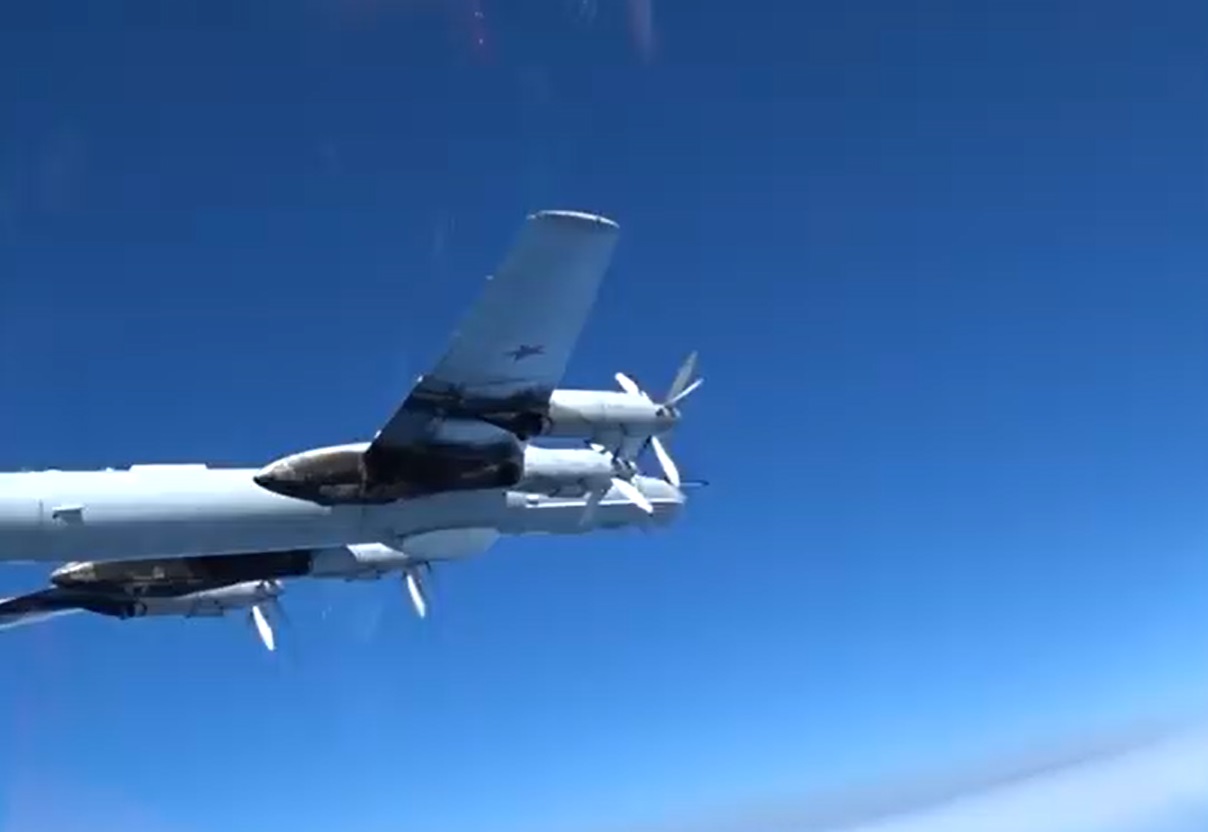
U.S. Air Force F-22 fighter jets, supported by KC-135 Stratotankers and an E-3 Airborne Warning and Control System, intercepted four Russian Tu-142MK (NATO reporting name Bear-F Mod. 3) reconnaissance aircraft entering the Alaskan Air Defense Identification Zone (ADIZ) on June 27, North American Aerospace Defense Command said in a statement.
“The Tu-142s came within 65 nautical miles south of the Alaskan Aleutian island chain and loitered in the ADIZ for nearly eight hours. The Russian aircraft remained in international airspace and at no time entered United States or Canadian sovereign airspace,” Saturday’s statement said.
The Tu-142MK is an improved variant of Russian maritime reconnaissance and anti-submarine warfare (ASW) aircraft derived from the Tu-95 turboprop strategic bomber. It is equipped with new Korshun radar, avionics and anti-submarine warfare equipment.
The Tu-142MK is designed to search and destroy submarines in distant patrol areas. The aircraft can carry out long-range maritime reconnaissance, aiming, and search-and-rescue operations too.
NORAD employs a layered defense network of radars, satellites, and jet fighters to identify aircraft and determine the appropriate response. The identification and monitoring of aircraft entering the U.S. or Canadian ADIZ demonstrates how NORAD executes its aerospace warning and aerospace control missions for the United States and Canada.
“This year alone, NORAD forces have identified and intercepted Russian military aircraft including bombers, fighters, and maritime patrol aircraft on ten separate occasions when they have flown into the ADIZ. Despite COVID-19, we remain fully ready and capable of conducting our no-fail mission of homeland defense.” – General Terrence J. O’Shaughnessy, NORAD Commander
In a release late Friday, Russia’s Defense Ministry also reported that its Su-30 fighter jet intercepted three U.S. aircraft over the Black Sea and “escorted” them away from the Russian border.