

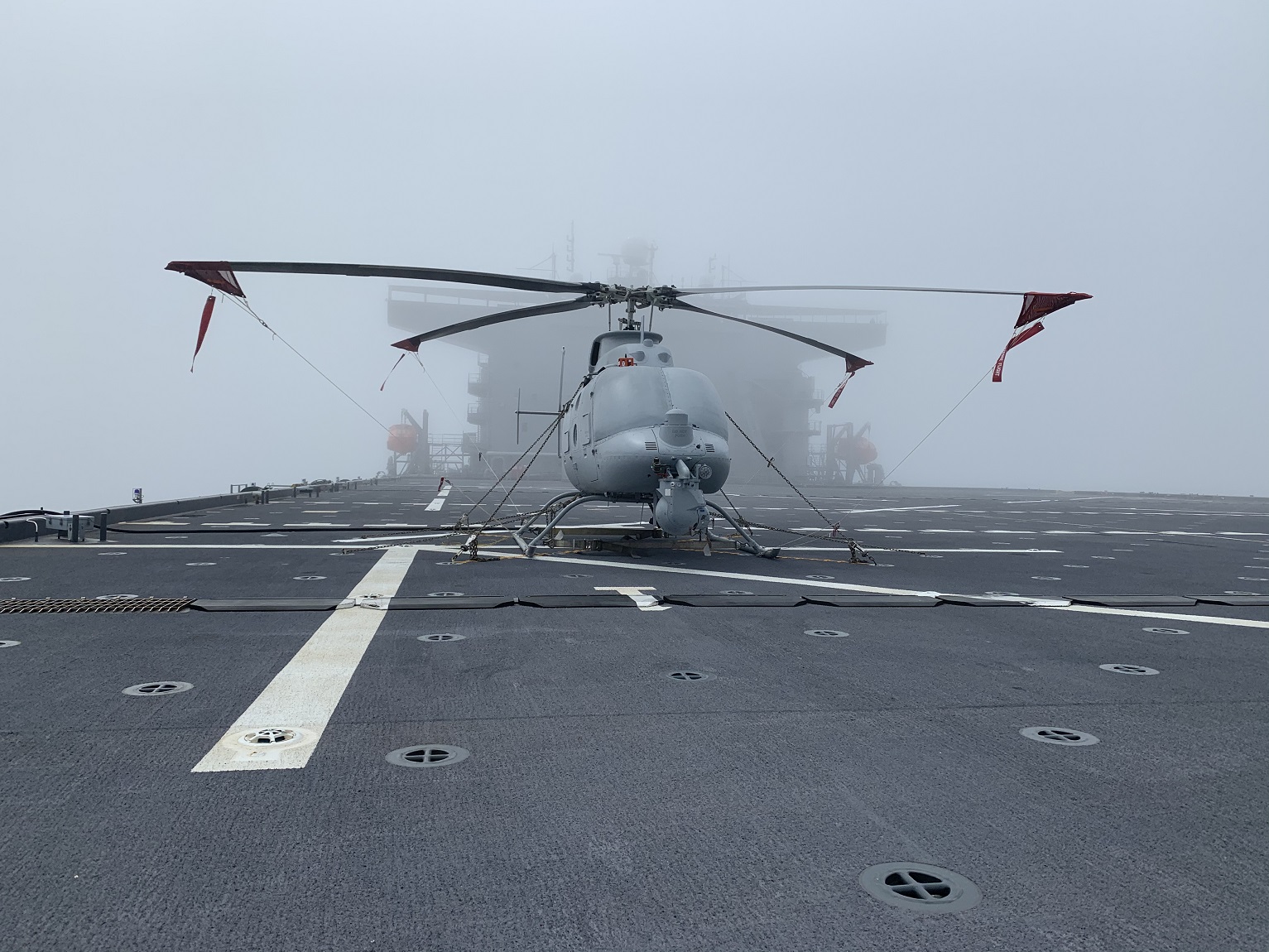
The Navy’s newest unmanned helicopter, the MQ-8C Fire Scout, completed the first dynamic interface testing aboard Expeditionary Sea Base (ESB) Hershel “Woody” Williams.
The Naval Air Systems Command said that this event marked the first time Fire Scout operated from an ESB-class ship opening up opportunities for future deployments.
The Williams was built at a cost of about $500 million in 2017, and is the second of three Expeditionary Sea Base ships built for the Navy by a private sector company. The new ship was commissioned on March 7, 2020.
The Expeditionary Sea Base operates with a mixed crew of Navy Seamen, Mariners, and civilians and is uniquely designed to have an open operations deck below and a flight deck above.
As to the MQ-8C, this is an unmanned air system (UAS) designed and manufactured by Northrop Grumman to support both land and sea-based military operations.
The NAVAIR’s website said the unmanned helicopter has a range of 150 nautical miles and a payload capacity of more than 700 pounds which provides unique situational awareness and precision target support for the Navy on land and at-sea with its multiple intelligence, surveillance and reconnaissance (ISR) capabilities.
The MQ-8C Fire Scout’s airframe is based on the commercial Bell 407, a mature helicopter with more than 1,600 airframes produced and over 4.4 million flight hours. Combined with the maturity of Northrop Grumman’s autonomous systems architecture, Fire Scout meets customer requirements for ship-based and land-based autonomous systems. It also has the ability to autonomously take off and land on any aviation-capable ship and from prepared and unprepared landing zones. This enhancement significantly increases range and endurance (more than double) and payload capacity (more than triple).
Currently, the MQ-8C has completed developmental testing and is ready to deploy.