

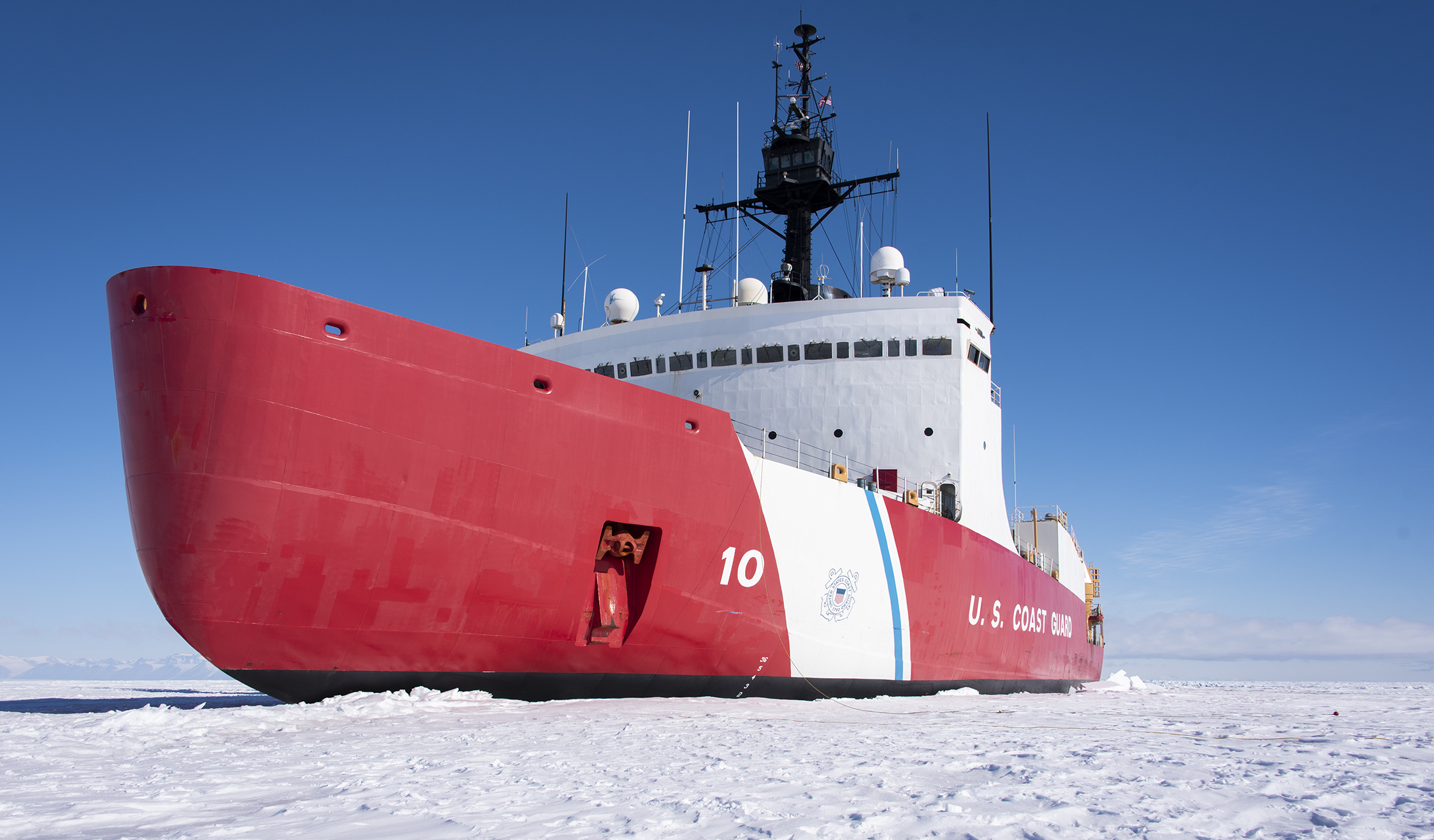
The U.S. Coast Guard Cutter Polar Star, the nation’s only heavy icebreaker, entered the fast ice Jan. 1 approximately 20 miles north of McMurdo Station, Antarctica, which marks the official start of the ship’s icebreaking mission, known as Operation Deep Freeze.
Fast ice is the thick ice attached to the shore of Antarctica.
The Polar Star’s mission is to break through the 20 miles of solid ice, some of which is up to 10 feet thick, in order for the National Science Foundation’s McMurdo and Amundsen-Scott South Pole stations to be resupplied. The Polar Star breaks through the fast ice to create an initial channel and then travels back through the passage to further break the ice into small enough pieces for other ships to get through safely. These refuel and supply ships carry critical fuel and supplies used to sustain NSF operations throughout the year until Polar Star returns in 2021.
The 2019-2020 ODF season marks the 60th Anniversary of the Antarctic Treaty and the 64th year of military dedication, ingenuity and labor in support of the Antarctic mission.
ODF is unlike any other U.S. military operation. Antarctica is the coldest, windiest, most inhospitable continent on Earth. Each trip to Antarctica requires careful planning and coordination. As weather changes quickly at the bottom of the world, conditions are continuously monitored to ensure safety of aircraft, ships, cargo, passengers and crews supporting ODF.
The Polar Star is the only operational heavy icebreaker in the U.S. fleet. The cutter, which was commissioned in 1976, has a crew of 159 people, weighs 13,500 tons and uses 75,000 horsepower to break ice up to 21 feet thick.
The U.S. military began its Operation Deep Freeze mission in 1955.
The Coast Guard has been the sole provider of the nation’s polar icebreaking capability since 1965, and seeks to increase its icebreaking fleet with six new Polar Security Cutters to ensure continued national presence and access to the polar regions.
