

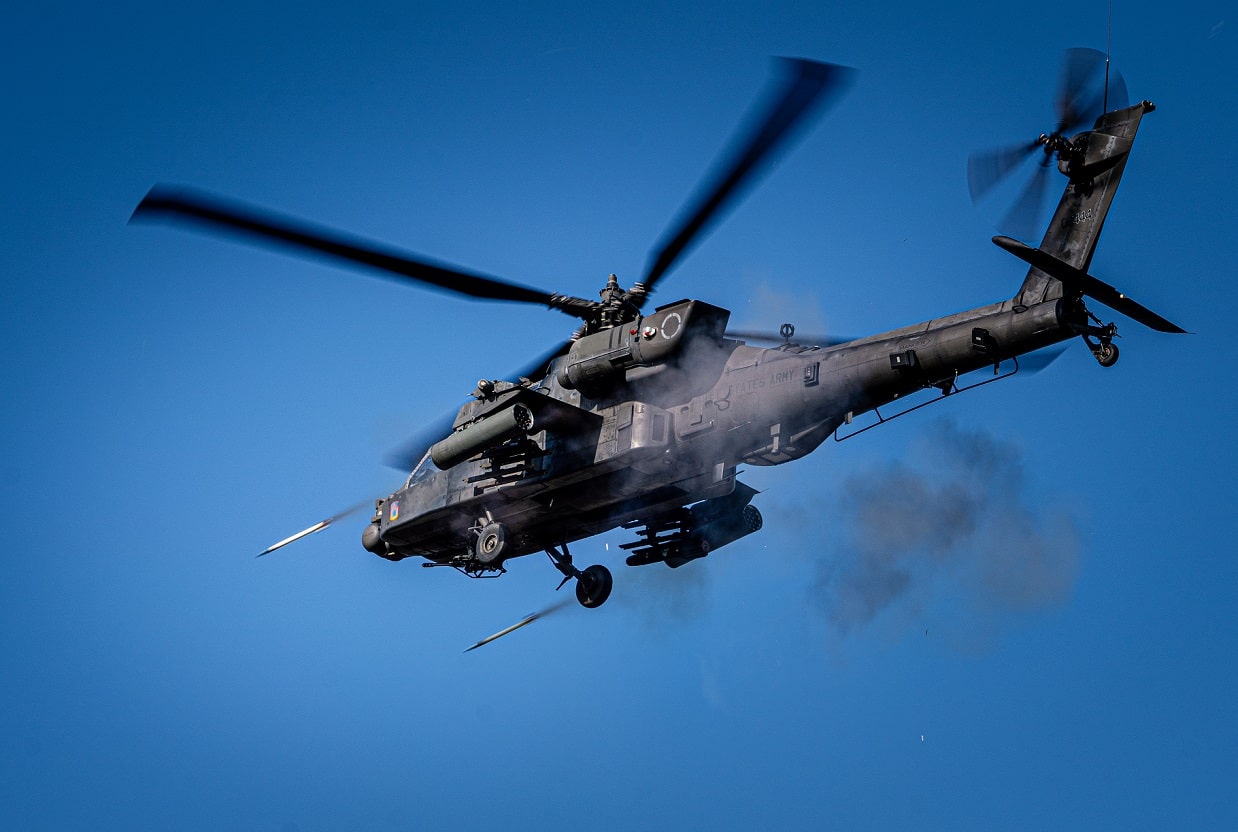
BAE Systems, Britain’s biggest defense company, announced that it was awarded research and development funding through the U.S. Army to create an advanced radar jamming technology.
According to a statement issued Monday by leading British defense firm, the technology aims to improve air survivability and mission effectiveness for U.S. Army rotary-wing aircraft and unmanned aerial systems (UAS) by detecting and defeating complex and unknown threats in electronic combat.
As part of the contract, BAE Systems FAST Labs research and development team will design technology to integrate adaptive radio frequency jamming and sensing capabilities into one system. Whereas today’s electronic countermeasure systems are too bulky and heavy for most rotary-wing and UAS platforms, BAE Systems technology will combine multiple, software-programmable antennas into a digital phased array that will enable simultaneous functions, exceeding existing capabilities while reducing the size, weight, and power (SWaP) of current systems. The technology will enable these platforms to safely fly closer to threats and within contested areas while remaining protected.
“With the continuously evolving threat landscape, it’s critical to provide the next-generation of digital phased array technology to better defend our armed forces in electronic warfare,” said Chris Rappa, product line director for Radio Frequency, Electronic Warfare, and Advanced Electronics at BAE Systems FAST Labs. “Our technology will give the Army’s rotary-wing aircraft and UAS a new, low SWaP system to securely and drastically increase their range of movements in future missions.”
Research for this contract adds to BAE Systems’ advanced electronics portfolio and is based on many years of investment on various programs with the Air Force Research Lab (AFRL), U.S. Army, and the Defense Advanced Research Projects Agency (DARPA), including DARPA’s CONverged Collaborative Elements for RF Task Operations (CONCERTO) and DARPA’s Radio Frequency Field Programmable Gate Arrays (RF-FPGA) programs. Work for the contract will be completed at the company’s facilities in Nashua, New Hampshire and Merrimack, New Hampshire.