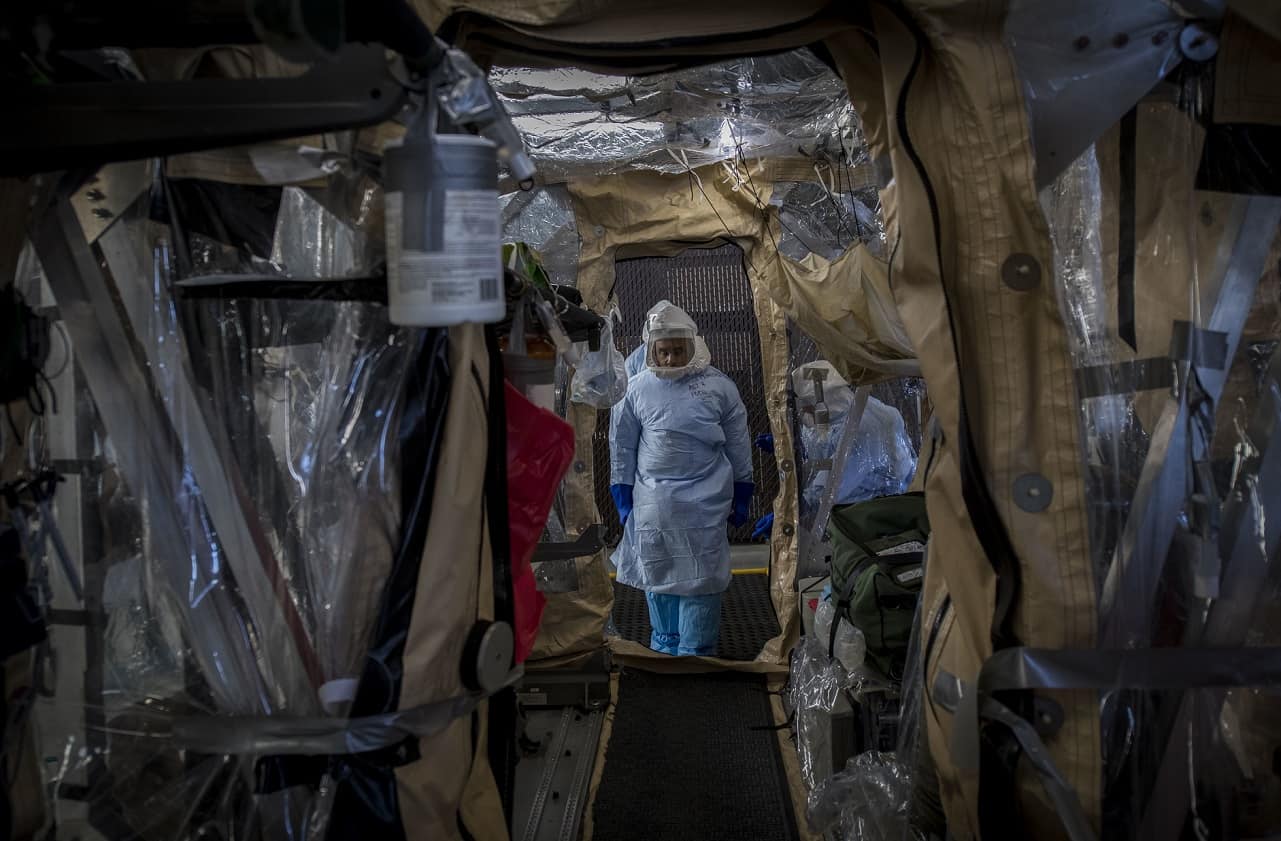
A deadly global pandemic could sweep across the world in hours and kill millions, and for this reason, the U.S. Air Force conducted a training exercise with a special isolation device that used to transport patients with especially dangerous infectious diseases like Ebola.
Many know that from natural disasters to a catastrophic attack on the homeland, the U.S. military has a plan of action ready to go if either incident occurs.
Members of the 43rd Aeromedical Evacuation Squadron from Pope Army Airfield, North Carolina and 375th AES from Scott Air Force Base, Illinois, conducted a Transport Isolation System training exercise to maintain readiness at Joint Base Charleston Oct. 21-24, according to a recent service news release.
The TIS, sometimes calls as a zombie box, is a device used to transport Ebola patients, either by C-17 Globemaster III or C-130 Hercules aircraft, while preventing the spread of disease to medical personnel and aircrews en route to a U.S. hospital equipped to treat them.
The TIS is comprised of an antechamber for donning and doffing of personal protective equipment and an isolation module in which the patient physically travels and where aeromedical evacuation technicians are able to render medical care.
“We conduct periodic exercises and training events, like we did this week, to allow us to maintain readiness and continually evolve this transport capability,” said Lt. Col. Lee Nenortas, Air Mobility Command deputy chief of the Medical Readiness and Plans Division. “We strive to improve our concept of operations, tactics, techniques and procedures.”
Joint Base Charleston is currently the only military installation with the TIS. The TIS mission is a subspecialty of the aeromedical evacuation mission, so it is vital to train on specialized tasks to provide patient care safely, according to Col. Leslie Wood, Air Mobility Command medical director for en route care.
“Our mission is a multi-disciplinary effort,” Wood said. “We would not be able to accomplish it without our host, Joint Base Charleston.”
The TIS requires support-team members, including biomedical repair technicians, bioenvironmental engineering personnel and medical logisticians, as well as aeromedical evacuation crews and critical care air transport team members to operate.
Nenortas also mentioned the importance of teamwork when conducting training and real-world missions with the TIS.
“Medicine is a team sport,” Nenortas said. “This mission takes clinicians, who are actually providing patient care, and medical support personnel, who are behind the scenes providing supplies and ensuring equipment is running effectively, to conduct safe medical care and transport of the patient and our staff.”