

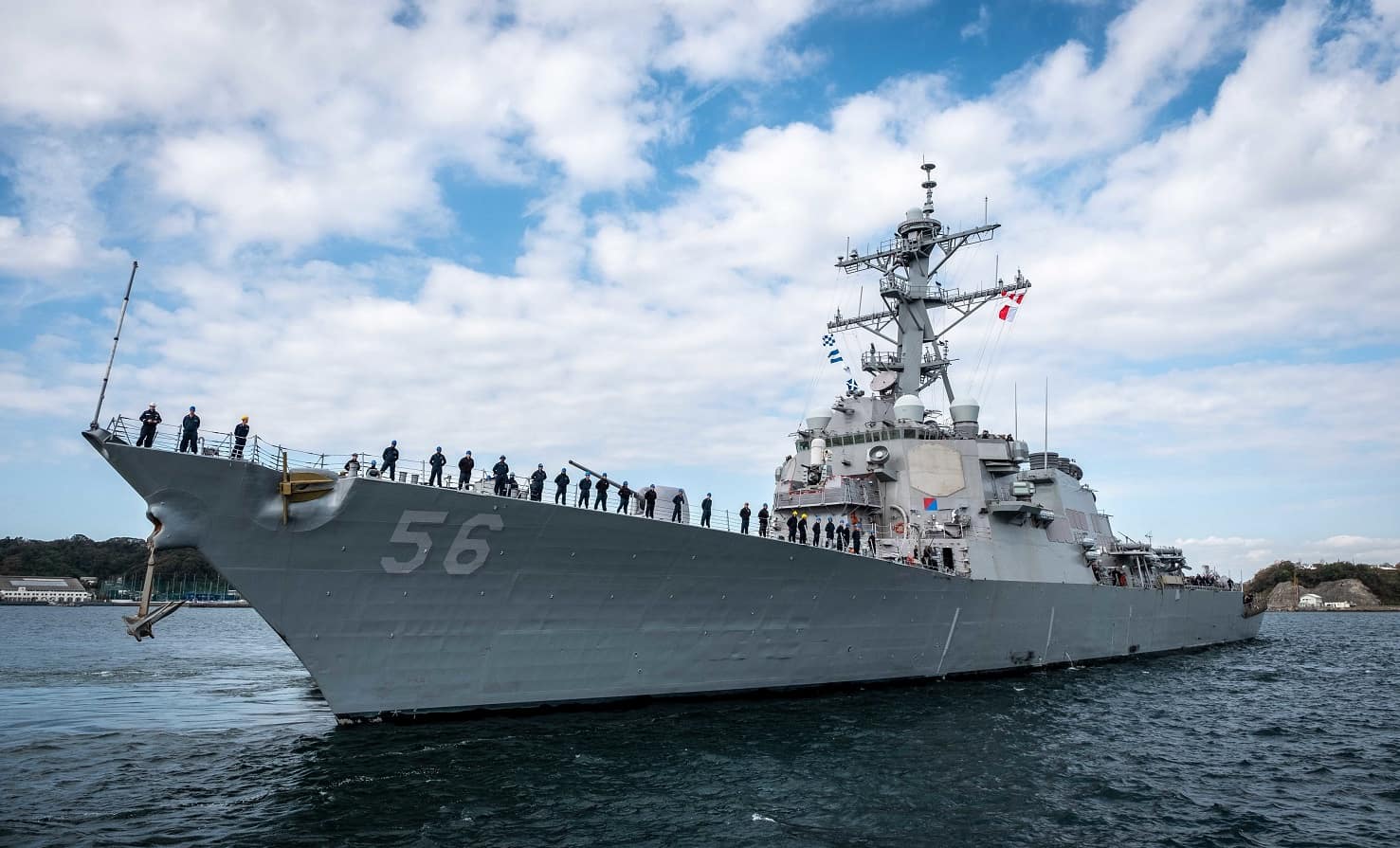
A Japan-based Arleigh Burke-class guided-missile destroyer USS John S. McCain (DDG 56) completed her necessary repairs and is underway to conduct comprehensive at sea testing, according to a Navy news release.
The guided-missile destroyer John S. McCain suffered serious damage as a result of colliding with a commercial vessel near Singapore on Aug. 21, 2017. Ten Sailors died as a result of the crash.
During the at-sea testing, the ship and her crew will perform a series of demonstrations to evaluate that the ship’s onboard systems meet or exceed Navy performance specifications. Among the systems that will be tested are navigation, damage control, mechanical and electrical systems, combat systems, communications, and propulsion application.
John S. McCain, assigned to Destroyer Squadron FIFTEEN (DESRON 15) and forward-deployed to Yokosuka, Japan, completed her in-port phase of training, and will continue Basic Phase at-sea training in the upcoming months to certify in every mission area the ship is required to perform and prepare for return to operational tasking.
“The USS John S. McCain embodies the absolute fighting spirit of her namesakes, and shows the resiliency of our Sailors. She has completed her maintenance period with the most up-to-date multi-mission offensive and defensive capabilities, preparing her to successfully execute a multitude of high-end operations,” said Capt. Steven DeMoss, commander, Destroyer Squadron 15. “As a guided-missile destroyer assigned to Destroyer Squadron 15, the John S. McCain is poised and ready to contribute to the lethal and combat ready forward-deployed naval force in the free and open Indo-Pacific region.”
John S. McCain completed repairs and extensive, accelerated upgrades over the last two years, following a collision in August 2017.
“This whole crew is eager to get back to sea, and that’s evident in the efforts they’ve made over the last two years to bring the ship back to fighting shape, and the energy they’ve put into preparing themselves for the rigors of at-sea operations,” said Cmdr. Ryan T. Easterday, John S. McCain’s commanding officer. “I’m extremely proud of them as we return the ship to sea, and return to the operational fleet more ready than ever to support security and stability throughout the region.”
Multiple upgrades to the ship’s computer network, antenna systems, radar array, combat weapons systems and berthing have ensured John S. McCain will return to operational missions with improved capability and lethality.
John S. McCain, is assigned to Destroyer Squadron (DESRON) 15, the Navy’s largest forward-deployed DESRON and the U.S. 7th Fleet’s principal surface force.