

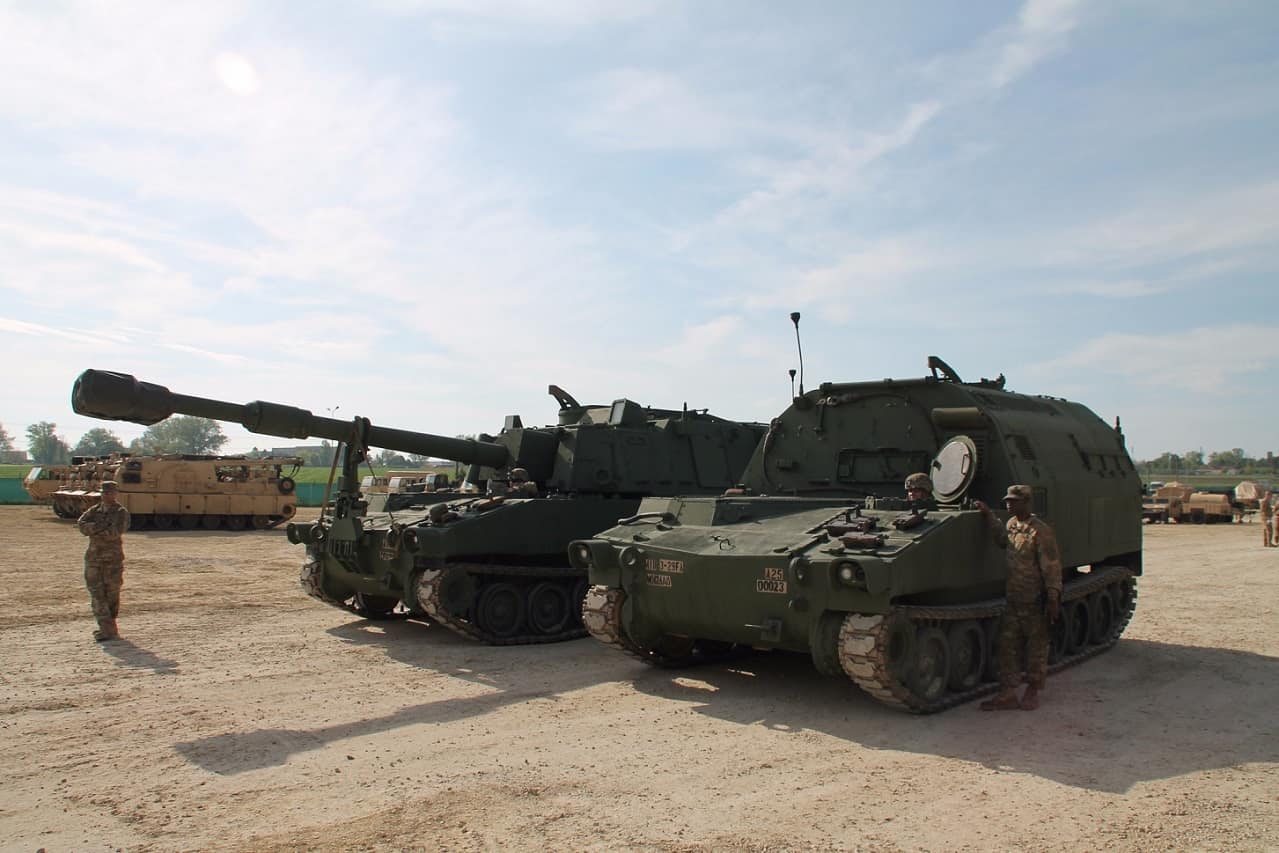
BAE Systems Land & Armaments L.P., a business unit of leading British defense firm BAE Systems, was awarded a $48 million contract modification to support producing of advanced variants of Paladin artillery system.
The contract modification announced on 4 October by the U.S. Department of Defense, calls for the company’s Pennsylvania-based division, to prepare to build the M109A7 self-propelled howitzer and M992A3 field artillery ammunition support vehicle.
The Department of Defense said Friday that BAE Systems received a $48 million modification for long-lead material associated with the build of the newest self-propelled howitzer and carrier-ammunition tracked vehicle. Work will be performed in York, Maine, with an estimated completion date of Jan. 31, 2023.
The M109A7 is the latest howitzer in the BAE Systems M109 family of vehicles, the primary indirect fire support system for the ABCTs. It uses the existing main armament and cab structure of a Paladin M109A6, and replaces the vehicle’s chassis components with modem components common to the Bradley vehicle. The improved chassis structure provides greater survivability and commonality with the existing systems in the ABCT, reducing operational sustainability costs by replacing obsolete components.
The M109A7 program enhances the reliability, maintainability, performance, responsiveness, and lethality of the combat-proven M109A6 Paladin Self-Propelled Howitzer and M992A2 Field Artillery Ammunition Support Vehicle’s (FAASV) while providing increased commonality within the U.S. Army Armored Brigade Combat Team (ABCT).
The M109A7 is supported by the Army as a vital technology enhancement program to maintain the combat capability of its ABCTs. The M109A7 will solve long-term readiness and modernization needs of the M109 family of vehicles through a critical redesign and production plan that leverages the most advanced technology available today. This state-of-the-art “digital backbone” and power generation capability provides a more robust, survivable and responsive indirect fire support capability for ABCT Soldiers.