

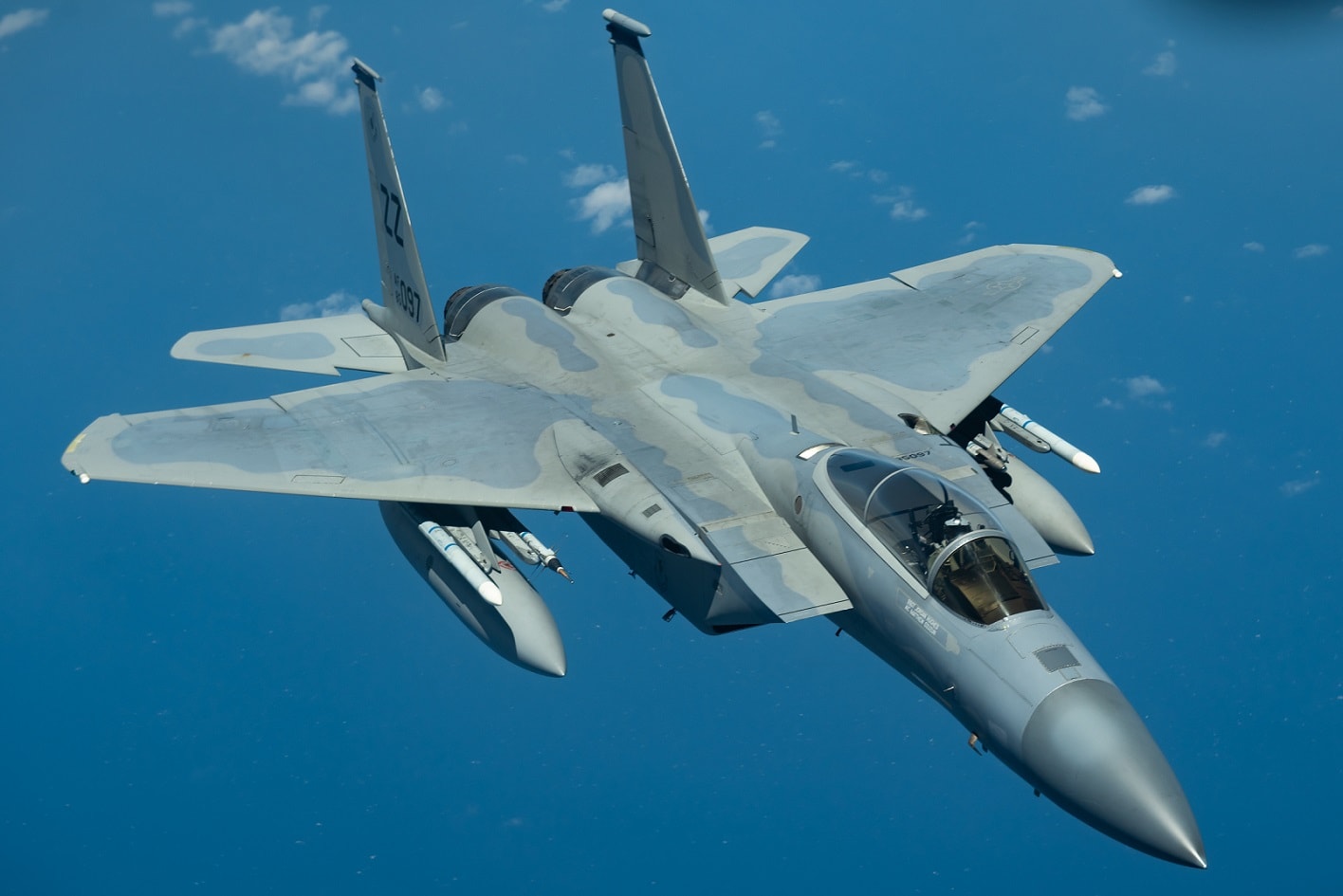
The United States Air Force marks the 40th anniversary of the F-15 Eagle tactical fighters arrival on Okinawa, Japan.
This year, the Kadena Air Base’s F-15 Eagle fighters celebrate its 40 years of air superiority, according to a statement issued by 18th Wing Public Affairs.
The F-15C Eagle is among the most successful modern fighters, with over 100 victories and no losses in aerial combat.
“This fighter is a dream to fly,” said Lt. Col. John G.J. DeLion, 67th Fighter Squadron commander. “I’ve been high enough to see the curvature of the earth and far faster than the speed of sound. They are easy to land in good or bad weather and fly smoothly in both. I count myself lucky every day I get to fly one.”
Over the years, both the U.S. and Japanese Air Self-Defense Force squadrons who fly the F-15, have had to adapt continuously to counter unique and ever-changing threats across the Pacific area of operations. Bilateral F-15 training increases operational readiness and interoperability of U.S. and JASDF forces while also strengthening relations and developing mutual trust, further enhancing our commitment to a free and open Indo-Pacific.
“We focus exclusively on one thing: air superiority,” said Capt. Robert Shine, 44th FS scheduler. “Other aerial platforms are certainly capable of fighting other jets, but no one focuses exclusively on this task like F-15C pilots. Our aircraft allow other platforms, sister-service partners, and allied nations to focus on their specific responsibilities. When bomber or refueler aircraft are not worried about getting shot down by enemy fighters, they are able to be more accurate and achieve mission success.”
In order to achieve that level of success and sustain it for nearly half a century, both aircrew and maintainers have had to take a disciplined approach to ensuring success each and every day.
”Depending on the complexity of the mission, we start planning the day before we fly,” said DeLion. “The day of the flight we arrive early, check the weather and speak with support staff members before our mission briefing. Eventually, we step to our jet and discuss the mission with the enlisted crew chief, do a walk-around of the aircraft and then start the pre-taxi/pre-flight procedures.”
Then it’s finally time to takeoff.
“You push the power up and go into full afterburner,” DeLion stated. “You get pushed back into the seat and pull back on the stick…and you’re airborne. Now it’s time to execute your mission.”
Once airborne, the F-15C Eagle can perform a wide-range of lethal capabilities.
“It’s an incredible feeling when the afterburners light and the jet lifts off of the ground,” said Shine. “Every sortie is different and comes with its own challenges, so there’s never a dull day. We push the jets and ourselves to the limit as much as possible.”
These F-15C Eagles, a twin-engine, air superiority fighter jet, have maintained a prominent presence within the Asia-Pacific region and an indisputable role in Air Force mission security around the globe.
There is a special trust between the operators flying the aircraft and the maintainers taking care of it.
“We have young professionals that get after the mission of maintaining these aircraft every day,” said Col. William Ray, 18th Maintenance Group commander. “There are lots of challenges, it’s not easy to maintain by any stretch, but my airmen love it. My airmen love this jet, they love the mission and they put their best foot forward every day to make sure we give our aircrew our best mission-ready aircraft.”
The 18th Wing’s team of dedicated maintainers work 24/7 to ensure mission success.
“These aircraft are able to meet and exceed challenges despite age and repairs by the blood, sweat, and tears of the outstanding airmen who maintain them,” said DeLion. “No airframe, whether new or old is functional without high-caliber maintainers. They work in the heat, rain, and wind, maintaining the Eagle under challenging conditions nearly every day.”
Forty years after its first Okinawa flight, it is still relevant because of how well it was designed, and how well they are maintained.
“Lethality is all the Eagle does,” said Shine. “F-15Cs are a pure air-superiority aircraft. Our competition and even other fellow service branches look to us to be undisputed experts on it. There’s not an air force in the world that wants to tangle with us because of our dominance, thanks to this fighter jet.”