

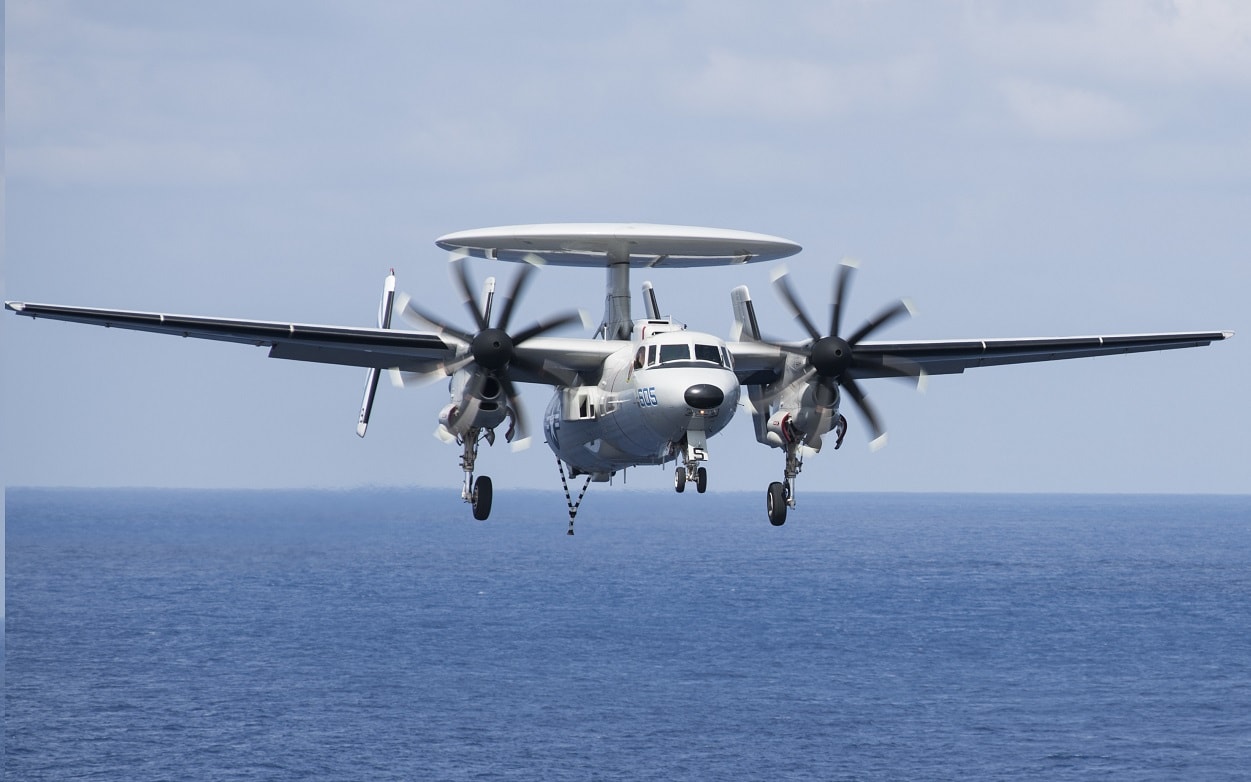
U.S. defense contractor Northrop Grumman has announced that it completed its first delivery of an E-2D Advanced Hawkeye aircraft to the Japanese Air Self-Defense Force (JASDF) on March 29.
In November 2014, the Japan Ministry of Defense competitively selected the Northrop Grumman E-2D to fulfill an emerging next-generation airborne early warning requirement.
“Northrop Grumman’s longstanding partnership with Japan is beginning a new chapter with the delivery of the first Japan E-2D,” said Jane Bishop, vice president and integrated product team leader, manned airborne surveillance programs, Northrop Grumman. “This aircraft provides a significant increase in early warning and surveillance capability to outpace Japan’s evolving security needs.”
Japan has operated the Northrop Grumman E-2C Hawkeye since 1983 and is the largest E-2 operator outside the U.S. The E-2D delivers a two-generation leap in radar technology, allowing the aircraft to track threats at extended range. The aircraft can also be used in a humanitarian assistance and disaster relief capacity for civilian emergency coordination.
E-2D Hawkeyes have eight-bladed, turbofan propellers and twin engines, giving it over 300 knots of air speed. While it is not as fast as a jet, it gets better fuel flow, meaning it can stay airborne long enough to complete their mission.
The E-2D offers interoperability with next-generation aircraft systems and U.S. Navy allies to support regional security cooperation. To ensure long-term success of the Japan E-2D fleet, Northrop Grumman is providing continued support to JASDF in the areas of sustainment and maintenance, in coordination with several Japanese firms.