

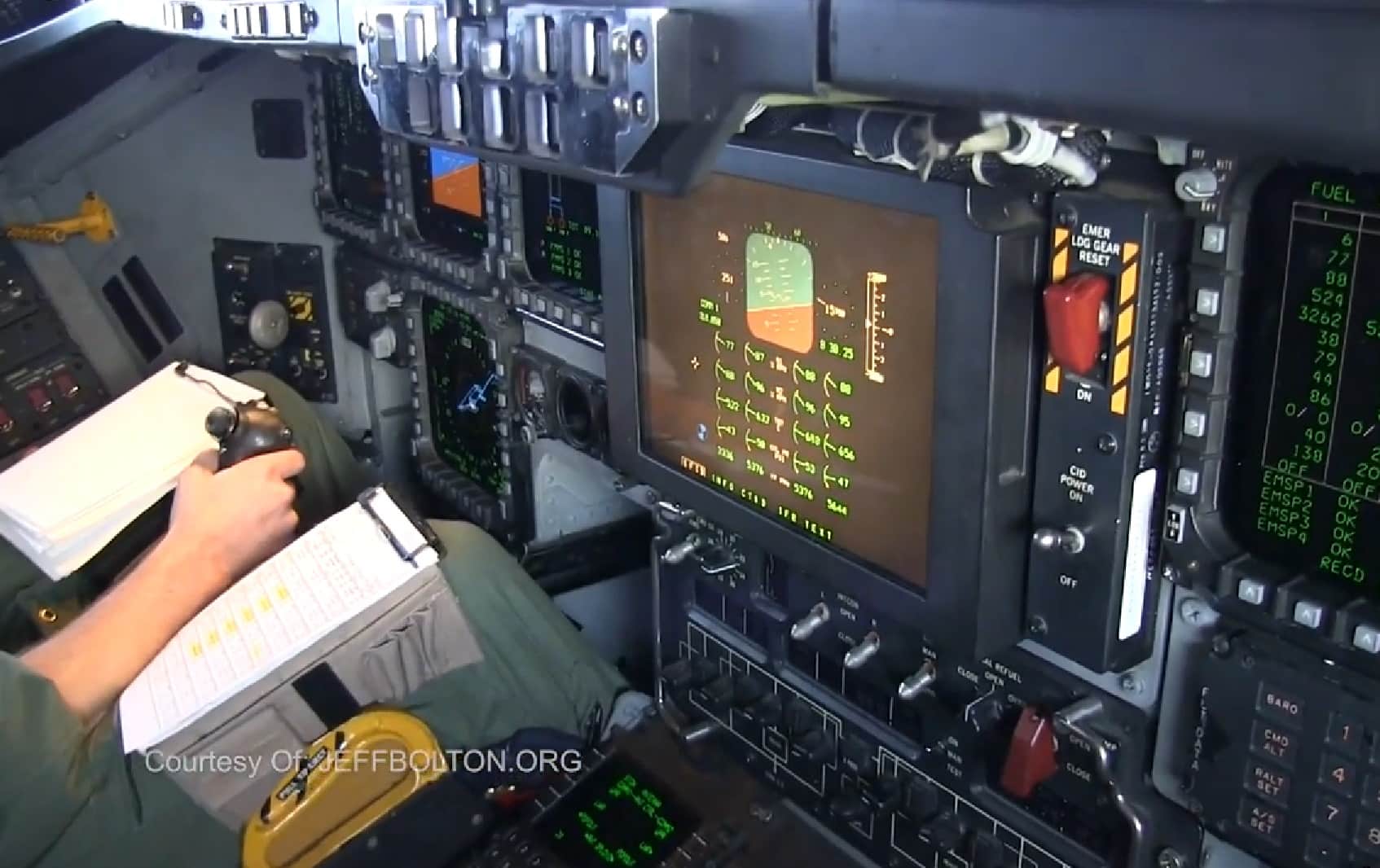
For the first time in the 30-year history of the Air Force’s B-2 stealth bomber program, video footage recently filmed in a B-2A “Spirit” stealth bomber cockpit while in flight is available for viewing at Defense News. Additional footage of the B-2 cockpit in-flight, as well as cockpit photographs are also available at JeffBolton.org
A product of Dallas-based film producer and radio personality Jeff Bolton, this historic video shows the full array of instrumentation in this technological wonder, as well as a dramatic in-flight refueling from inside the cockpit of America’s most secret aerial weapon.
The B-2 stealth bomber deploys internationally, and also flies up to 44-hour round trip missions around the world from its home base at Whiteman Air Force Base in Missouri. “In an era of rising tensions between global nuclear powers – the United States, China, Russia, and North Korea – this timely video of is a vivid reminder of the B-2’s unique capabilities,” said producer Jeff Bolton, “No other stealth bombers are known to exist in the world.”
The revolutionary blending of low-observable technologies with high aerodynamic efficiency and large payload gives the B-2 important advantages over existing bombers. Its low-observability provides it greater freedom of action at high altitudes, thus increasing its range and a better field of view for the aircraft’s sensors. Its unrefueled range is approximately 6,000 nautical miles (9,600 kilometers).
The B-2’s low observability is derived from a combination of reduced infrared, acoustic, electromagnetic, visual and radar signatures. These signatures make it difficult for the sophisticated defensive systems to detect, track and engage the B-2. Many aspects of the low-observability process remain classified; however, the B-2’s composite materials, special coatings and flying-wing design all contribute to its “stealthiness.”
The B-2 has a crew of two pilots, a pilot in the left seat and mission commander in the right, compared to the B-1B’s crew of four and the B-52’s crew of five.