

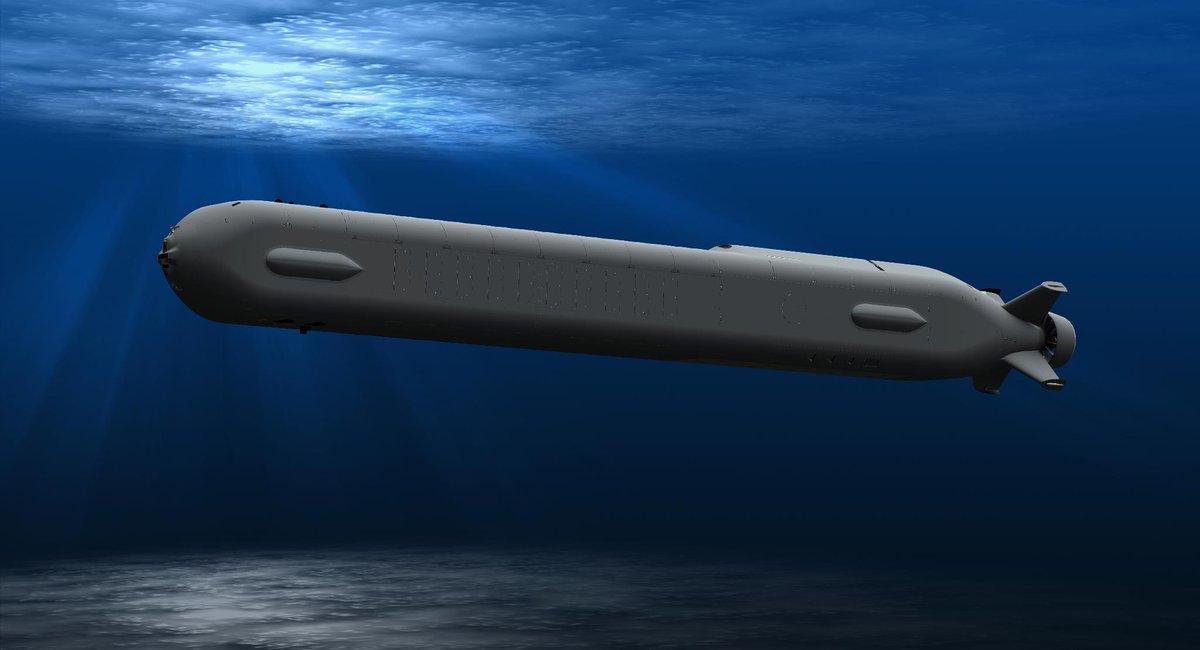
The Royal Navy (United Kingdom’s naval warfare force) is moving forward with a plan to develop an autonomous version of an existing large underwater vehicle or unmanned submarine.
According to recently notice by Defence and Security Accelerator (DASA), the Royal Navy has requested tenders from the industry for the large unmanned underwater vehicle as a testbed for future Extra-Large Unmanned Underwater Vehicles (XLUUV) technology.
The Royal Navy is looking for a flexible UUV capable of hosting different payloads/sensors which will be utilized in a range of testing scenarios.
The unmanned submarine should be able to:
- operate independently for a minimum of 3 months,
- operate at significant range from the position of deployment (e.g. up to 3000 nautical miles),
- carry, deliver and recover test payloads of >2m3 and 2 metric tonnes (see vignette 3),
- provide flexible, accurate and timely covert intelligence gathering capability (see vignette 1),
- provide an anti-submarine warfare (ASW) barrier capability (see vignette 2).
The contract will have two stages, a research, design and re-fit stage and a testing and trialling stage. In the latter stage it is expected that the system will be tested in representative environments for extended periods; the sea trials in Stage 2 may be up to 2 years long. This range of tests will determine capability limits of a UUV, to assist in the development of future requirements and the design of future capabilities.
The total funding available for this competition is £1m for Stage 1 (research and development of an autonomous control system and re-fit of an existing manned submersible to implement this innovative autonomy); and a further £1.5m for Stage 2 (rent and testing of the novel autonomous functions of the submersible at a manufacturer-proposed operating base for up to 2 years). Tasking of Stage 2 is dependent on the success of the Stage 1 capability demonstrations.
The competition closes at midday (BST) on 11 June 2019.
According to the British Ministry of Defence, contact for the new underwater system will be signed 01 August 2019.