


The Defense Advanced Research Projects Agency (DARPA) Biological Technology Office with U.S. weapons maker Northrop Grumman Corp is developing the new type of undersea sensors.
DARPA selected Northrop Grumman Corporation to prototype sensing capabilities using undersea organisms to assist in passively detecting and tracking undersea threats, the aerospace giant reported on 11 April.
As part of the PALS program, Northrop Grumman will develop biological sensing hardware that has increased sensitivity for certain sensor modalities, achieving greater range. Artificial intelligence will be applied to observe patterns in the marine environment to help classify targets. Northrop Grumman is partnered with Coda Octopus (Nasdaq: CODA), Duke University, University of Maryland, Baltimore County and the University of Memphis.
“The detection, classification and tracking of undersea objects is a critical military capability and we are excited to work with DARPA to develop this next generation approach,” said Mike Meaney, vice president, advanced missions, Northrop Grumman.
The Persistent Aquatic Living Sensors (PALS) program aims to leverage biology to augment the Department of Defense’s existing, hardware-based maritime monitoring capabilities.
The program will tap into marine organisms’ innate abilities to sense and respond to perturbations in their environments and apply those abilities to the detection, characterization, and reporting of manned or unmanned underwater vehicles ranging from small autonomous vessels to large nuclear submarines. Because marine organisms are ubiquitous in their environments, self-replicating, and largely self-sustaining, sensing systems that use marine organisms as their foundation would be discreet, cost-effective, and provide persistent undersea surveillance with a minimal logistical footprint.
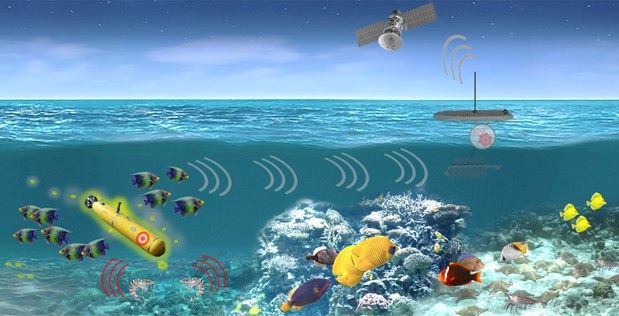
The envisioned PALS system would work in two stages. In the first stage, marine organisms would sense the presence of an underwater vehicle (or confounder) in their environment and respond with an output signal or other observable behavior. In the second stage, a man-made detector system would observe, record, and interpret the organisms’ response, and transmit analyzed results to remote end users as distilled alerts.
The complete PALS system would also discriminate between target vehicles and other sources of stimuli, such as debris and other marine organisms, to limit the number of false positives. By teaming marine organisms with distributed detection systems, PALS aims to greatly extend the lifetime and range of undersea surveillance capabilities.