

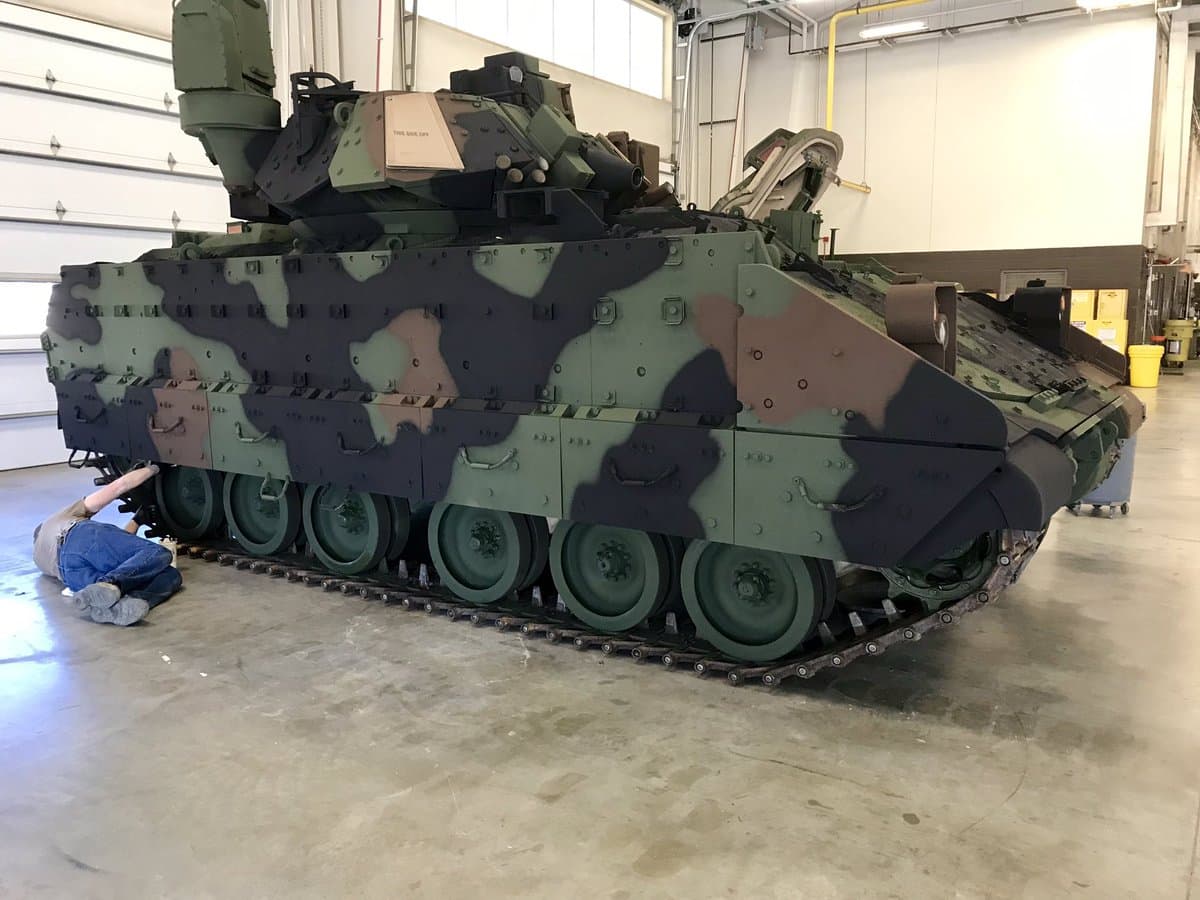
The U.S. Army is working for several years to paint all of its ground combat vehicles in shade of woodland green as part of the readiness plan to counter increasing Russian ground force threat.
Army’s Bradley fighting vehicles, M109A6 Paladin self-propelled howitzers, and even M1A2 Abrams tanks will use the woodland pattern to match new terrain. Army now has a new advanced coating system for ground vehicles that suppresses ground vehicle heat signatures, making the vehicles much more difficult to detect.
All ground combat vehicles to receive new visual camouflage pattern using brown, black and green instead desert camo from time in the Global War on Terror.
Early the U.S. Army has given further details on the capabilities of its new advanced coating system for ground combat vehicles.
The Ground Vehicle Coating System was developed by a joint venture between the Combat Capabilities Development Command Ground Vehicle Systems Center, the Combat Capabilities Development Command Army Research Laboratory and the Army’s Manufacturing Technology program to reduce detectable infrared signatures that are emitted from vehicles, making them much more difficult to detect and track. This new coating also mitigates the effects of chemical agents that adversaries may use to injure, incapacitate or kill Soldiers.
In addition to reducing the cost of the coating per gallon by approximately 75 percent from when the program originally started, the coating can be applied to vehicles in existing facilities, including depots and arsenals, using equipment already in the Army’s inventory. This will decrease application costs and increase production output.
The return to the forest colors coincides with security concerns among eastern NATO allies since Russia’s intervention in Ukraine.
Pentagon makes no secret of his concern about the growth of Russia’s activity in Eastern Europe and calls on NATO allies to assemble 30 land battalions, 30 air squadrons and 30 combat vessels capable of deploying in 30 days or less by the year 2020.
SEP-115 from Fury is in-shop for Woodland paint. This is BEFORE. @FortBenning pic.twitter.com/t7Ayav3Ycn
— Red Knight 6, Commander, 1-81 AR (@RedKnightHQ66) 1 April 2019
More Paint Shop pics. Prepping big 115 for paint. @FortBenning pic.twitter.com/u6hL8mOOUD
— Red Knight 6, Commander, 1-81 AR (@RedKnightHQ66) 2 April 2019