

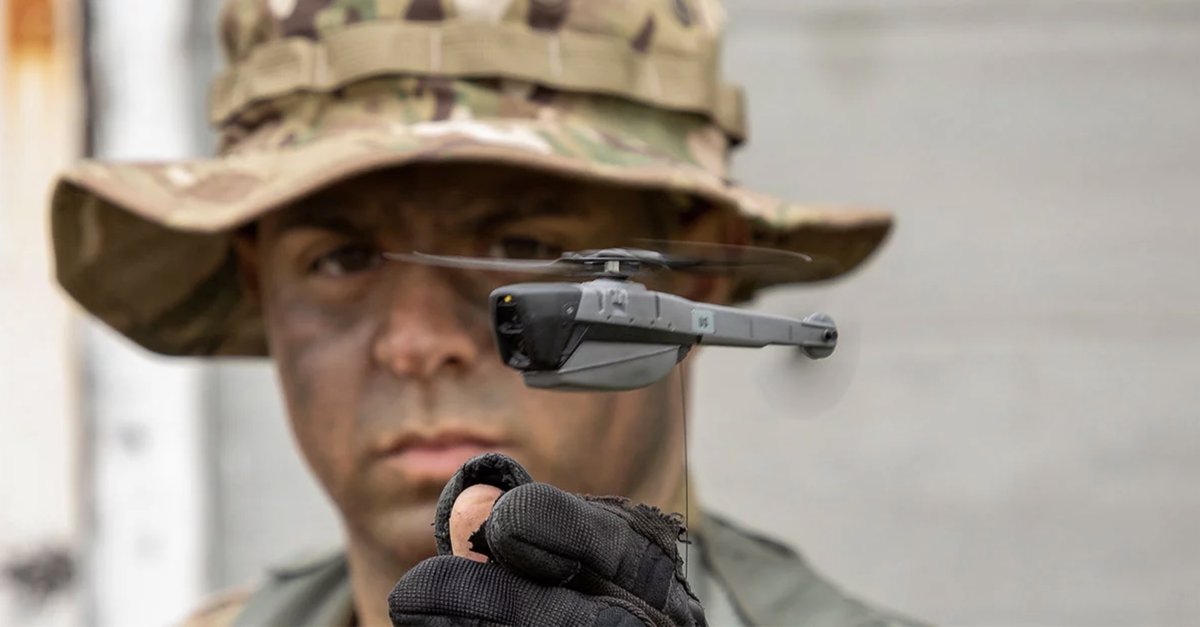
U.S. Army orders Black Hornet nano-unmanned aerial systems

FLIR Systems has announced that it has been awarded a $39.6 million order to deliver Black Hornet Personal Reconnaissance Systems (PRS) in support of the U.S. Army.

According to statement, the highly capable nano-unmanned aerial vehicle (UAV) systems delivered under this contract will support platoon and small unit level surveillance and reconnaissance capabilities as part of the Soldier Borne Sensor (SBS) Program.

Also noted that the U.S. Army awarded in June 2018 the first SBS phase contract to FLIR for an initial batch of Black Hornet PRS. These systems are being delivered now to the U.S. Army for initial integration into the force.

- ADVERTISEMENT - CONTINUE READING BELOW -

“We are proud to be selected by the U.S. Army for the SBS Program of Record. This contract represents a significant milestone with the operational large-scale deployment of nano-UAVs into the world’s most powerful Army,” said Jim Cannon, President and CEO of FLIR Systems.

“This contract is a major win for the newly established Unmanned Systems & Integrated Solutions business division at FLIR and demonstrates the strong and urgent demand for nano-UAV technology offered by FLIR. Protecting U.S. warfighters with our unmanned solutions is a key objective for FLIR,” he added.

This contract expands the use of FLIR’s Black Hornet PRS for Armysurveillance and reconnaissance programs. FLIR has delivered over 8,000 Black Hornet nano-UAVs around the world.

Apart from the U.S. Army, French Defense Procurement Agency (DGA) also ordered Black Hornet 3 nano-UAV and PRS to support French Armed Forces operations.

The cost of French Armed Forces order is a value of $89 million.

Readers who wish to follow our weekly coverage can subscribe to the Weekly Defense Roundup.

If you wish to report a grammatical or factual error in this article, please let us know by using the online form.

Executive Editor
  • In this story
  • USA

Support The Defence Blog

Independent reporting takes resources. Join us on Patreon.

Become a patron

More Like This

U.S. Army tests balloon-carried solar stratospheric aircraft

U.S. Army soldiers attached a solar-powered fixed-wing aircraft to a high-altitude balloon at Orote Airfield on Naval Station Guam on June 24, 2026, and...

U.S. Marines deploy Iron Dome-based missile system to Guam

U.S. Marines from III Marine Expeditionary Force were photographed calibrating and evaluating the Medium-Range Intercept Capability system on Mason Range, Guam, on June 24,...

U.S. Army engineers test drone that breaches wire obstacles

A drone climbed into 40 km/h (25 mph) gusts above a high desert training range in Oregon on June 22, 2026, carrying a live...

Two U.S. destroyers get new electronic warfare suites

Two U.S. Navy guided-missile destroyers have completed a comprehensive mid-life modernization that gives them the most advanced shipborne electronic warfare capability the Navy has...

U.S. Air Force wants a new infrared sensor for its F-15 jets

The U.S. Air Force is looking for industry solutions to upgrade one of the most tactically valuable but persistently underdeveloped sensors on its F-15...