

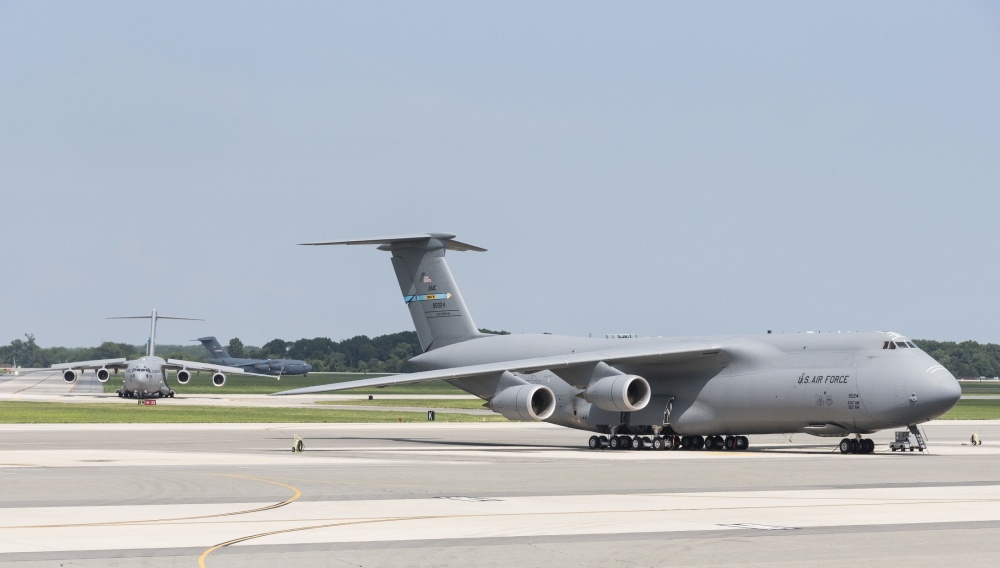
The U.S. Department of Defense has announced that Honeywell received the contract, which covers a repair and upgrade of the C-5M Super Galaxy’s Versatile Integrated Avionics/Avionics Integrated Units (VIA/AIUs).
The contract, announced by the Department of Defense, is worth more than $7,8 million. Also noted that this order subsumes all work on previous order FA8625-18-F-6801, providing for the repair and upgrade of 85 of the existing -903 and -904 configuration VIA/AIUs to the -905 configuration.
Work will be performed in Albuquerque, New Mexico, and is expected to be completed by July 5, 2020.
Honeywell’s Versatile Integrated Avionics for C-5M Super Galaxy uses line replaceable units with shared functions to lower weight, reduce wiring and decrease spares inventory.
New board Honeywell’s solution is based on key advances that were made by the company in the development and implementation of the advanced avionics architecture.
Since its inception, the C-5 has been a critical instrument of national policy. From the defense of Israel in the Yom Kippur war, to the air bridge supporting coalition forces in Desert Storm, the C-5 delivers unmatched capability to carry enormous loads over global distances.
The C-5 stands 65 feet high with a length of 247 feet and a 223-foot wingspan. The upgraded C-5M can haul 120,000 pounds of cargo more than 5,500 miles — the distance from Dover Air Force base in Delaware to Incirlik airbase in Turkey — without refueling. Without cargo, that range jumps to more than 8,000 miles.
In deployed airlift operations, the C-5M is demonstrating a new era of highly capable, reliable and affordable airlift. With departure reliability rates greater than 90 percent and payload increases of 20 percent over legacy C-5s, the Super Galaxy is delivering more to the warfighter on every mission. With a substantial improvement in unrefueled range, the C-5M is overflying traditional en-route fuel stops, enabling a reduction in fuel consumption by as much as 20 percent. This is the OEM difference.