

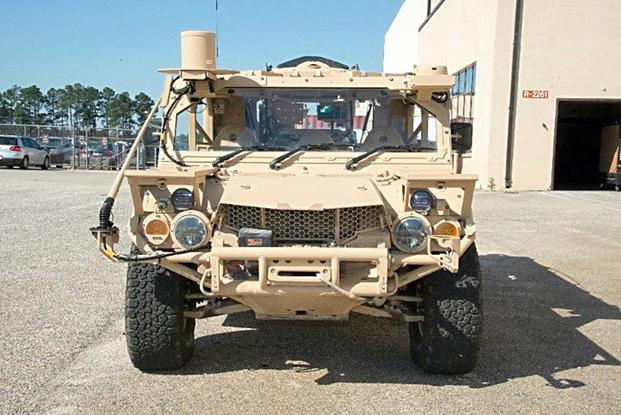
General Dynamics delivers first vehicles for U.S. Army’s Ground Mobility Vehicle program

General Dynamics Ordnance and Tactical Systems announced that the company has successfully completed delivery of the first Army-Ground Mobility Vehicles (A-GMV 1.1) to the US Army. 

According to the company’s statement,  this marks the First Unit Equipped (FUE) with the new A-GMV 1.1 capability, which was delivered within four months of contract award and consisted of vehicles, spares and training.

The Army Ground Mobility Vehicle fulfills a need in the airborne and air assault operations undertaken by Airborne Infantry Combat Teams. The A-GMV 1.1 is configured to carry an airborne infantry squad of nine paratroopers, and their associated equipment (a payload capacity of over 5,000 pounds.) The vehicle’s open design allows for multiple mission roles and can be modified to accept possible kit configurations such as remote and manned turrets, armor and arctic kits if the Army develops a requirement for them in the future. The A-GMV 1.1 can be transported by Army inventory helicopters.

- ADVERTISEMENT - CONTINUE READING BELOW -

“The A-GMV 1.1 provides the Army with a vehicle of superior off road mobility. We’re proud to support the Army in accelerating this capability to the field.” said Steve Elgin, vice president and general manager of armament and platform systems for General Dynamics Ordnance and Tactical Systems.

A family of unique modular, military grade, mission-ready vehicles is designed to be internally transportable via CH-47 Helicopter as well as U.S. Air Force C–130 Hercules and C-17 Globemaster III heavy lift aircraft.

Built for speed, mobility and maneuverability, the new vehicles allow operators to access previously denied terrain in demanding environments. These versatile vehicles can be reconfigured to support multiple crew and mission profiles, from three to nine operators with full payload and mission profile kits.

Readers who wish to follow our weekly coverage can subscribe to the Weekly Defense Roundup.

If you wish to report a grammatical or factual error in this article, please let us know by using the online form.

Executive Editor
  • In this story
  • USA

Support The Defence Blog

Independent reporting takes resources. Join us on Patreon.

Become a patron

More Like This

U.S. Army Reserve tests Pyka’s autonomous cargo aircraft in live exercise

Pyka's autonomous cargo aircraft DropShip flew a 32 km (20-mile) resupply mission entirely without a human pilot from Gulfport to Diamondhead, Mississippi, then executed...

Mayman Aerospace CEO: autonomous drones must replace helicopters in contested battlespace

At 3 a.m. in a contested forward operating base, a patrol thirty kilometres out is taking casualties. They need blood, plasma, and ammunition, not...

U.S. Army buys more of its toughest Arctic combat vehicle

The U.S. Army awarded BAE Systems Land and Armaments a $35 million contract modification on June 30, 2026, for additional production of the general-purpose...

AEVEX wins $50M deal for GPS-resistant strike drones

AEVEX Corp. secured a $50 million contract from the United States Air Force on June 30, 2026, to continue expanding unmanned mission-support capabilities for...

U.S. Air Force spends $471M to fix tanker parts supply problem

The U.S. Air Force awarded a combined $471 million in contracts to 28 different companies on a single day, spreading the work of exchanging...

U.S. Marines deploy Iron Dome-based missile system to Guam

U.S. Marines from III Marine Expeditionary Force were photographed calibrating and evaluating the Medium-Range Intercept Capability system on Mason Range, Guam, on June 24,...