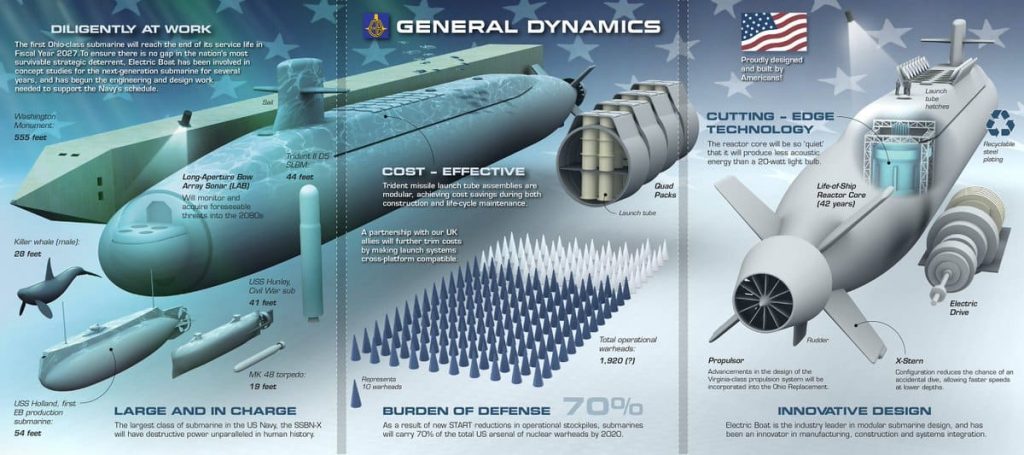
The General Dynamics has announced on 17 September that the U.S. Navy has awarded the company a $480.6 million contract modification to continue the development of the lead Columbia-class submarine, the nation’s next-generation sea-based strategic deterrent.
According to the statement, the modification includes funding for advance procurement, advance construction and long lead time material for Columbia (SSBN 826). Construction of the lead ship of the class is scheduled to begin in the fall of 2020. The Navy plans to build a fleet of 12 new SSBNs.
Initially awarded in September 2017, the overall contract has a potential value of $6.1 billion.
“In close collaboration with the Navy and the submarine industrial base, Electric Boat will continue to lead key aspects of the Columbia-class development effort. This work includes design, material procurement, construction and operating-cost reduction. The entire Columbia-class team is committed to achieving an affordable and effective program. Our nation’s security depends on it,” said Electric Boat President Jeffrey S. Geiger.
General Dynamics Electric Boat has established standards of excellence in the design, construction and lifecycle support of U.S. Navy submarines. In its position as an industry leader, Electric Boat remains committed to applying its technical strengths and business expertise to effectively manage the challenges of nuclear-submarine production.
The company’s three primary locations are in Groton and New London, Conn.; and Quonset Point, R.I. Its current workforce is approximately 16,800 employees.
The Columbia-class submarine, formerly known as the Ohio Replacement Submarine and SSBN-X Future Follow-on Submarine, is a future United States Navy nuclear submarine class designed to replace the Trident missile-armed Ohio-class ballistic missile submarines.
The first submarine is scheduled to begin construction in 2021 and enter service in 2031.