

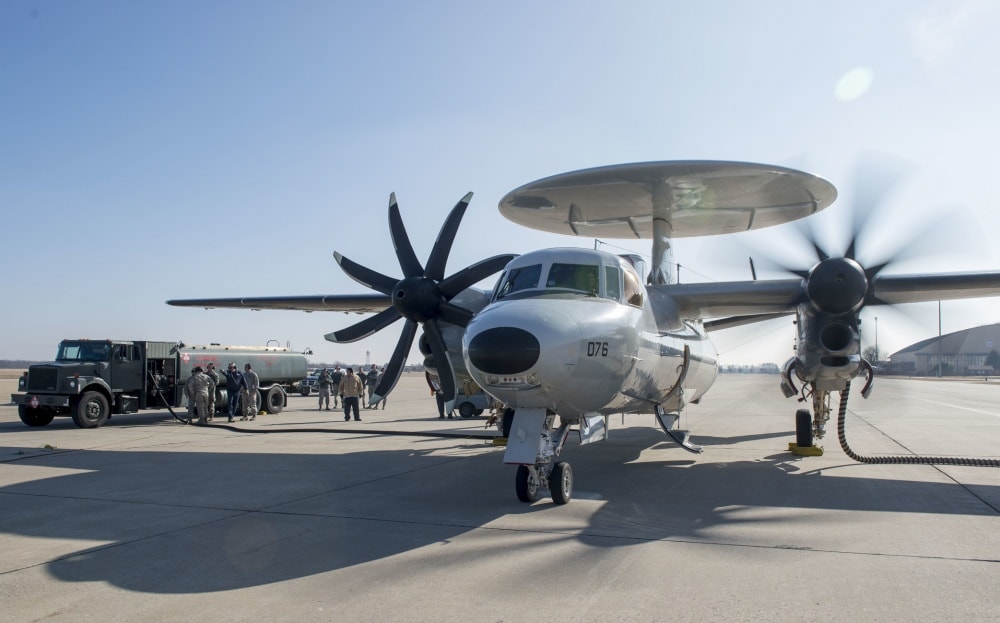
The U.S. Department of State has approved a possible $3.135 billion Foreign Military Sale to Japan of nine E-2D Advanced Hawkeye (AHE) Airborne Early Warning and Control (AEW&C) aircraft, the US Defense Security Cooperation Agency (DSCA) said in a 10 September statement.
Also included in the proposed deal are aircraft ancillary equipment, modifications, spare and repair parts, support equipment, publications and technical documentation, software, personnel training and training equipment, ferry services, U.S. Government and contractor logistics, engineering, and technical support services, and other related elements of logistics and program support.
According to the statement of the U.S. Department of State, the potentional sale of E-2D AHE aircraft will improve Japan’s ability to effectively provide homeland defense utilizing an AEW&C capability. Japan will use the E-2D AHE aircraft to provide AEW&C situational awareness of air and naval activity in the Pacific region and augment its existing E-2C Hawkeye AEW&C fleet. Japan will have no difficulty absorbing these aircraft into its armed forces.
The proposed sale of this equipment and support does not alter the basic military balance in the region.
The principal contractor will be Northrop Grumman Corporation Aerospace Systems in Melbourne, Florida.
According to the Northrop Grumman, the E-2D Advanced Hawkeye is the latest variant of the Navy’s carrier-based radar and command-and-control plane. It is designed to extend sensor coverage and facilitate coordination with other aircraft at long ranges.
It has 360-degree long-range radar that is effective over open sea, shoreline, and land. It is designed to detect, track, and identify air and surface targets, provide Friend or Foe identification and employs electronic surveillance systems.
The plane is nearly 58 feet long, has an 80-foot wingspan, can fly faster than 300 knots, and can fly to altitudes as high as 37.000 feet. It carriers a crew of five: two pilots and three mission systems operators. The co-pilot also can act as a fourth mission systems operator.