

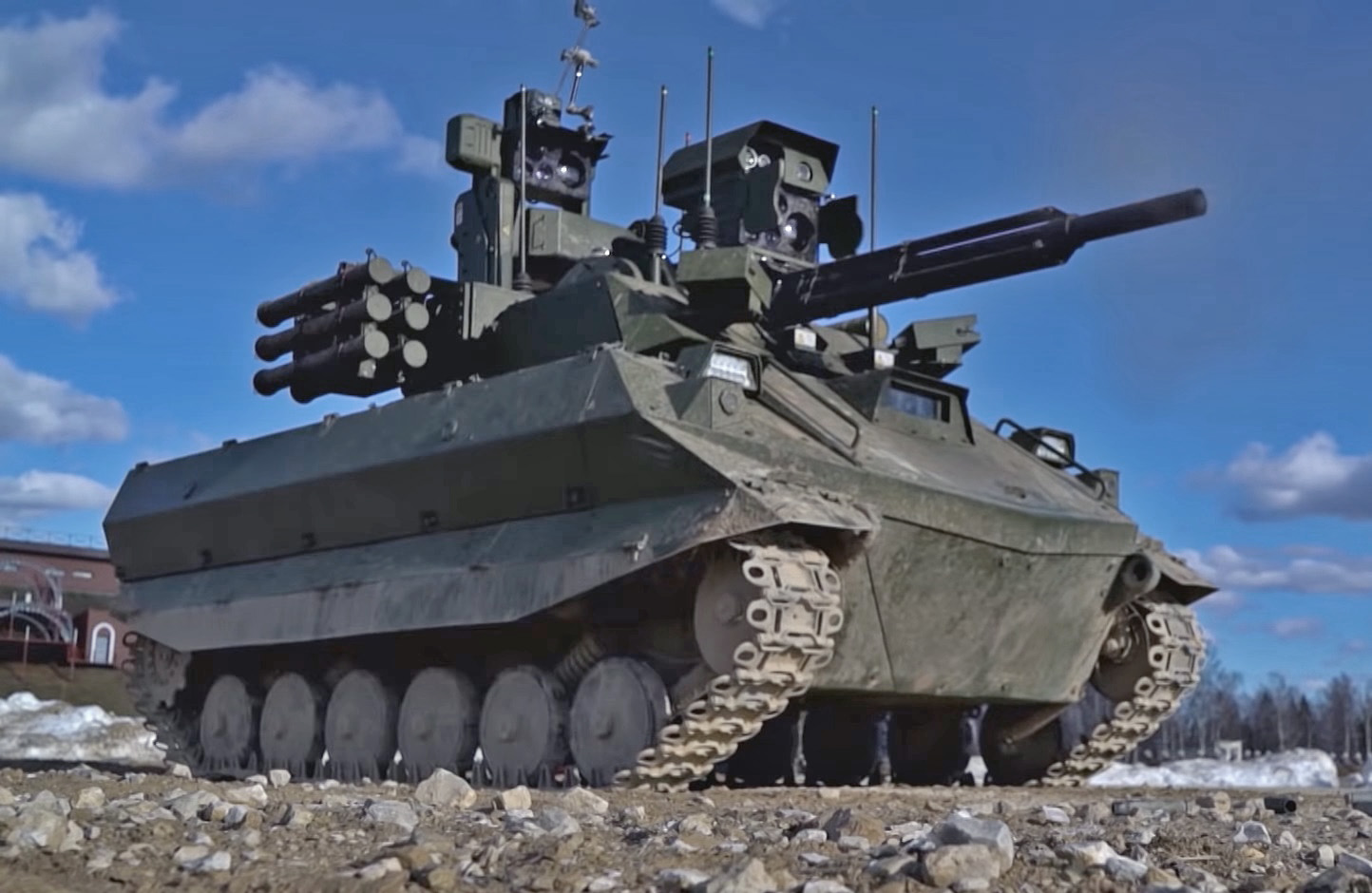
Senior Research Officer at the 3rd Central Research Institute of the Russian Defence Ministry, A.P. Anisimov, has reported on the critical deficiencies of Russia’s modern Uran-9 unmanned ground vehicle (UGV).
The Uran-9 is a modern Russian combat UGV—often described as a “miniature tank”—designed to provide remote reconnaissance and fire support for counter-terrorism, reconnaissance, and military units operating in urban environments.
During the 10th All-Russian Scientific Conference “Actual Problems of Protection and Security,” held from April 3 to 6, 2018, at the N.G. Kuznetsov Naval Academy in St. Petersburg, Anisimov revealed the results of the Uran-9’s combat testing in Syria. The findings identified a number of deficiencies, many of them classified as critical.
According to the report, the Uran-9 complex proved incapable of performing its assigned tasks. During combat missions, the average effective control range from the forward command post was only 300–500 meters in urban areas with low-rise buildings. There were also 17 recorded cases of short-term loss of control (up to one minute) and two cases of long-term loss of control (up to 1.5 hours).
The trials also revealed low reliability in the vehicle’s running gear, including support and guide rollers and suspension springs. The Uran-9’s chassis is not suitable for prolonged ground combat and requires frequent field repairs.
During an evaluation of its reconnaissance capabilities, it was found that the electro-optical systems could detect and identify targets at a range of no more than 2 kilometers. The OCH-4 optical station was unable to detect enemy observation or targeting devices and often generated multiple false signals from objects on the ground and in the airspace within its observation sector.
There were also instances of unstable operation of the 30 mm 2A72 automatic cannon, including six delays and one complete failure. The UGV can only fire from a stationary position, as its weapons, sighting systems, and sensors lack stabilization, which severely limits its combat effectiveness.
As a result, Anisimov concluded that modern Russian combat UGVs are not yet capable of performing assigned tasks during conventional combat operations.
