

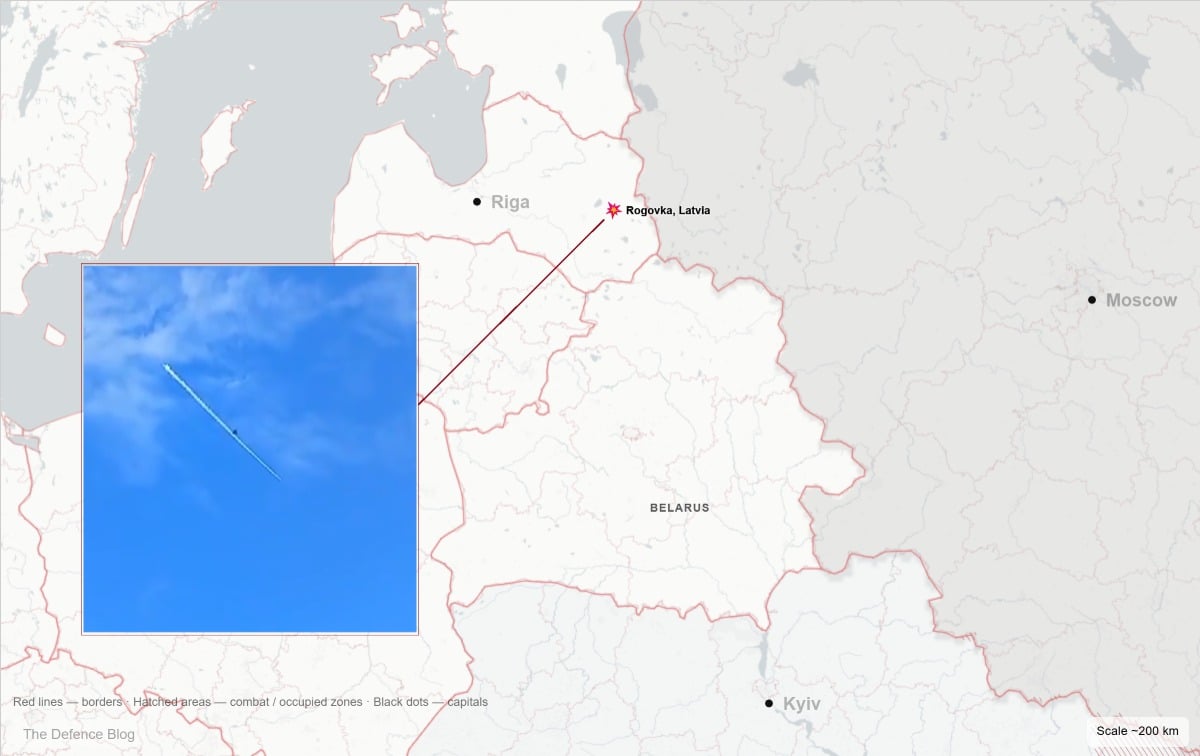
- A French Rafale from NATO's Baltic Air Policing 71 detachment at Šiauliai intercepted and shot down an unidentified drone over Latvia on Monday morning.
- The Latvian National Armed Forces confirmed the intercept after lifting an air raid alert in eastern Latvia; drone origin and type were not officially identified.
A French Air and Space Force fighter jet intercepted and destroyed an unidentified drone that entered Latvian airspace on Monday morning, in what NATO described as its alliance air defense capability working exactly as designed.
The Latvian National Armed Forces confirmed the intercept after lifting an air raid alert that had been activated across the country’s eastern districts, and video of the moment a missile struck the drone was published by Uldis Budriķis, Chairman of the Foreign Affairs Committee of the Estonian Parliament, who accompanied his post with the words: “NATO airpower in action this morning, safeguarding Latvian airspace.”
The interception was carried out by aircraft from NATO’s Baltic Air Policing mission, the alliance’s continuous air defense operation covering Estonia, Latvia, and Lithuania, three member states that do not operate their own fast jet interceptors and rely on rotating NATO contributions for airspace protection. France currently provides the alert force under Baltic Air Policing 71, deploying Rafale fighters from the 71st detachment based at Šiauliai Air Base in northern Lithuania.
The same French detachment conducted the interceptions of six Russian military aircraft over the Baltic Sea on June 2, an operation that generated significant attention when France’s Joint Staff published targeting camera footage of a Rafale pulling alongside a Russian Su-35. Monday’s intercept of an unidentified drone represents a qualitatively different kind of mission, but the same detachment and the same aircraft.
The Rafale, built by French aerospace company Dassault Aviation and operated exclusively by France’s Air and Space Force and Navy, is one of Europe’s premier multirole combat aircraft, capable of intercepting everything from supersonic combat jets to slow-moving unmanned systems. Its integration into the Baltic Air Policing framework reflects France’s sustained contribution to collective NATO air defense since the alliance expanded its eastern flank posture following Russia’s full-scale invasion of Ukraine in February 2022. Shooting down a drone with a Rafale and an air-to-air missile is not an economically efficient exchange by any procurement calculation, but it is a statement of capability and resolve that carries weight in the current security environment.
Latvia has documented a pattern of drone intrusions over recent months, with multiple incidents of unidentified unmanned aircraft crossing into its airspace from the direction of the Latvian-Russian border or over the Baltic Sea. Several of those incidents have been linked to Russian electronic warfare activity in the region, where dense jamming and GPS spoofing systems deployed by Russian forces in support of operations in Ukraine have been documented creating navigational disruption that can cause drones operating near the conflict zone to lose their programmed flight paths and drift into neighboring airspace. The phenomenon has been observed across multiple Baltic and Nordic countries since 2022, with incidents reported in Finland, Estonia, Latvia, and Poland involving drones, missiles, or debris that crossed international borders as a byproduct of the Russian electronic warfare environment.
Whether the drone intercepted on Monday was a Russian military or commercial drone that had strayed due to electronic warfare interference, a deliberate probe of Latvian and NATO airspace defenses, or something else entirely remains unconfirmed from the available reporting. The Latvian Armed Forces announcement did not specify the drone’s origin, type, or assessed intent, and no official attribution had been made by either Latvian or NATO authorities at the time of the intercept confirmation. That absence of identification is not unusual in these situations, where the combination of small radar cross-section, low speed, and limited onboard identification equipment can make it difficult to positively identify a small unmanned aircraft before it must be engaged.
The decision to shoot down the drone rather than simply track it until it exited Latvian airspace or ran out of power reflects a shift in NATO’s approach to airspace incursions that has been building since a series of incidents in 2023 and 2024 demonstrated that tolerating drone incursions without response created ambiguity that adversaries could exploit. Each uncontested crossing establishes a precedent, and Baltic states in particular, sharing borders with Russia or operating near Russian electronic warfare environments, have pushed for a more assertive posture that treats airspace sovereignty as a non-negotiable line rather than a threshold to be negotiated case by case.