

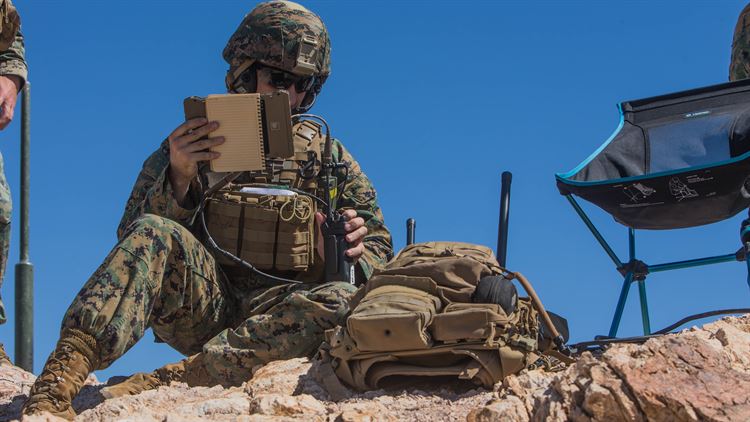
Marines from MAWTS-1 conducted and organized a digitally-aided close air support fire mission using Target Handoff System tablets at Chocolate Mountain Aerial Gunnery Range, Calif, on Sept. 22, 2017.
CAS is a vital asset to ground forces because it allows medical evacuation and removes hostile air targets and mechanized ground forces. Without CAS dozens of ground forces may not still be here today.
This is the first time these systems have been integrated and fielded for a Marine Corps exercise.
This exercise was conducted during Weapons and Tactics Instructors course 1-18. WTI is a course that brings service members from all across the world to participate in training that teaches pilots, air crew and ground forces to work together to benefit the Marine Air Ground Task Force.
Marines set up artillery at Firebase Burt to provide fire support for the range. Using a tablet known as the Target Handoff System V2, they can relay their position to artillery and aerial support using GPS location and indicate where their target is. The tablet connects to a PRC-117G radio to use voice communication in conjunction with GPS.

“We were sending VMF messages to (F/A-18D’s) using THS and on the same tablet we had a 117G hooked in with an ANW2 network,” said Gunnery Sgt. Andrew Rogers, a joint tactical air controller with Marine Aviation Weapons and Tactics Squadron 1. “So we were able to track position/location information of multiple friendly positions while they moved”
Rogers said this helps the ground units by sending direct and accurate information to fire support
According to Rogers, the hardest part of this mission was communicating with the helicopters because they didn’t have the GPS system equipped in the helicopters.
“Right now, their radios aren’t able receive the types of messages we send,” said Rogers.
He said they communicated the grid and fire pattern through normal voice communication.
Over the course of this exercise they used 155mm howitzer shells, 20mm autocannons on the helicopters and planes as well as 5 inch rockets and several 1000lb JDAM bombs.
“The purpose of today was threefold,” said Maj. Eben Buxton, a CH-53E Super Stallion pilot with MAWTS-1. “We were integrating two tablet/digital networking programs of record.”
The THS V2 communicates primarily through K-series messages and VHF and is and will be used by forward air controllers and field artillery. The other program of record is the MAGTF Common Handheld Early Capabilities Release (MCHECR), which has the goal of getting these tablets into the hands of infantry squad leaders and platoon commanders
“This is an event we call IPFLY,” said Buxton. “So the aircraft that we are supporting were primarily MAWTS-1 aircraft and the instructors come out to conduct proficiency flights.”
“So we work with them for our proficiency on the ground and their proficiency in the air. It’s a good opportunity to conduct a tactical exercise with these systems like we did today because we have experts in the air and experts on the ground.”
