

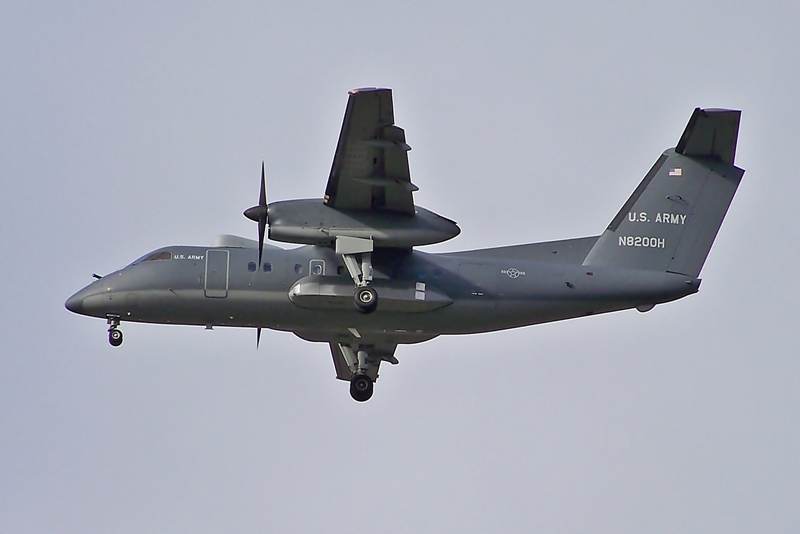
The next step in the saga that is the U.S. Army Airborne Reconnaissance Low program has unfolded. On November 5, the Army awarded Leidos a massive $661.84 million contract in support of Airborne Reconnaissance Low-Enhanced (ARL-E). The ARL-E project follows from the Army’s failed attempt to replace the ARL platform with the Aerial Common Sensor (ACS), which was canceled in 2006.
Under this contract, Leidos will provide the Army with ARL-E design, architecture engineering, configuration management, system integration, testing, and technical and logistics support. It is one of the first major contracts to be awarded under the ARL-E procurement, which the Army first began budgeting in its FY15 requests. The system, based on the Q400 (DHC-8) platform, will eventually replace the older DHC-7-based ARL-M. Eight or nine ARL-Es are eventually expected to be produced, with system deliveries stretching into the early 2020s. An optimistic forecast schedule will not see the first ARL-E delivery until 2018.
In related developments, in September, Northrop Grumman was selected by the Army to begin development of a new Synthetic Aperture Radar/Ground Moving Target Indicator (SAR/GMTI) system for the ARL-E, known as the Long-Range Radar (LRR). At the time, Steve McCoy, vice president of tactical sensor solutions at Northrop Grumman Electronic Systems, said, “Our low-risk, affordable solution combines mature active electronically scanned array [AESA] technology with operationally proven hardware and software to meet all-weather and long-range ISR requirements.”
Northrop Grumman’s LRR will combine aspects of the company’s Generation 2 Vehicle and Dismount and Exploitation Radar (VADER) back-end electronics and software with a new AESA. This approach ensures that Northrop Grumman can meet the rapid pace of ARL-E platform development as currently outlined by the Army. By using the core electronics of an in-use, field-tested system in combination with a new T/R array, Northrop Grumman’s testing period will be shortened considerably. VADER’s software and hardware will only need to be calibrated or scaled to function optimally with the new array’s characteristics.