

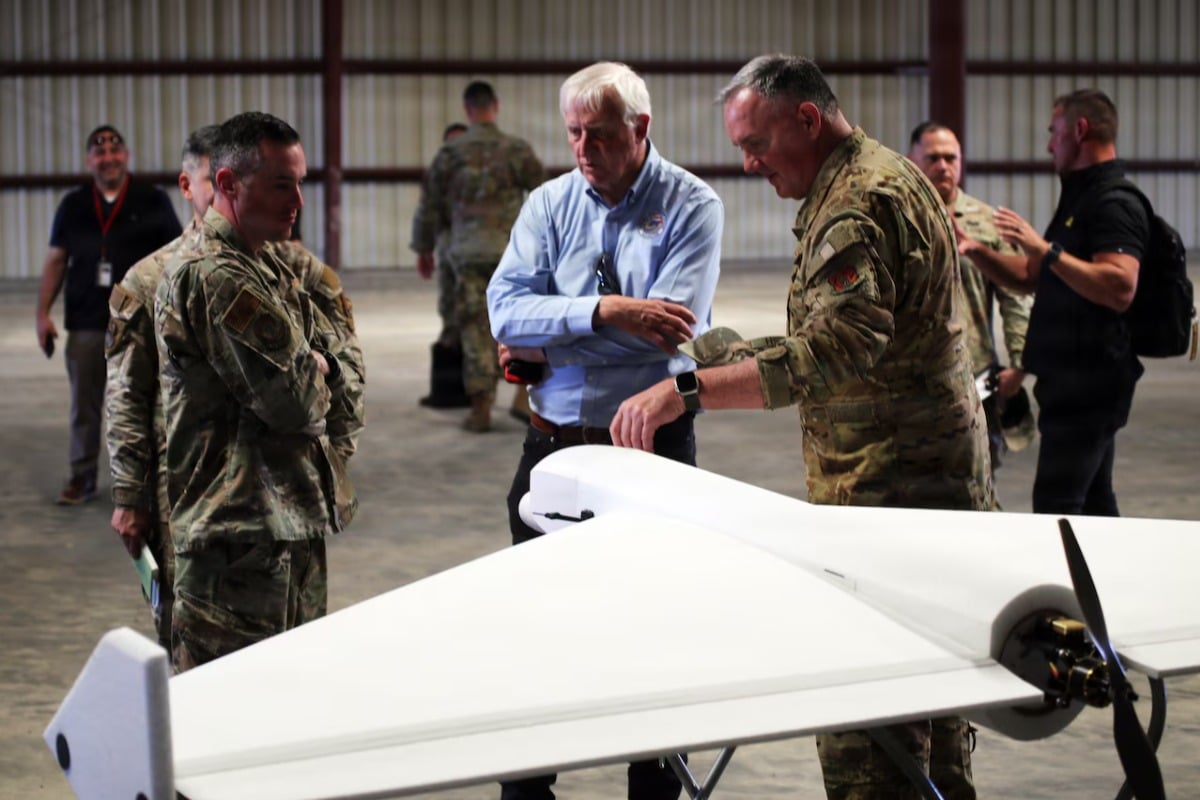
- The Washington National Guard held a counter-drone field demonstration at Yakima Training Center on June 2, 2026, involving federal, state, and local agencies preparing for FIFA World Cup 2026.
- Washington is the only FIFA host state to conduct a joint counter-drone rehearsal exercise, according to Maj. Gen. Gent Welsh, the state's adjutant general and homeland security advisor.
With millions of soccer fans heading to the Seattle area for the FIFA World Cup this summer, the Washington National Guard gathered federal agents, police officers, and military units at a desert training range in June to rehearse a threat that barely registered on public safety radar a year ago: drones.
Representatives from federal, state, and local law enforcement agencies convened at the Yakima Training Center in Washington on June 2 for a counter-drone field demonstration day that organizers say was the only event of its kind held anywhere in the United States in preparation for World Cup 2026. The demonstration included multiple active-duty and National Guard units, state defense forces, the Washington Emergency Management Division, and the Civil Air Patrol, with participants observing live showcases of drone detection systems, swarm operations, interception techniques, radio-frequency mitigation capabilities, and render-safe procedures for neutralizing unmanned aircraft on the ground.
Air Force Maj. Gen. Gent Welsh, the adjutant general and homeland security advisor for Washington state, made the national significance of the event explicit. “When you look at all the FIFA states, all the FIFA cities and all the different challenges that people are dealing with, Washington is the only state that actually brought people together to rehearse and discuss any of this stuff,” Welsh said. “This is the only one-of-its-kind event in the entire country that’s going on.” That assessment, if accurate, says something pointed about how unevenly the United States has approached drone security planning for one of the largest sporting events in history.
The FIFA World Cup 2026 is a genuinely massive security challenge. The tournament will be hosted across 16 cities in the United States, Canada, and Mexico, with Seattle’s Lumen Field serving as one of the American venues. Matches at major international sporting events routinely draw crowds of 60,000 to 80,000 people in stadiums surrounded by urban infrastructure, transportation networks, and large outdoor fan zones. The proliferation of consumer drones, which can now be purchased for a few hundred dollars and flown with minimal training, has transformed the threat calculus for mass-gathering security in ways that existing aviation security frameworks were not designed to address. Commercial drones have disrupted sporting events in Europe, been used to smuggle contraband into prisons worldwide, and in conflict zones from Ukraine to the Middle East have demonstrated repeatedly that small, inexpensive unmanned aircraft can carry lethal payloads with real effect.
Welsh offered a characteristically direct summary of how he views the risk. “Some people look at these drones and see a great tool to do agricultural spraying with; I look at these things, and I literally see an improvised explosive device with wings,” he said. That framing reflects a security posture that has been shifting rapidly across American law enforcement and military circles since drone incursions over sensitive sites, including military bases, nuclear facilities, and major infrastructure, became a recurring news story in the years following the pandemic.
The June demonstration represented the culmination of a yearlong effort that began with a counter-drone summit hosted by the Washington Military Department in late 2025, bringing together government, public safety, academia, and industry leaders to map the threat landscape and identify capability gaps. That summit led to the launch of a counter-drone fundamentals course through the Washington National Guard’s Western Regional Counterdrug Training Center, designed to provide military, law enforcement, and public safety professionals with foundational training in drone detection, identification, legal authorities, and response planning. The legal authorities dimension is particularly complex in the United States, where federal law tightly restricts who can legally take action against an unmanned aircraft, even one posing a clear threat, creating jurisdictional friction that exercises like the Yakima demonstration are designed to work through before an actual incident forces improvised decisions in real time.
FBI agent Phil Randolph, who participated in the demonstration, captured how quickly the operational landscape has changed. “A year ago, we were not in this space,” Randolph said. “A year ago, we wouldn’t have thought about drone detection around NFL stadiums. Now we’re leaning forward.” The Seattle Police Department has also sent officers to specialized counter-drone training in Huntsville, Alabama, a city that hosts substantial Army aviation and missile defense infrastructure and has become an informal hub for counter-drone expertise in the United States.
The Yakima Training Center itself is emerging as the physical anchor for Washington’s counter-drone ambitions. The installation covers approximately 132,374 hectares (327,000 acres) of largely unobstructed terrain in central Washington, providing a training environment where detection systems can be evaluated at realistic ranges, drone swarms can be flown without airspace conflicts, and interception techniques can be practiced without the restrictions that govern exercises near populated areas.
Army Col. Craig Broyles, the Washington National Guard’s counterdrug program director, articulated the long-term goal plainly: “We want to build an Army counter-UAS center of excellence right here at Yakima Training Center.” Army Col. Phillip Lamb, the National Guard’s senior Army advisor, reached for a cultural reference to make the point about the facility’s unrealized potential. “This really is the Kevin Costner moment from ‘Field of Dreams,'” Lamb said. “We have 327,000 acres of untouched, unobstructed training area right here at Yakima Training Center.”
Welsh was careful to frame the effort as extending well beyond the immediate World Cup deadline, pushing back against any assumption that the program would wind down after the tournament concludes.
“Don’t just look at this as, ‘Hey, we’ve got to get through FIFA, and then we’ll go back to work,'” Welsh said. “We’re going to be dealing with the threat for the rest of our lives.”