

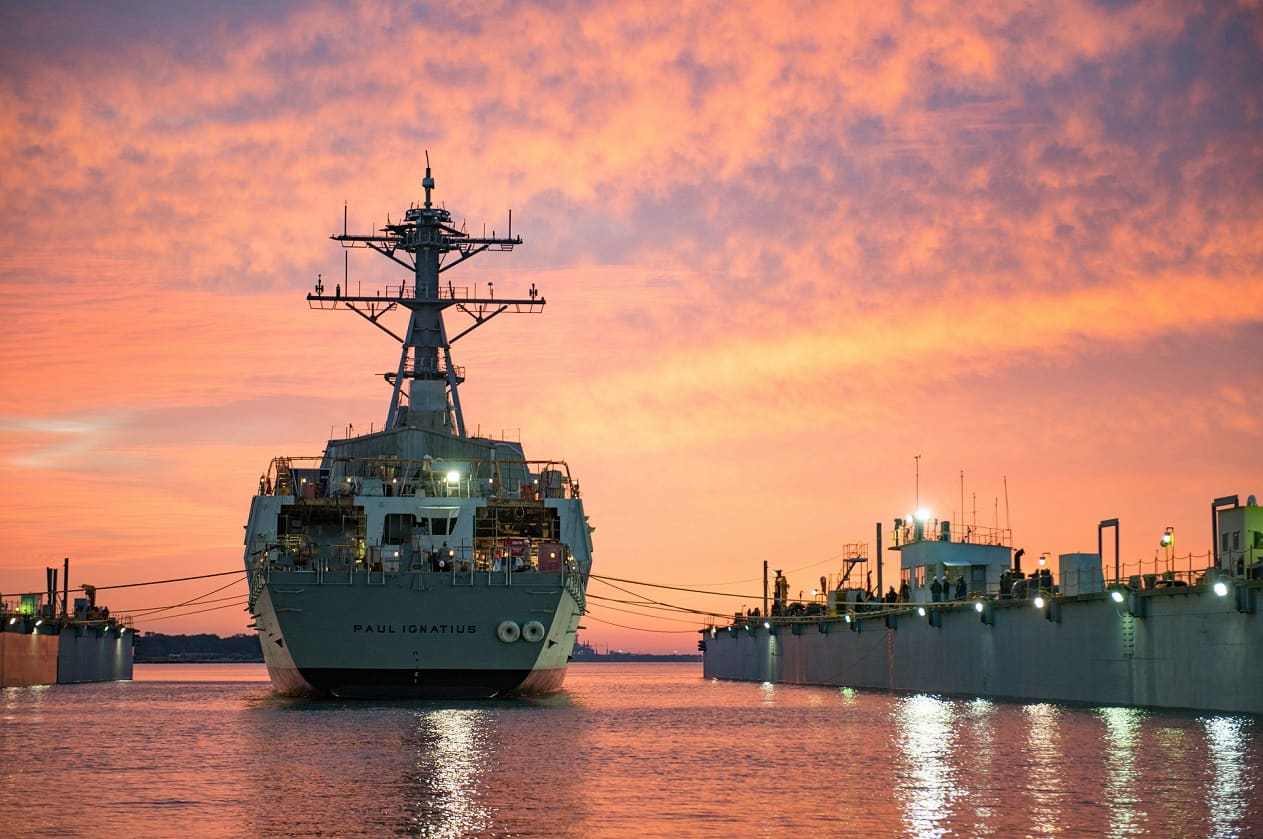
The U.S. Navy has announced the commissioning date for its newest Arleigh Burke-class guided missile destroyer, the future USS Paul Ignatius (DDG 117).
The Navy will commission its newest Arleigh Burke-class guided missile destroyer, the future USS Paul Ignatius (DDG 117), during a 10 a.m. EDT ceremony Saturday, July 27, at Port Everglades in Fort Lauderdale, Florida.
The ship is named in honor of Paul Robert Ignatius, who served in the U.S. Navy during World War II, and later during the Lyndon B. Johnson administration as assistant secretary of defense for installations and logistics from 1964 – 1967, and secretary of the Navy from 1967 – 1969.
Secretary of the Navy Richard V. Spencer, who is also performing the duties of deputy secretary of defense, will deliver the commissioning ceremony’s principal address. Ignatius’ wife, Nancy, who passed away earlier this year, is the ship’s sponsor. Dr. Elisa Ignatius, granddaughter to the late Mrs. Nancy Ignatius, will serve as the ship sponsor representative. Dr. Ignatius will honor naval tradition when she gives the first order to “man our ship and bring her to life!”
“The future USS Paul Ignatius stands as proof of what the teamwork of all our people – civilian, contractor and military – can accomplish together,” said Spencer. “From the start of the acquisition process, to the keel laying and christening, to today’s commissioning and the many missions she will fulfill going forward, this destroyer enhances our capabilities for air, undersea, surface, strike and ballistic missile defense.”
The future USS Paul Ignatius will be the 67th Arleigh Burke-class destroyer, and is one of 21 ships currently under contract for the DDG 51 program. Arleigh Burke-class destroyers conduct a variety of missions from peacetime presence and humanitarian assistance/disaster relief to sea control and power projection. Built in the Flight IIA configuration, the ship delivers rapid reaction time, high firepower, and improved electronic warfare capabilities.