

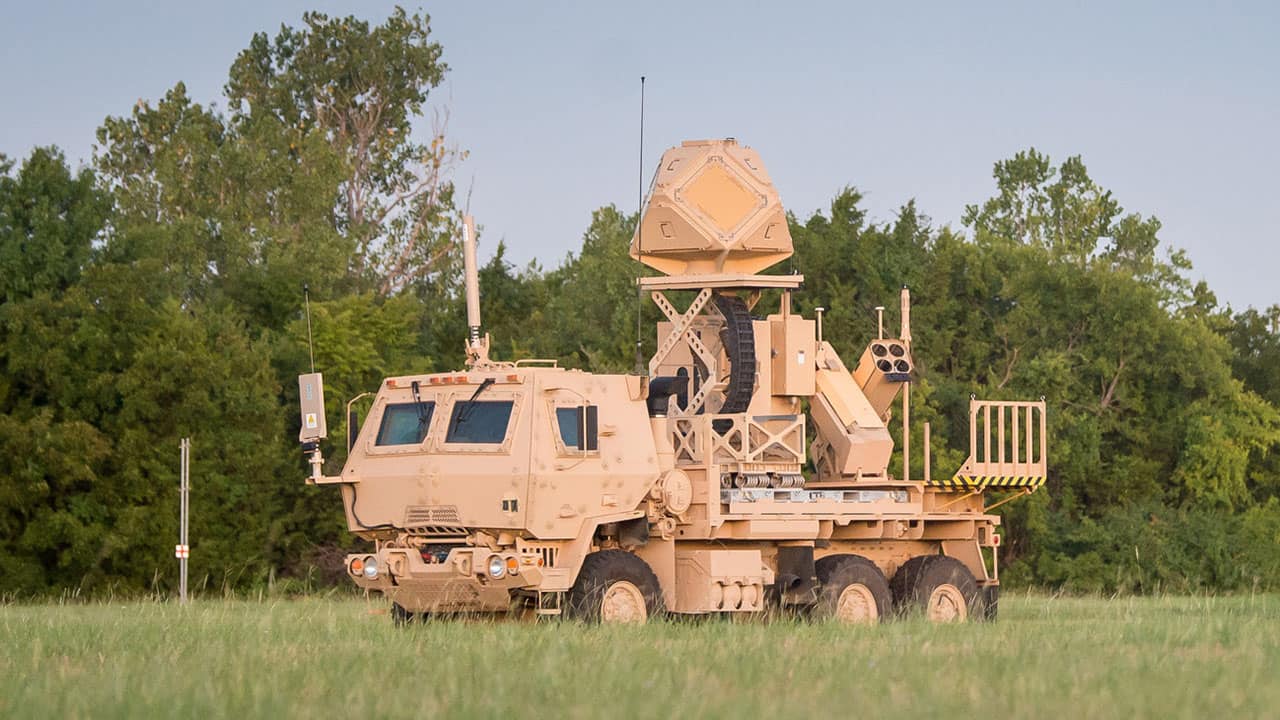
U.S. Army orders advanced counter-unmanned aerial vehicle radar

On 1 November, Raytheon has announced that the U.S. Army awarded the company a $191 million contract for Ku-band radio frequency radars. KuRFS, an advanced electronically scanned array system, fills an immediate U.S. Army operational need for a counter-unmanned aerial vehicle radar.

According to a statement, already deployed, KuRFS delivers precision fire control as well as “sense and warn” capability for multiple missions including detection of rocket, artillery, mortar and swarming UAS threats.

“Seeing threats – like swarming drones – as soon as possible on the battlefield is essential to protecting critical assets and saving soldiers’ lives,” said Andrew Hajek, senior director of tactical radars at Raytheon Integrated Defense Systems. “KuRFS makes this possible by delivering a unique combination 360-degree situational awareness, precision and mobility.”

- ADVERTISEMENT - CONTINUE READING BELOW -

KuRFS enables defense against multiple threat types through integration with the Land-Based Phalanx Weapon System, 50-caliber guns and 30 mm cannons. The radar also supports high-energy laser and the Coyote weapon system in both a ground mounted or vehicle mounted configuration.

Because of an urgent operational need, the Army is expected to use Coyote as a counter-UAS solution before the end of the year.

Raytheon’ KuRFS is able to quickly address the urgent needs of the Army through a model of rapid-turn development and deployment. This reduces time to fielding, while providing enhanced flexibility to adapt to a quickly-changing threat environment in the drone space.

Readers who wish to follow our weekly coverage can subscribe to the Weekly Defense Roundup.

If you wish to report a grammatical or factual error in this article, please let us know by using the online form.

Executive Editor
  • In this story
  • USA

Support The Defence Blog

Independent reporting takes resources. Join us on Patreon.

Become a patron

More Like This

U.S. Army Reserve tests Pyka’s autonomous cargo aircraft in live exercise

Pyka's autonomous cargo aircraft DropShip flew a 32 km (20-mile) resupply mission entirely without a human pilot from Gulfport to Diamondhead, Mississippi, then executed...

Mayman Aerospace CEO: autonomous drones must replace helicopters in contested battlespace

At 3 a.m. in a contested forward operating base, a patrol thirty kilometres out is taking casualties. They need blood, plasma, and ammunition, not...

U.S. Army buys more of its toughest Arctic combat vehicle

The U.S. Army awarded BAE Systems Land and Armaments a $35 million contract modification on June 30, 2026, for additional production of the general-purpose...

AEVEX wins $50M deal for GPS-resistant strike drones

AEVEX Corp. secured a $50 million contract from the United States Air Force on June 30, 2026, to continue expanding unmanned mission-support capabilities for...

U.S. Air Force spends $471M to fix tanker parts supply problem

The U.S. Air Force awarded a combined $471 million in contracts to 28 different companies on a single day, spreading the work of exchanging...