

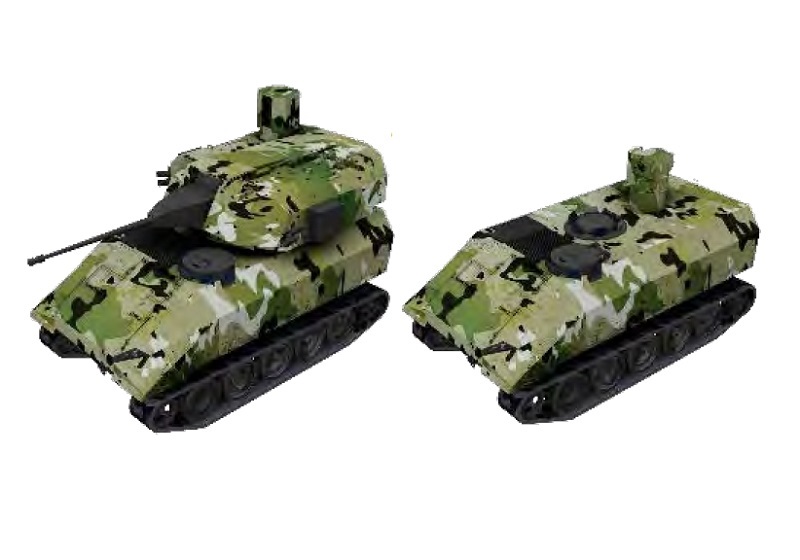
One of the U.S. Army’s top research centers has already achieved considerable success in developing a prototype of the Next-Generation Combat Vehicle (NGCV).
Some sources claim that the United States Army Tank Automotive Research, Development and Engineering Center (TARDEC) are now nearing production of demonstrator of new robotic vehicle build onto a surrogate platform.
Exact specifications of the new unmanned combat system were not disclosed, but Kevin Mills, TARDEC Ground Vehicle Robotics associate director revealed some details of a future robotic system during United States Army’s annual meeting and exposition, which was held April 10 in Washington, D.C.
According to his report, the Robotic Combat Vehicle (RCV) programme may consist of developing an effective weaponized robotic system by integrating robotic controls, target acquisition, and remote weapon system onto a surrogate platform for soldier evaluation; initial excursions with combat platforms.
As one of the surrogate platforms, it is proposed to choose the M113 tracked armored personnel carrier that can become a modular base with the ability to integrate multiple mission payloads.
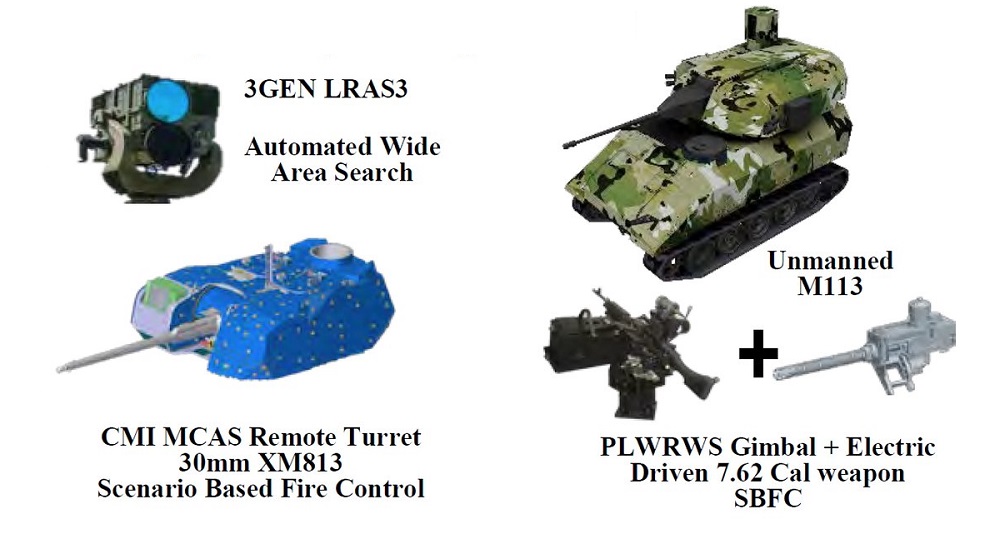
An unmanned version of M113 tracked vehicle also can be fitted with XM813 30mm remote weapon station (RWS) with ammunition handling system (AHS) and Scenario Based Fire Control System; x2 purpose-built electric drive 7.62 machine gun remote weapon station (RWS); Automatic turreted mortar (81mm).
To provide autonomy in the unmanned vehicle will have emerging sensors, modules artificial intelligence, and cyber technologies with integrated 360 situational awareness, autonomous search and target acquisition (AiTD/R) unburdening the Soldier operator, with a high degree of survivability and lethality in a highly contested environment Where the RCV is experiencing loss of control or is visually lost, the vehicle returns to a last point of communication.
Provision is also developments of automated, advanced multi-function sensors and algorithms enabling man-unmanned combined arms maneuver in complex environments. for next generation manned, optionally manned, and robotic platform applications.

According to the “Strategic Capabilities Roadmap”, the development of the first two prototypes of the new NGCV RCV based on a surrogate platform of M113 tracked armored personnel carrier will be complete in the fiscal year 2019.