

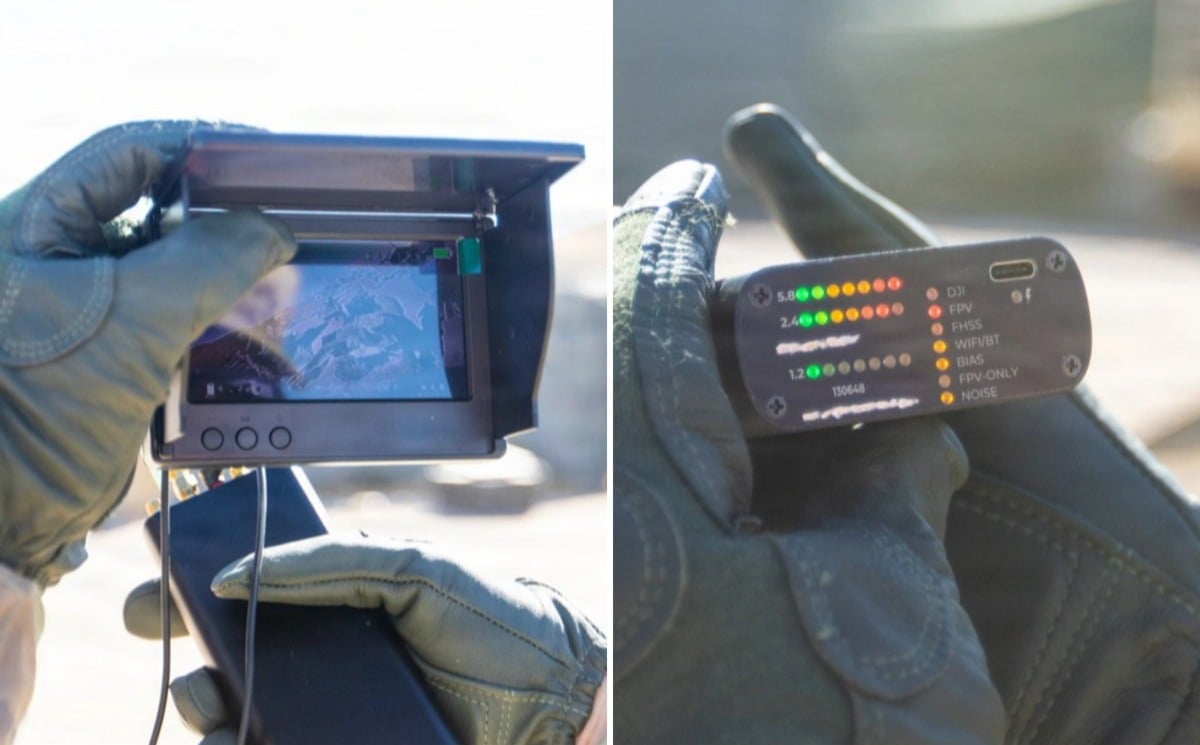
- A drone detector physically identical to the Ukrainian Obriy 1.3 by Kara Dag Technologies was observed at a U.S. Army exercise at Fort Irwin, California on October 28, 2025, labeled BlackSky Guardian-1.
- Kara Dag Technologies announced a strategic partnership with Anduril Industries in March 2026, approximately five months after the Fort Irwin observation.
A small handheld device spotted at a U.S. Army exercise at Fort Irwin, California, on October 28 last year and only now has drawn attention from defense observers for reasons that go beyond its compact size.
The device, observed in use during Army training and labeled with the designation BlackSky Guardian-1, appears to be physically identical to the Obriy 1.3 drone detector, a battlefield-proven Ukrainian product developed by Kara Dag Technologies, a Kyiv-area company that has been manufacturing and refining the system under live combat conditions in Ukraine since 2023. The identifying markings and branding visible on the device had been covered or obscured, but the physical form, antenna configuration, and layout visible in imagery from the exercise match the Obriy 1.3 in ways that multiple observers familiar with the Ukrainian system have found difficult to attribute to coincidence.
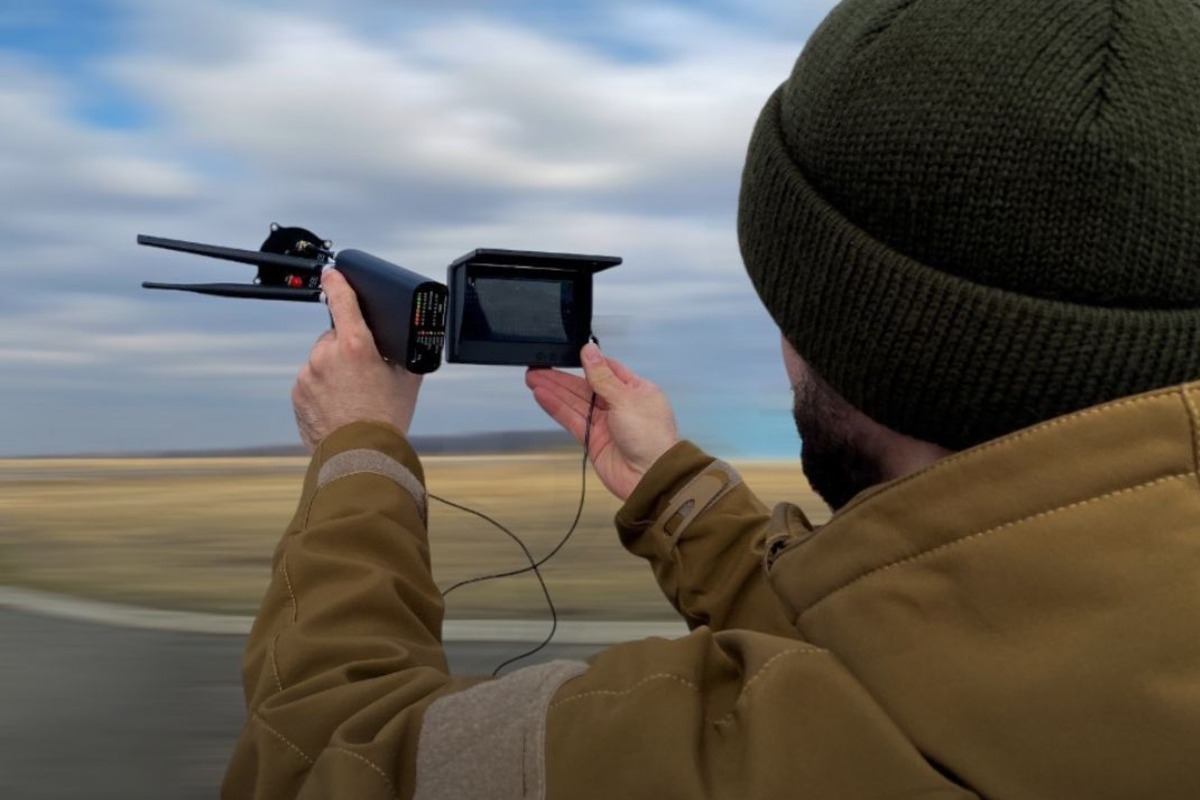
The Obriy 1.3 is not an obscure or experimental product. The system is a battlefield-tested personal drone detector that warns the wearer of hostile FPV drones out to a typical range of 2.5 km and potentially out to 5 km, giving the wearer plenty of time to react and take cover, and is currently in mass production. The system is widely used in the war in Ukraine to protect both forward-deployed Ukrainian military personnel as well as civilians living in proximity to the front line, according to Kara Dag COO Andrew Poberezhniuk, who described its operational use to European Security and Defence at Poland’s MSPO 2025 defense exhibition in September 2025. The device detects FPV, DJI, and Autel drones operating in the 1.2 GHz, 2.4 GHz, and 4.9 to 6.0 GHz frequency ranges, covers a stable detection range up to 2 km (1.2 miles) with direction-finding capability, runs for eight hours on battery, supports a mobile spectrum analyzer app, and can output video intercepts from analog FPV drone feeds directly to a connected monitor. Its operational mode suite includes WiFi filtering to reduce false alarms in cluttered signal environments, a blackout mode that disables LEDs while keeping all detection functions active, FPV-only scanning, adjustable sensitivity thresholds, and silent operation with vibration alerts.
That feature set maps precisely to the technical requirements that U.S. Army units training at Fort Irwin’s National Training Center in the Mojave Desert would need as they work through counter-drone detection procedures. The National Training Center, located approximately 60 km (37 miles) east of Barstow in the California high desert, is the Army’s premier large-scale combat training facility, where brigade-level units rotate through realistic combat exercises against a permanent opposing force. During the Army’s first armored Transforming in Contact 2.0 combat training center rotation at Fort Irwin in late October and early November 2025, the service was actively evaluating a range of new technologies including drone detection and counter-UAS systems. The appearance of a device visually consistent with the Obriy 1.3 during that same rotation, under a different commercial designation, suggests the Army or a contractor involved in the exercise was field-testing the Ukrainian system’s capabilities against the drone threat environments the NTC generates.
The broader context for this observation is the U.S. Army’s well-documented urgency around small drone detection at the individual soldier level. The Army’s C5ISR Center has been conducting market research specifically for acoustic and radio-frequency detection solutions for Group 1 and Group 2 unmanned aerial systems for dismounted troops, reflecting a recognized gap in the current inventory that Ukraine’s experience has made impossible to ignore. The war in Ukraine has demonstrated that soldiers operating without personal drone detection capability are extraordinarily vulnerable to FPV drone attacks, which can be launched from several kilometers away, fly at speeds that leave almost no reaction time, and cost their operators a fraction of what even a basic engagement costs the defender. The Obriy 1.3’s battlefield deployment record across one of the most drone-intensive conflict environments in history gives it a real-world validation dataset that no amount of controlled testing can replicate.
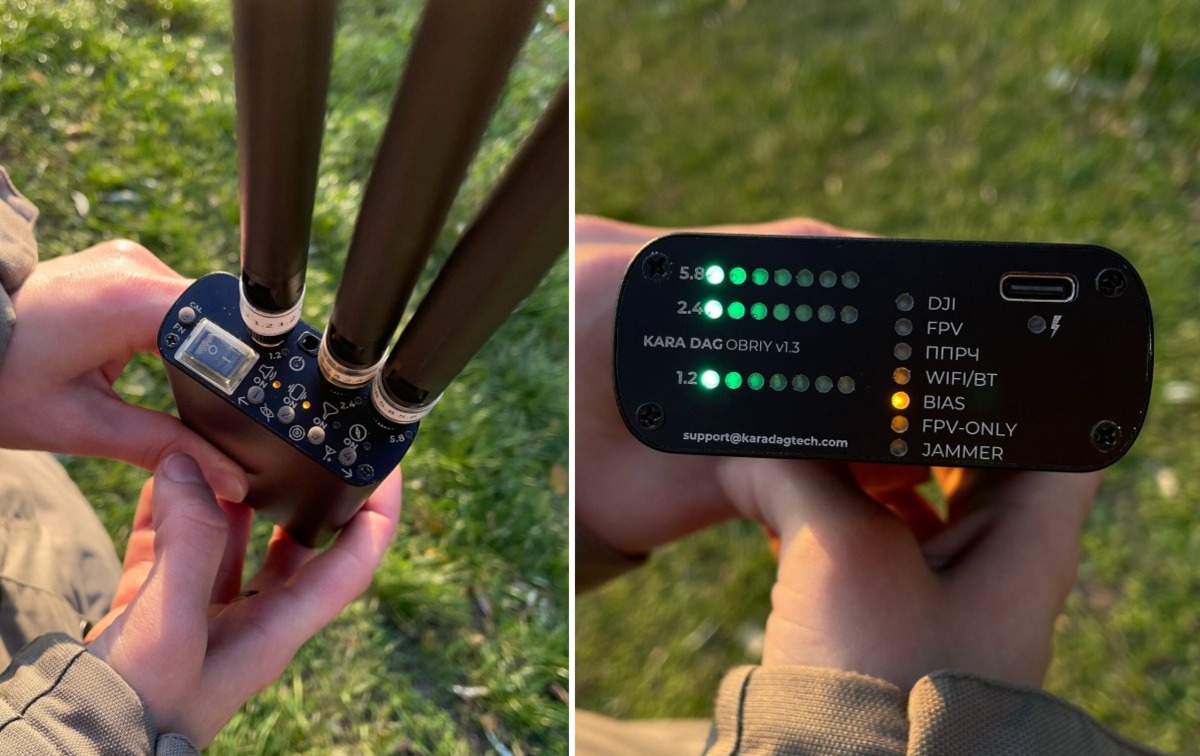
Kara Dag Technologies maintains what investors and analysts describe as the largest proprietary drone RF signature database of its kind, with each deployed device capturing new drone signals and contributing them to a globally accessible database, meaning that when a drone is identified and cataloged in one combat zone it becomes instantly available to any Kara Dag system worldwide. That continuous learning architecture, described by Green Flag Ventures as akin to a VirusTotal for drones, gives the Obriy system an adaptive advantage over static detection systems whose signature libraries require manual updating, and it is precisely the kind of capability that would make the system attractive to a military evaluating it for wider adoption.
The Anduril Industries partnership that Kara Dag Technologies announced in March 2026, approximately five months after the Fort Irwin observation, adds a significant layer of context to the Fort Irwin sighting. Kara Dag COO Andrew Poberezhniuk explained that over its years of operation, the company has built what it believes is one of the most extensive real-world RF datasets on UAV signals, and that the cooperation with Anduril is part of a larger transition in how defense systems are built, with RF and counter-UAS data described as no longer a byproduct but a foundational layer that directly impacts system performance, adaptability, and iteration speed. Anduril, the California-based defense technology company that has become one of the Pentagon’s most prominent software-defined defense suppliers through its Lattice AI command and control platform, brings institutional access to U.S. military procurement channels that a Ukrainian startup would have difficulty navigating independently. The combination of Kara Dag’s battlefield-proven hardware and signature database with Anduril’s procurement relationships and software integration capabilities creates exactly the kind of pathway through which a Ukrainian counter-drone technology could find its way into American military exercises under a rebranded designation.
Whether the BlackSky Guardian-1 designation represents a formal commercial rebranding of the Obriy 1.3 for the American market, a temporary test label applied by an integrator evaluating the system, or something else entirely remains unconfirmed from available public sources. No official U.S. Army statement has acknowledged the device’s presence at Fort Irwin or its relationship to the Kara Dag product, and the obscuring of original markings on the device observed at the exercise makes definitive identification from imagery alone a probabilistic rather than certain conclusion, however strong the visual similarities appear to observers familiar with both systems.
What the Fort Irwin observation confirms, at minimum, is that a device physically consistent with a Ukrainian battlefield drone detector reached a U.S. Army combat training exercise within roughly two years of that detector entering mass production in Ukraine, carrying a designation that does not appear in any publicly available U.S. defense procurement record. Ukraine’s counter-drone technology has been flowing westward as documentation, lessons learned, and transferred hardware since the beginning of the full-scale war, and the Obriy’s appearance at Fort Irwin, whatever name it was carrying that day, fits a pattern that has been accelerating since 2022.
The irony is not subtle. The Army that is urgently looking for exactly what the Obriy 1.3 provides may have already been field-testing it in the California desert.