

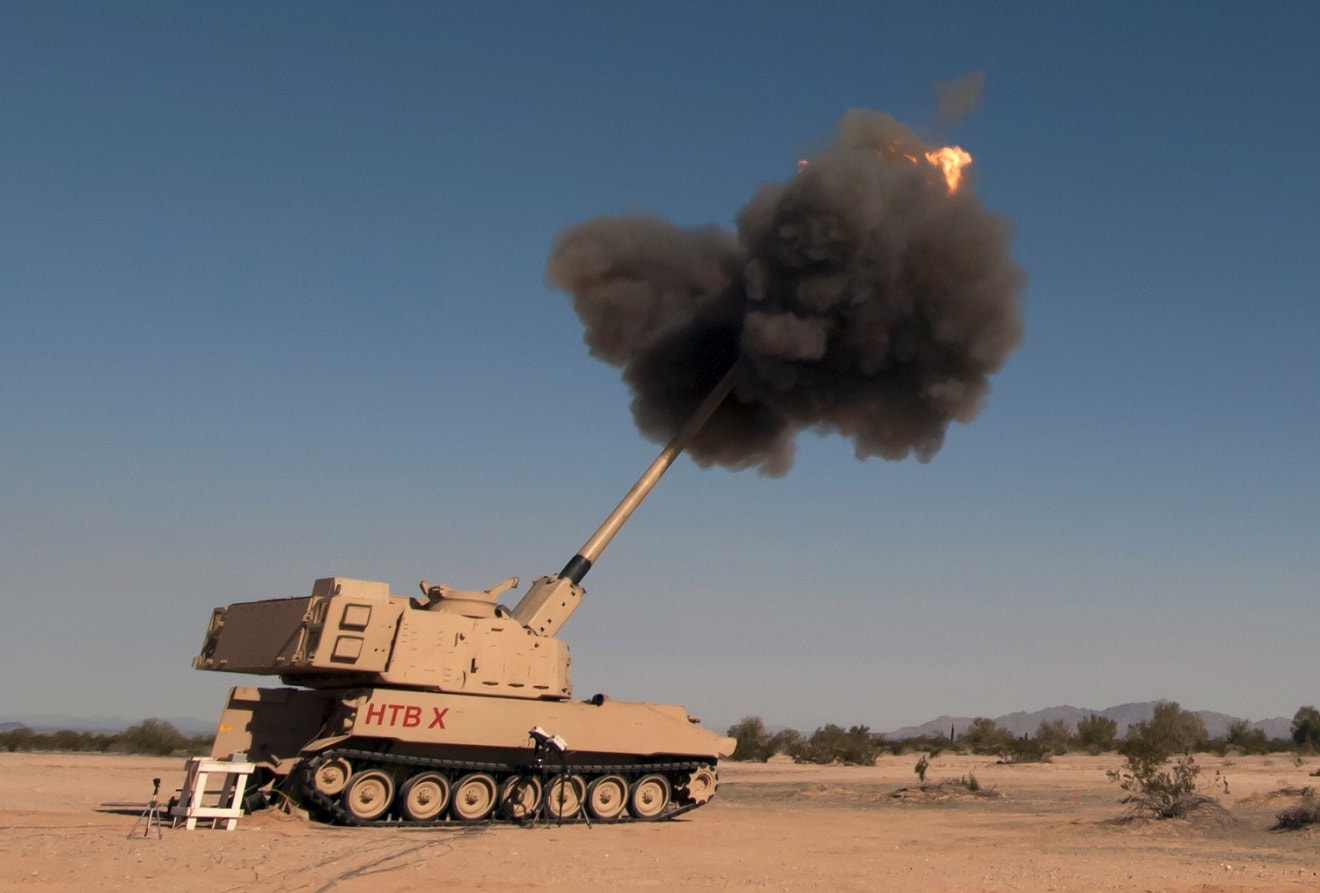
The U.S. Department of Defense and BAE Systems announced on Monday an agreement worth about for $45 million for the Extended Range Cannon Artillery, commonly known as ERCA, Increment 1 prototype.
The long-awaited U.S. Army contract provides work to increase the range and rate of fire on current and future M109A7 self-propelled howitzers.
A next-generation Extended Range Cannon Artillery (ERCA) prototype is being developed for fielding in 2025. The ERCA consists of two parts—a new rocket-boosted shell, the XM1113, and a longer howitzer barrel. The XM1113, which has a current range of 30 km when fired from the Paladin, was tested at Yuma Proving Ground in Arizona in April 2018.
In addition to longer range, ERCA will have a longer cannon rifle tube, a fully automated ammunition loading system and a communications system that will work in GPS-denied environments.
The development of ERCA is in collaboration with the Army’s Combat Capabilities Development Command (CCDC) Armaments Center.
This prototype phase will address capability gaps in the Army’s indirect fire systems and improve the rate and range of fire with the development of power distribution software and hardware integration solutions. ERCA will be integrated onto the M109A7 and will require the M109A7’s current 39-caliber turret to be replaced with a 58-caliber, 30-foot long gun barrel with the objective of creating firepower double the current range.
“ERCA is a significant technological step forward for the Army’s artillery portfolio,” said Scott Davis, vice president or programs, BAE Systems’ Combat Vehicles business. “We were selected based on our years of experience in the development of self-propelled howitzer systems. Long-range precision fire is a top priority for the Army, and we are pleased to be a partner in efforts to equip soldiers with the latest technology.”
The development program aims to provide the warfighter with extended range while maintaining the weight found in current systems to minimize performance impacts on the chassis. Under separate contracts, BAE Systems is also developing precision guidance kits with anti-jamming capabilities (PGK-AJ) that can operate in the challenging ERCA firing environment. PGK-AJ is compatible with existing and new long-range rounds for multiple firing platforms, including the M109 self-propelled howitzer.
BAE Systems is currently producing the M109A7 configuration for the Army in the low-rate initial production phase.
Development work on ERCA Self Propelled Howitzer will take place at the Army’s Picatinny Arsenal and BAE Systems’ facilities in York, Pennsylvania; Sterling Heights, Michigan and Minneapolis, Minnesota.