

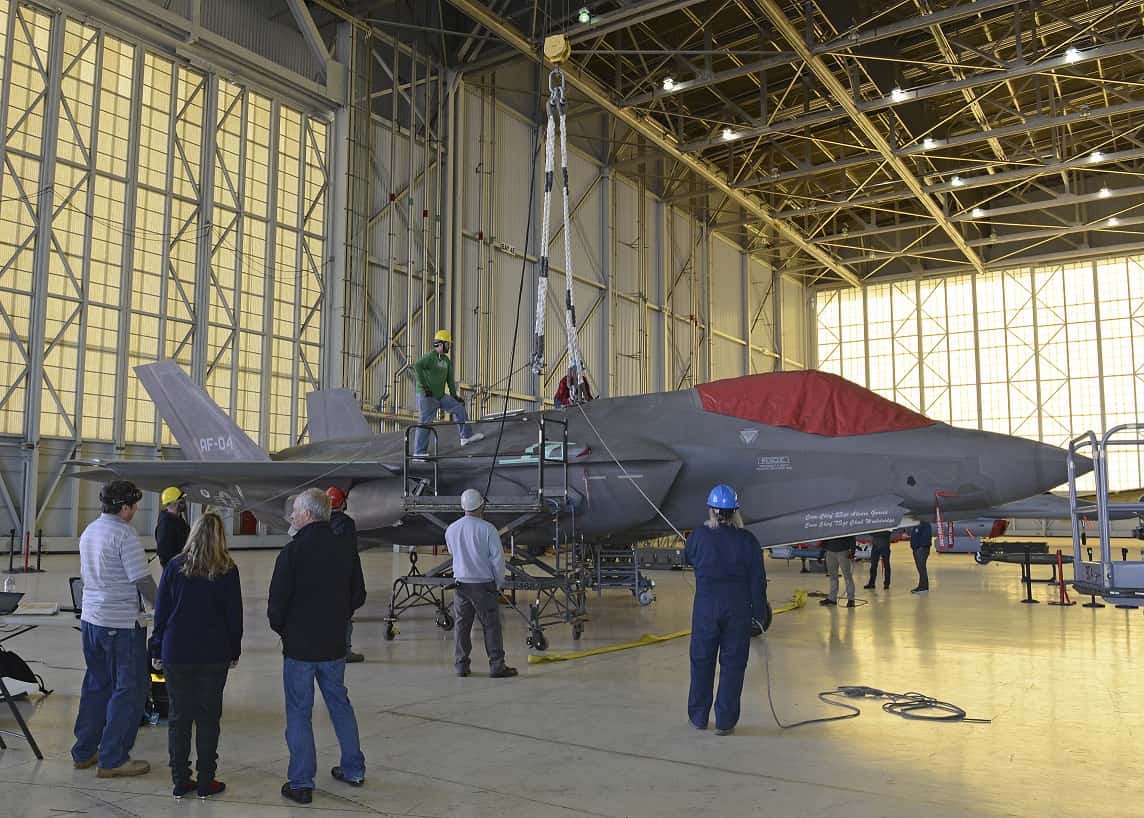
412th Test Wing Public Affairs has reported that team of testers from Edwards Air Force Base linked up with representatives from Lockheed Martin company to go over crash recovery procedures for the F-35 Lightning II aircraft.
According to a report, members from the 412th Maintenance Squadron performed the actual procedures on the aircraft for what is referred to as crash, damage, disabled aircraft recovery, or CDDAR. Different methods were verified such as using an aircraft sling attached to the F-35 to be lifted by a crane; “belly bands” that can be placed underneath the jet and attached to a crane; and inflatable airbags or lifting bags that can be used to raise a crashed or disabled F-35.
“Each item used can be tailored to the incident,” said Robert Miller, 412th Logistics Test Squadron, F-35 Joint-Service Technical Order Development, Edwards Verification Site lead. “For example, if the right main landing gear is collapsed, there are procedures using any of the above items to lift the disabled side.”
Miller said the 412th MXS is responsible for local crash recovery response and are the subject matter experts for all things CDDAR. At the verification event, there were also members from the 412th Aircraft Maintenance Squadron who assisted in aircraft access, cover removal and aircraft preparation before and after the event.
Miller added his and the 412th Logistics Test Squadron’s F-35 responsibility is performing oversite of all things verification for any maintenance procedures performed on the fifth-generation fighter. Lockheed Martin sent an engineer and the crash recovery procedures author from Fort Worth, Texas, to the event.
“These are procedures we have in the F-35 operating community we hope are never used,” Miller said. “However, in the event of an incident, the CDDAR team needs well vetted and tested procedures in order to recover the aircraft. If the aircraft is still on the runway, it may become time sensitive to remove the aircraft. There are so many variables and there is no ‘one-size-fits-all’ when it comes to recovering a disabled aircraft.”
Miller concluded the F-35 technical order verification team works with all variants of the F-35 and the CDDAR procedures will be adapted to a great extent for the use on ships for the Marine and Navy versions now being developed.