

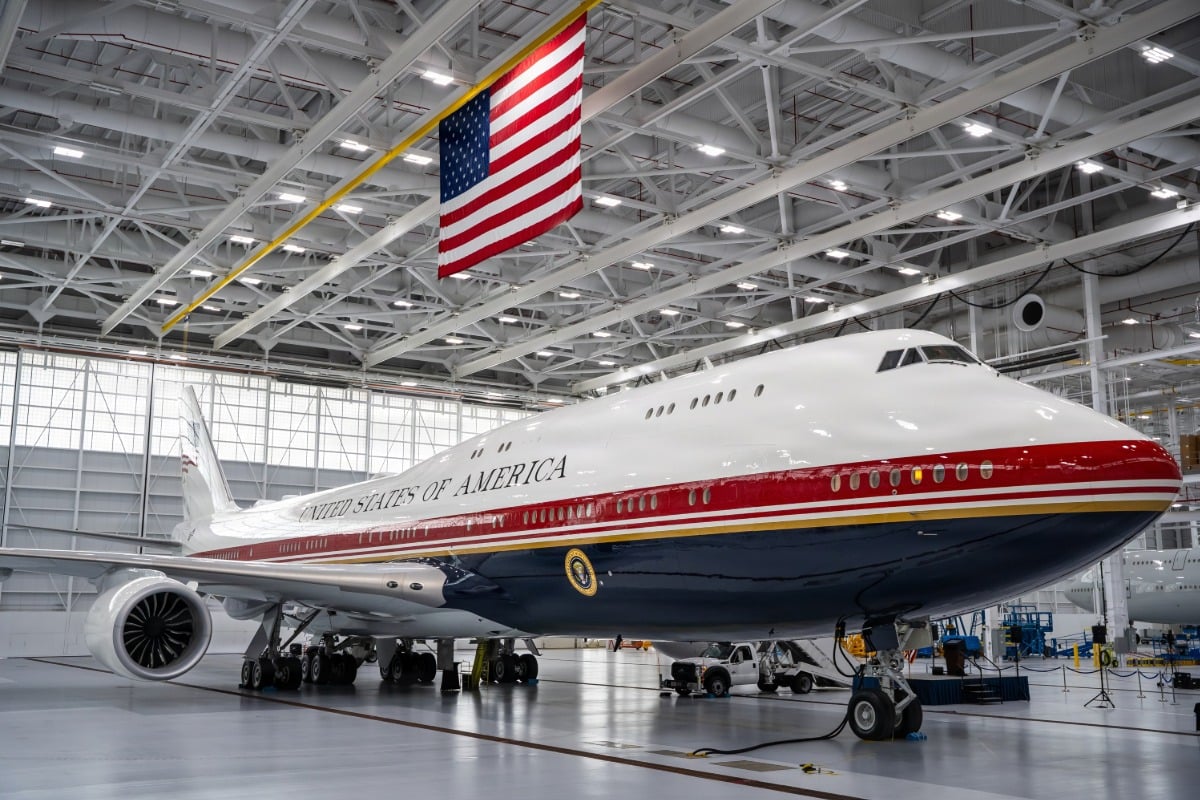
- The U.S. Air Force's VC-25B Bridge aircraft has arrived at the Presidential Airlift Group and begun commissioning flights to validate its presidential mission capability.
- The Boeing 747-8-based aircraft was acquired as a previously owned commercial jet, modified with secure communications, and painted in new red, white, and blue livery.
The United States now has a new Air Force One, and it arrived faster than almost anyone in Washington thought possible when the program began, filling a critical gap in presidential security that the aging original fleet could no longer reliably cover on its own.
The Air Force’s VC-25B Bridge aircraft has officially arrived at the Presidential Airlift Group, the specialized unit at Joint Base Andrews in Maryland responsible for flying the President of the United States, and has begun its commissioning flights, the final series of validation missions that must be completed before the aircraft can carry the commander in chief. The plane arrived wearing the new red, white, and blue livery that replaces the iconic powder-blue color scheme that has defined Air Force One’s appearance since the Kennedy administration, and carries the full suite of secure communications and executive modifications required for presidential transport.
The VC-25B Bridge is a Boeing 747-8, the latest and largest variant of the 747 widebody jet family, which has served as the backbone of long-haul commercial aviation for more than five decades. The 747-8 stretches approximately 76 meters (250 feet) in length, making it one of the longest passenger aircraft ever built, and carries a range of roughly 14,800 kilometers (9,200 miles) without refueling, enough to reach virtually any point on Earth from Washington in a single flight. That range matters enormously for a presidential aircraft, since the ability to fly nonstop to any crisis point without stopping to refuel in a foreign country is both a security and a diplomatic imperative. The VC-25B Bridge was not purpose-built for the presidential mission from the factory floor. It was acquired as a previously owned commercial aircraft and modified under a disciplined government engineering program, an approach that allowed the Air Force to move considerably faster than the long-delayed primary VC-25B program, the brand-new Air Force One replacement that Boeing has been struggling to deliver for years, would permit.
The reason a Bridge aircraft exists at all reflects a quiet but serious problem that has been building inside the presidential airlift mission for years. The current Air Force One fleet consists of two VC-25A aircraft, military modifications of the original Boeing 747-200 that entered presidential service in 1990, making them aircraft that are now more than three decades old and requiring increasingly demanding and time-consuming heavy maintenance cycles to keep airworthy. When one VC-25A goes into heavy maintenance, the remaining aircraft carries the full presidential airlift burden alone, a situation that limits scheduling flexibility and creates operational risk if that aircraft develops a problem of its own. The Bridge aircraft directly addresses that vulnerability by adding a third executive transport to the rotation, relieving pressure on the VC-25A fleet until Boeing completes the purpose-built VC-25B replacement, which is intended to serve the presidential mission for the next four decades.
Secretary of the Air Force Troy Meink addressed the program’s achievement in direct terms.
“The safety and security of the commander in chief is our highest priority. From the beginning, we meticulously evaluated every requirement to accelerate delivery while maintaining the high standards expected of the presidential mission. This effort proves that the U.S. Air Force can move fast without sacrificing quality, security, or reliability.”
The training pipeline that supported the Bridge program’s delivery began in October 2025, when the Air Force leased a Boeing 747-8F freighter from Atlas Air, the American cargo carrier, to begin training the pilots and maintainers who would operate the new aircraft before it was ready to fly. The Air Force subsequently purchased a Lufthansa Boeing 747-8i, a commercial passenger variant, as a full-time dedicated training asset for the entire crew complement, allowing training to continue at scale without taking the Bridge aircraft itself off its modification schedule. A full three-dimensional mockup of the Bridge aircraft’s interior was delivered in January 2026, giving White House staff and the Presidential Airlift Group the ability to begin familiarization training months before the first commissioning flight, an investment in crew readiness that the Air Force describes as integral to the accelerated timeline.
The interior of the Bridge aircraft was modified with deliberate restraint, prioritizing mission capability over aesthetic transformation. The Air Force statement notes that much of the previous head of state interior layout was left minimally changed, with the modification team concentrating resources on security systems, communications infrastructure, and airworthiness rather than redesigning passenger spaces that are rarely used during typical presidential missions. That trade-off reflects a broader philosophy that ran through the entire Bridge program: move fast by spending effort only where it directly serves the mission, and make no compromises on the things that matter most.
Air Force Chief of Staff General Ken Wilsbach characterized the delivery in terms that acknowledged the skepticism the program had faced from the start.
“Many thought it could not be done, but the United States Air Force was able to execute and provide a secure, reliable airborne command post on an accelerated timeline.”
Commissioning flights, the series of validation missions now underway, serve as the final examination for the modified aircraft, allowing the White House enterprise, the interagency community of officials responsible for presidential security and logistics, to validate that the aircraft can perform every mission it will be asked to execute before it carries the President for the first time. Once those flights are complete and the aircraft formally commissioned, it joins the VC-25A and C-32 fleets in the active presidential airlift rotation, giving the United States three executive transport options for the first time in the current operational era.
The original Air Force One color scheme, powder blue over white with the words “United States of America” along the fuselage, became one of the most recognized liveries in aviation history after President Kennedy’s administration selected it in 1962 on the advice of industrial designer Raymond Loewy. The new red, white, and blue scheme that now graces the VC-25B Bridge marks the first significant change to that visual identity in more than sixty years, a detail that has drawn as much public attention as any of the aircraft’s operational capabilities.