


Russia has introduced a new tactic in its drone campaign against Ukraine, using modified Shahed kamikaze drones equipped with cameras to attack a moving train.
According to footage released by Russia’s Ministry of Defense, several Shahed drones were launched at a train in motion. The first struck the locomotive, immobilizing the entire convoy, after which additional drones attacked the stationary cars. The ministry claimed the target was a “military train carrying armored vehicles and fuel.” However, Ukrainian officials said the train was transporting sand, timber, and grain — all civilian cargo.
The incident marks a departure from Russia’s typical Shahed drone usage, which has so far focused largely on static targets such as cities, power plants, and industrial sites. The addition of onboard cameras and live-control capability now allows these Iranian-designed drones, widely used by Moscow, to engage moving targets — including trains and truck convoys.
The shift poses a growing challenge for Ukraine, whose logistics networks, railways, and supply routes remain essential for sustaining the war effort and civilian life. While Russian missile strikes have targeted transport nodes before, this is the first documented attempt to destroy a moving target using Shahed drones, suggesting a new emphasis on disrupting dynamic logistical operations deep inside Ukrainian territory.
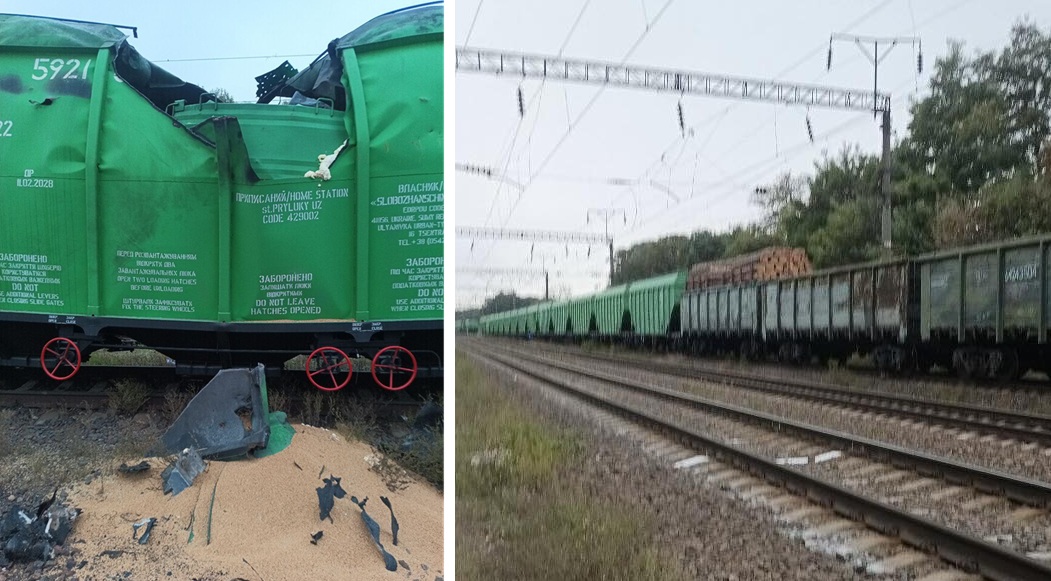
Ukrainian military officials also reported that Shahed drones approached dangerously close to helicopters responding to the incident, underscoring the increased risks to air defense and interception missions when drones are used against moving targets.
Serhiy Beskrestnov, a Ukrainian electronic warfare specialist known by his callsign “Serhiy Flesh,” said the attack demonstrates a limited but evolving capability. “Using Shahed with online control against moving targets is very limited,” he explained. “Launching a Shahed is not the same as launching a Lancet, and controlling a Shahed is not as dynamic.”
Beskrestnov noted that the drones’ operational range and targeting capabilities still impose constraints on their use.
“It is expected that high-risk targets will include railways, group transport convoys, and large equipment. A single pickup truck is not a target for a Shahed with a 50-kilogram warhead,” he said. According to him, the drones rely on a “Chinese camera and a Chinese radio modem,” with a practical operational range of up to 200 kilometers.
The use of Shahed drones in this way suggests Russia is seeking new methods to degrade Ukraine’s logistics, targeting not just stationary infrastructure but also the movement of goods and equipment. This evolution is part of a broader pattern in Moscow’s adaptation of Iranian drone technology, often modifying or upgrading the systems for specific battlefield roles.