

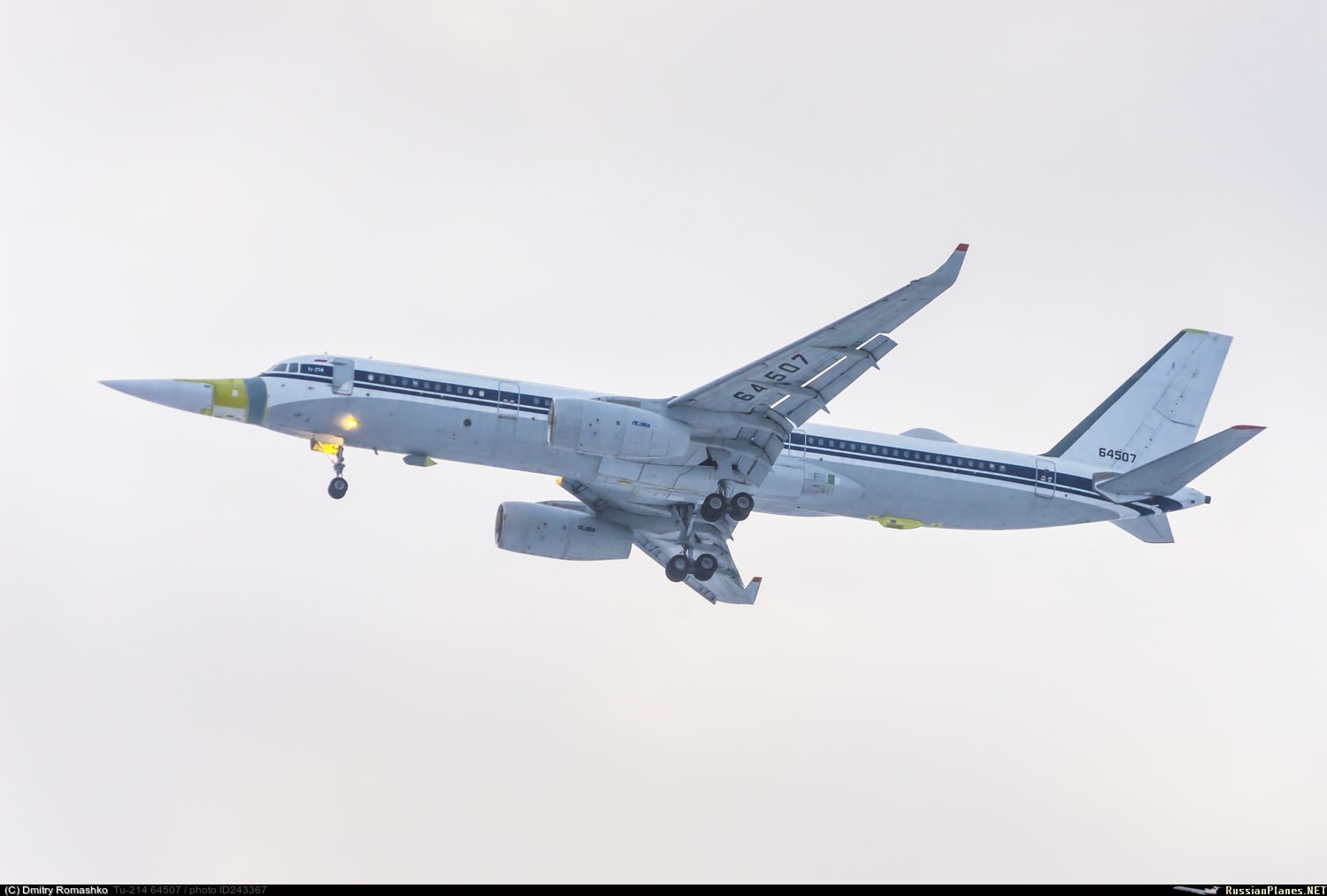
A highly modified commercial aircraft, called the
Russian news media have reported that heavily modified Tu-214LMK (registration number 64507) aircraft completed its first test flight at
the Gorbunov Kazan Aviation Plant on 29 December.
According to the official PJSC Tupolev comment, “the purpose of the upgrade of the Tu-214LMK testbed is to create a flying laboratory for testing in-flight onboard equipment complexes of the Tu-160 and in the future – the PAK DA bombers”.
The Tu-214LMK flying testbed has been retrofitted in order to perform flight-test the highly advanced integrated avionics developed for the upgraded and next-generation strategic bombers.
Tu-214LMK’s modifications include installation of a Tu-160M2 radar (PAK DA radar in future) housed in the forward fuselage section of the nose of the plane.
The Tu-214LMK testbed will reduce risk as well as future flight test hours by enabling extensive in-flight testing, evaluation
The upgraded Tupolev Tu-160M2 strategic bombers will start arriving for Russia’s long-range aviation soon.
Russia’s Ministry of Defence (MoD) has ordered the first 10 Tu-160M2 strategic bombers from United Aircraft Corporation (UAC), in a deal worth RUB160 billion (USD2.7 billion dollars), the ministry said on 25 January 2018.
The signing ceremony took place during a visit by President Vladimir Putin to the Gorbunov Kazan Aviation Plant, also attended by the head of UAC, Yuri Slyusar, and Deputy Defence Minister Yuri Borisov.
In the process of its upgrade, the bomber will get a principally new avionics suite and the onboard integrated data control system. The Tu-160M2 will also feature satellite navigation systems, the short-range radio-technical navigation systems, the air signal systems, the defensive aids suite, the electronic warfare complex and other promising systems.