


- Japan’s Maritime Self-Defense Force tracked three Chinese Navy vessels transiting the Osumi Strait toward the Pacific on November 11.
- The ships included a Renhai-class destroyer, a Jiangkai II-class frigate, and a Fuchi-class supply ship.
Japan’s Joint Staff confirmed that three Chinese Navy vessels transited eastward through the Osumi Strait into the Pacific Ocean on November 11, continuing Beijing’s regular naval movements near Japanese waters.
According to an official release from the Joint Staff of Japan’s Ministry of Defense, the Maritime Self-Defense Force (MSDF) identified a Renhai-class missile destroyer (hull number 103) approximately 120 kilometers west of Kuchinoerabu Island, Kagoshima Prefecture, at around 5 a.m. The warship was later observed sailing eastward through the Osumi Strait toward the Pacific.
Later that afternoon, around 1 p.m., the MSDF also confirmed two additional People’s Liberation Army Navy (PLAN) vessels — a Jiangkai II-class frigate (hull number 547) and a Fuchi-class supply ship (hull number 902) — navigating the same route.
The Japanese Ministry of Defense said the MSDF destroyer Yugiri, the missile boat Ootaka, and the minesweeper Awaji conducted continuous surveillance and intelligence collection during the passage.
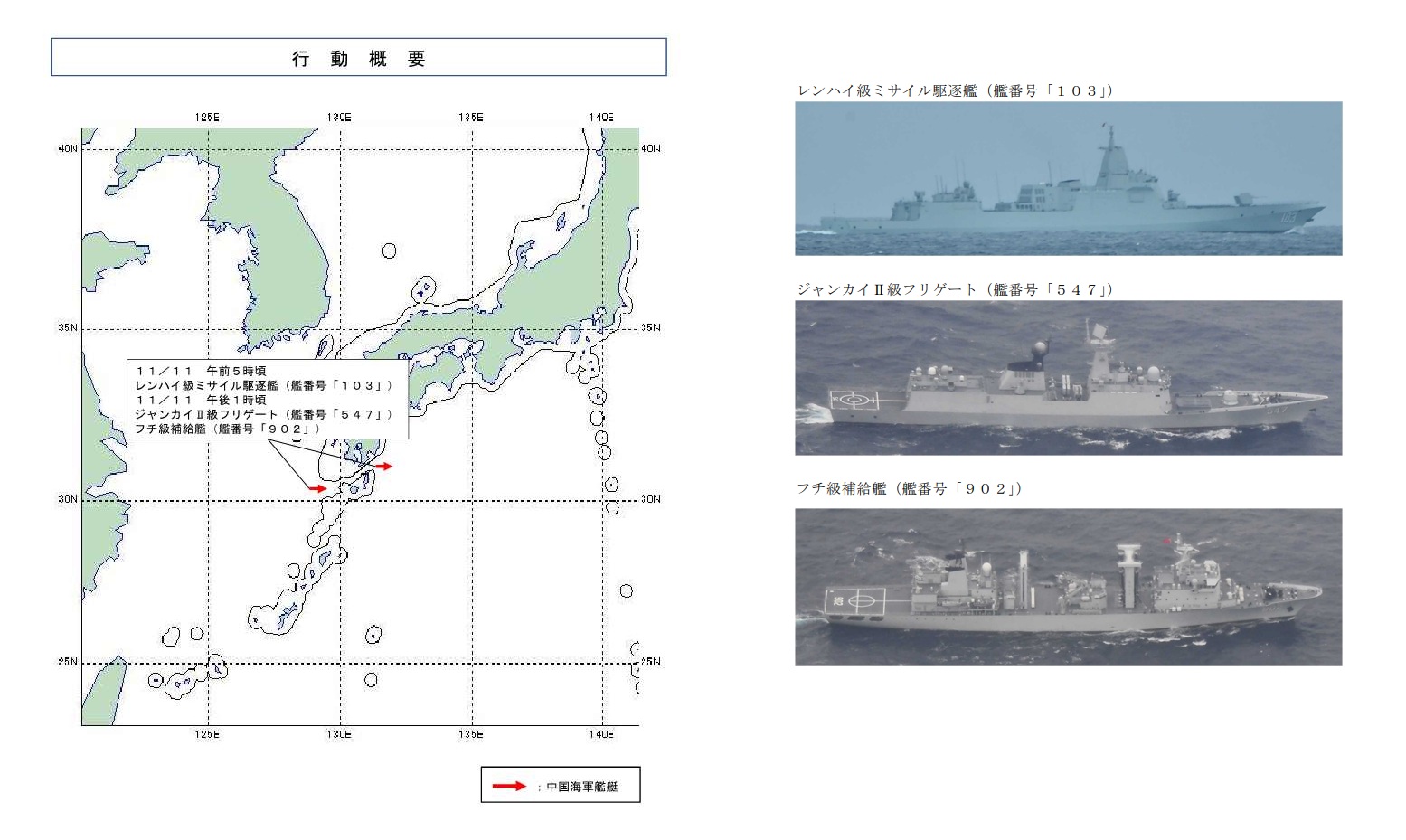
The Osumi Strait, located between Kyushu and the Ryukyu Islands, is a key international waterway frequently used by the Chinese Navy for transit between the East China Sea and the Pacific. These passages, while conducted in international waters, are closely monitored by Japan amid growing regional tensions and increased Chinese maritime activity near its southwestern islands.
The Joint Staff reiterated that Japan’s Self-Defense Forces would “continue to conduct warning and surveillance operations” to ensure situational awareness around its territorial waters.
The confirmed transit underscores the steady pace of Chinese naval operations near Japan and highlights the Japan Self-Defense Forces’ ongoing vigilance.