

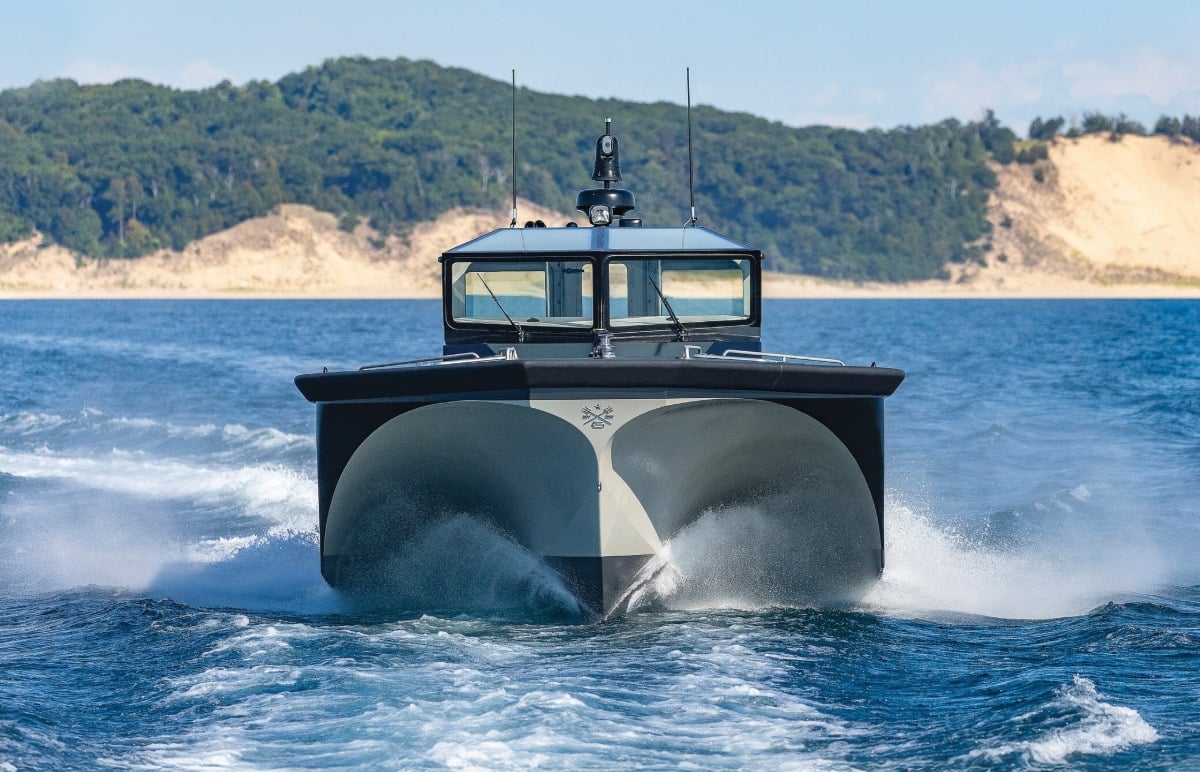
- Ghostworks unveiled MRLN, a remote-pilot autonomy system, on July 14, 2026 at the Pennsylvania Defense and Innovation Summit in Carlisle.
- MRLN was developed with General Atomics Aeronautical Systems and Mercury Marine and equips Ghostworks' Minerva-class vessel for five mission types.
Ghostworks, a boutique shipyard based in Holland, Michigan, introduced MRLN, the Multirole Remote Logistics Node, on July 14 at the Pennsylvania Defense and Innovation Summit, an event hosted by U.S. Senator Dave McCormick at the Army War College in Carlisle.
MRLN is not a boat itself but a remote-piloting and autonomy system that installs onto Ghostworks’ existing hull designs, letting operators reconfigure a single vessel for different missions rather than needing separate specialized boats for each job, all while a human operator retains the ability to take direct control at any moment rather than letting the system run fully autonomous.
The system emerged from a three-way partnership, with each company contributing a piece the others couldn’t easily build alone. Ghostworks supplied the physical platform, a 12.2-meter (40-foot) carbon fiber vessel called the Minerva, built on what the company calls its M-Hull design, a hull shape derived from technology Ghostworks acquired from M Ship Co., the firm behind the U.S. Navy’s M80 Stiletto stealth prototype that has quietly operated for two decades. General Atomics Aeronautical Systems, a company far better known for building the MQ-9 Reaper and other unmanned aircraft that have flown over battlefields for years, adapted its aerial autonomy and sensor software for use on the water, a crossover the company frames as a natural extension of skills it already had rather than starting from scratch. Mercury Marine, a name most boaters recognize from outboard engines rather than defense contracts, brought drive-by-wire propulsion technology and its Command Gateway product, the pieces that let MRLN actually steer, throttle, and hold station on a vessel operating remotely for extended periods.
“For decades, naval planners have had to accept that speed, range, and payload pull against each other. Optimize for one and you sacrifice the others,” said Brooke Kerschbaumer, CEO, Ghostworks.
“Our vessels were architected to break that constraint. MRLN gives operators human-in-the-loop command and control over that tradeoff space, mission to mission, without changing platforms,” Kerschbaumer said.
That tradeoff Kerschbaumer describes, sometimes called the iron triangle in naval design circles, has shaped ship procurement for generations because building a vessel optimized for one trait, whether that’s raw speed, long range, or heavy payload capacity, has traditionally meant accepting weaker performance in the other two. Ghostworks says its Minerva-class vessel sidesteps that compromise, carrying up to 7,938 kilograms (17,500 pounds) of payload at a cruise speed of 30 knots (56 km/h) while remaining operable in sea state 4, a wave height classification describing moderate seas with waves up to about 2.5 meters (8 feet), conditions rough enough that many smaller vessels would need to reduce speed or return to port. Independent coverage of an earlier Minerva variant last year described the vessel reaching sea trials just six months after design work began, an unusually fast development pace for a naval platform, though specifications on that earlier version differed somewhat from the figures in this announcement, suggesting the design has continued evolving since its initial unveiling.
“Leveraging our development of world-leading autonomy for air-vehicles into the maritime domain is a natural progression,” said Jeff Hettick, vice president of GA-ASI’s Agile Mission Systems.
“This partnership really highlights how bringing together the best in the defense industry can yield exciting new capabilities for our warfighters in a timescale that is relevant,” Hettick said.
Ghostworks says MRLN-equipped vessels can handle five distinct mission types: intelligence, surveillance, and reconnaissance work in contested coastal waters; autonomous logistics resupply to forward-deployed forces; mine countermeasures that keep crews away from explosive hazards; communications relay to extend network coverage across dispersed units; and direct combat support in shallow, contested littoral zones. That mission flexibility matters strategically because the U.S. Navy and allied forces have spent the past several years racing to field unmanned surface vessels capable of operating in contested waters without risking sailors, a push accelerated significantly by Ukraine’s success using inexpensive drone boats to damage and sink far more expensive Russian warships in the Black Sea.
“Our role was to prove that MRLN could meet the control and reliability demands of sustained surface operations,” said Carl Greiner, Director of Government and Advanced Maritime Systems, Mercury Marine.
“This integration expands what’s achievable in a remote-piloted maritime system,” Greiner said.
Ghostworks enters a field that has grown crowded quickly, with companies including Saronic and MARTAC already holding production contracts worth hundreds of millions of dollars for their own unmanned surface vessels, some of which have already seen combat use in recent conflicts. What sets Ghostworks’ pitch apart is less the autonomy itself and more the modular, mission-agnostic framing, betting that a single hull capable of switching between logistics runs, surveillance patrols, and combat support roles will prove more attractive to budget-constrained naval planners than a fleet of single-purpose vessels each built for one job.