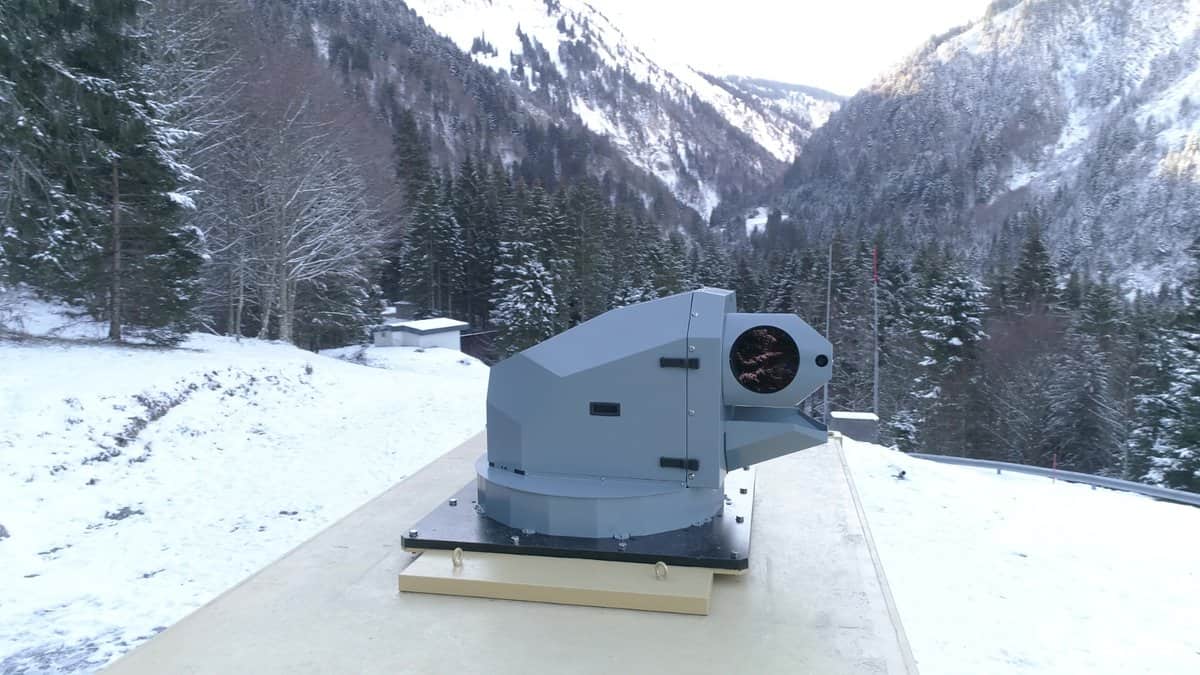
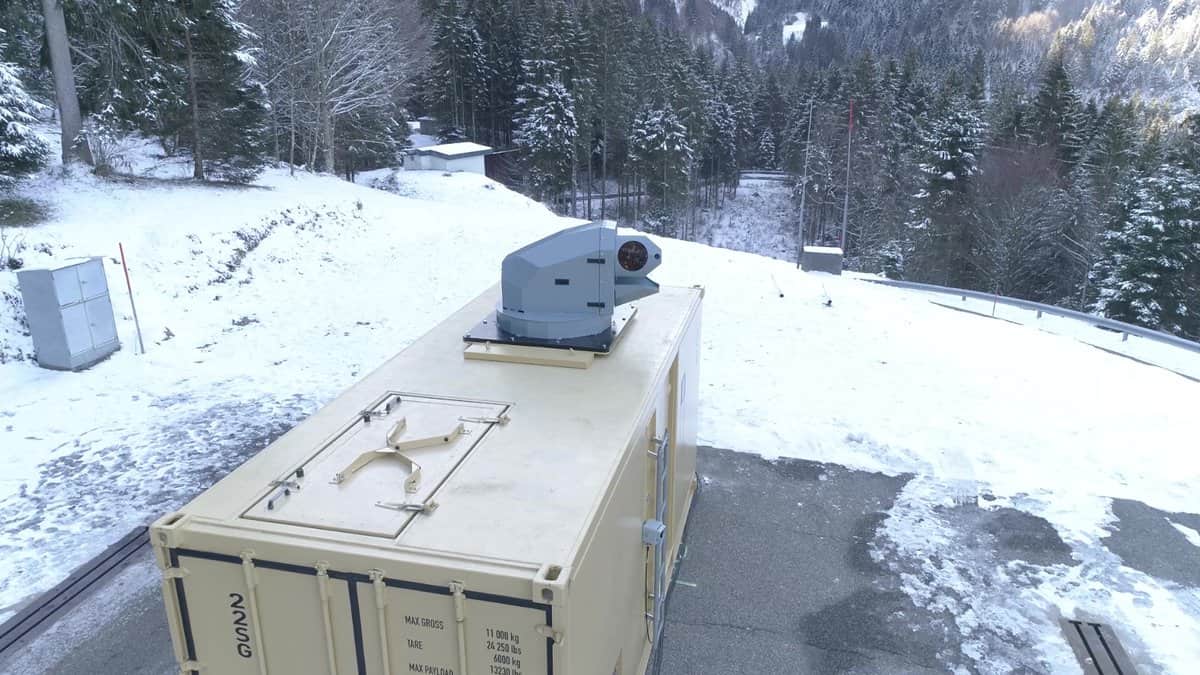
German weapons maker Rheinmetall announced on 28 February that it has successfully developed and tested new laser weapon station.
According to a news release put out by Rheinmetall, the company continues to make steady headway in the world of laser weapons, having recently completed a successful serious of comprehensive trials with a weapon station. In combination with a laser, the weapon station demonstrated its speed and precision in tests conducted in December 2018. The weapon station can be armed with lasers in the 100 kW output power range.
During the tests, which were conducted in Switzerland at the company’s Ochsenboden test center near Zürich, drones and mortar rounds were successfully engaged at operationally relevant ranges.
The laser weapon station is the latest stage and logical continuation of the process in which Rheinmetall has transformed laser weapon technology into a fully functional weapon system. It consists of four main components: the laser source, beam director with the telescope, and coarse tracker (weapon station).
The mobile weapon station performs the task of mechanically aiming the laser toward the target. Now that a weapon station specially designed to meet the requirements of a laser weapon station has been successfully realized, Rheinmetall has all of the principal assemblies for a future laser weapon system at its own disposal.
The laser weapon station was combined with a beam director – successfully employed in multiple tests – and high-performance Rheinmetall lasers. It is also designed to be combined with a soon-to-be-available 20 kW laser source, likewise made by Rheinmetall.
Equally suitable for ground, air and naval operations, the assemblies are modular and scalable in design, and can be deployed regardless of the threat situation on military platforms of all types.
Among the laser weapon station’s outstanding performance parameters are its extremely accurate mechanical aiming function, coupled with an unlimited, 360° traversing zone and an elevation range in excess of 270°. The system architecture (EN DIN 61508) is closely oriented to the MANTIS air defense system now in service with the Bundeswehr, and thus also offers interfaces for connecting it to higher-echelon air defense systems.