

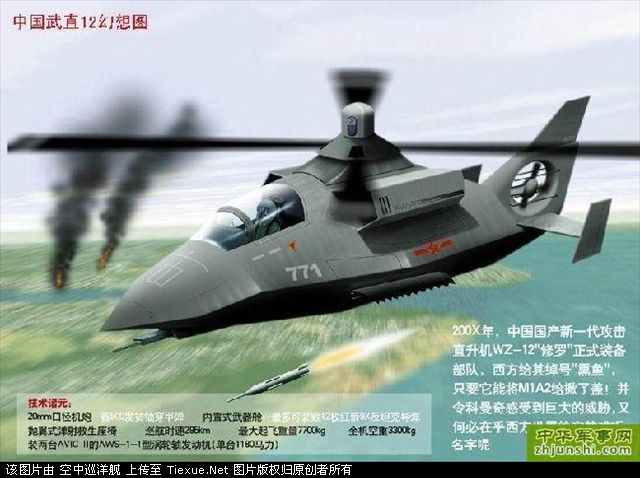
China has begun to develop a fourth-generation attack helicopter and expects to deliver it to the People’s Liberation Army around 2020, according to Aviation Industry Corp of China.
The company disclosed the information in a media brochure distributed to domestic journalists taking part in the Third China Helicopter Expo, which opened on Wednesday in Tianjin.
This is the first time that China has confirmed it is developing a new-generation combat helicopter.
The company gave no further details. However, Lin Zuoming, AVIC’s chairman, said on the sidelines of the expo that the new aircraft will have stealth capability and will reshape the combat patterns of the PLA ground force.
“It is a trend that the ground force will become increasingly dependent on helicopters because they have better strike capability and mobility than armored vehicles, and can transport supplies to frontier troops in a timely manner,” he said.
Wu Ximing, chief helicopter designer at the State-owned defense contractor, said the new helicopter will also feature supreme maneuverability in complicated environments, outstanding survivability and joint operational ability.
China now has the second-generation WZ-9, and third-generation WZ-10 and WZ-19, in its combat helicopter fleet. Their major tasks are anti-tank warfare and air support missions for infantry troops, as well as air-to-air combat.
The United States began to test the world’s first fourth-generation attack helicopter, the Boeing-Sikorsky RAH-66 Comanche, in 1996. It canceled the project in 2004 for a host of reasons, including technical specifications and budget cuts.
Russian media previously quoted Andrei Shibitov, deputy CEO of Russian Helicopters, as reporting that Russia is researching designs for a fourth-generation combat helicopter that is expected to have a low radar signature, a long range, an ultrafast speed and low noise and should be able to confront fighter jets.
According to an article carried in China Aviation News, a newspaper owned by AVIC, in May last year, Chinese helicopter engineers were developing a bearingless main rotor, a cutting-edge technology key to the fourth-generation helicopter.
In addition to the new combat helicopter, AVIC is also working on a medium-lift utility helicopter, which made its debut flight in December 2013.
Called by aviation observers the Z-20, the utility helicopter is supposed to ease a longtime shortage of such aircraft in the Chinese ground force and Navy.
Chinese designers are also working on the development of ultrafast helicopters that can achieve a speed of 700 km/h, according to AVIC.