


- Ukrainian pilot Tymur Fatkullin published footage of an An-28 aircraft armed with P1-Sun and Merops AS-3 Surveyor interceptor drones on wing-mounted pylons.
- Fatkullin confirmed the aircraft-launched interceptor method has already proven effective against Russian Shahed drones in real combat conditions.
Ukraine has converted an Antonov An-28 light turboprop aircraft into an airborne drone interceptor platform, arming it with drone-launched interceptors to hunt Russian Shahed long-range one-way attack drones in flight. The effort — documented in footage published by well-known Ukrainian pilot and volunteer Tymur Fatkullin — represents one of the most unconventional counter-drone solutions to emerge from the war.
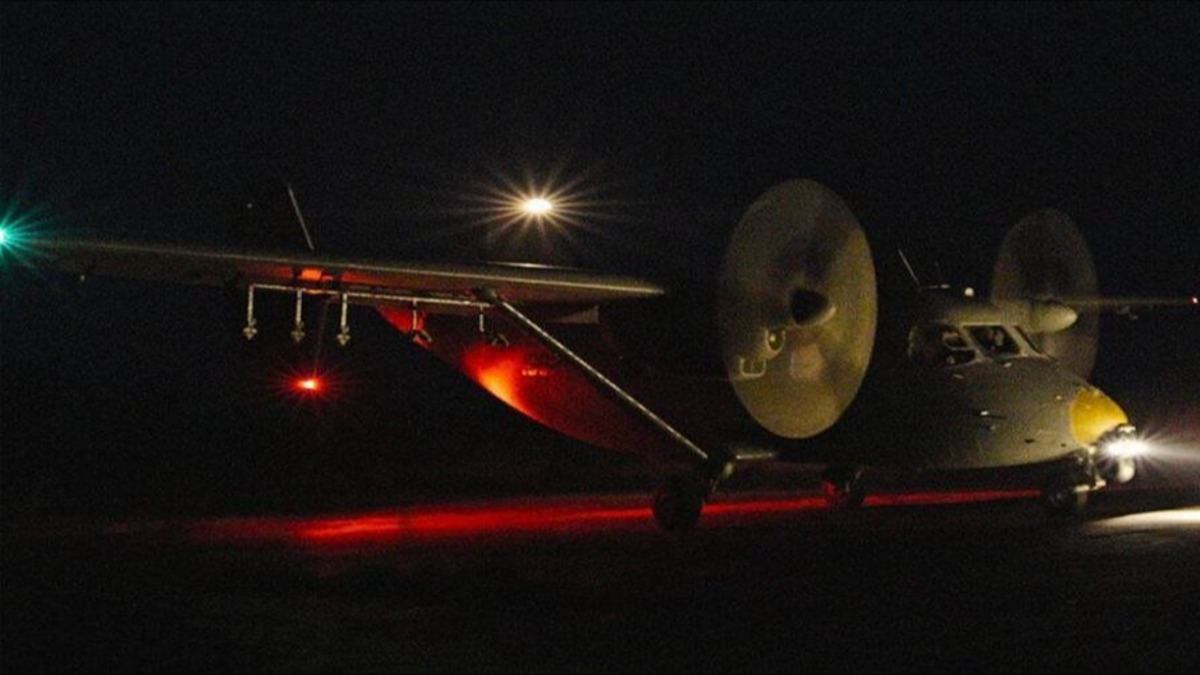
Fatkullin, who has been at the center of several improvised aviation initiatives since the start of the full-scale invasion, published video showing the An-28 equipped with wing-mounted pylons carrying interceptor drones. The footage shows two types of air-launched interceptors mounted under the aircraft’s wings: the Ukrainian-made P1-Sun and the Merops AS-3 Surveyor counter-drone system. The aircraft, already notable for carrying a six-barrel M134 Minigun, now functions as a dedicated airborne platform for drone intercept operations.
“Aircraft-launched P1-Sun interceptor against hostile Shaheds. This method has already proven effective in real combat conditions. We have also tested several other interceptor drones during training flights. You could call it a cheap air-to-air missile. For us, it is also a step toward technology that will allow drones to operate in zero visibility,” Fatkullin wrote alongside the video.
The effort was developed in partnership with a number of Ukrainian defense companies whose names have not been publicly disclosed. What is clear from the footage and the accompanying statement is that the system has moved beyond the experimental phase — it has been used in actual combat.

Russia’s Shahed-series drones — Iranian-designed loitering munitions — attack in waves, often at night, targeting Ukrainian energy infrastructure, cities, and military positions. Ukraine’s air defense network has intercepted thousands of them using surface-based systems, but every interceptor missile fired from a ground battery carries a cost that a Shahed does not. The economic math of the exchange is a constant pressure on Ukrainian resources.
An aircraft-launched interceptor drone changes that equation. The P1-Sun, developed in Ukraine, is described by Fatkullin as “a cheap air-to-air missile” — a platform designed to close with and destroy a Shahed without the cost overhead of a conventional interceptor. Mounting it on an aircraft rather than launching it from the ground gives the system altitude advantage, extended loiter time over a patrol area, and the ability to vector toward a threat using the mothership’s sensors and crew before release.
The Merops AS-3 Surveyor counter-drone system represents the higher-end option on the same pylons. A more capable and correspondingly more expensive platform than the P1-Sun, its inclusion in the flight tests suggests Ukraine is evaluating multiple interceptor types for different threat scenarios rather than committing to a single solution. Having both systems mounted simultaneously gives crews flexibility in how they engage depending on the target profile and tactical situation.

The An-28 itself is a Soviet-era light utility turboprop, originally designed for short-field operations in remote areas. It seats up to seventeen passengers in its standard transport configuration, flies on two Glushenkov TVD-10B turboprop engines, and is known for its ability to operate from unprepared strips. It is not a fighter. It was never intended to intercept anything. That is precisely what makes its conversion significant — Ukraine is not waiting for purpose-built platforms. It is taking what is available, modifying it aggressively, and putting it into the fight.
Armed with pylons, interceptor drones, and a Minigun, the modified An-28 now functions as a low-cost airborne counter-drone platform — part interceptor aircraft, part weapons testbed, and entirely outside any existing procurement category.
Fatkullin’s disclosure that the method “has already proven effective in real combat conditions” is significant. It means Ukraine has already flown this aircraft against Shaheds operationally — not just in training, not in simulation, but in actual engagement conditions. The footage from training flights showing multiple interceptor types being tested indicates the program is actively developing, with crews accumulating data on how different drone platforms perform when launched from a moving aircraft at operational altitudes.
Ukraine’s drone industry has accelerated faster than almost any other sector of its defense economy since 2022. Dozens of companies are developing, testing, and fielding systems at a pace that conventional procurement cycles cannot match. The An-28 interceptor program fits that pattern exactly — small teams, unconventional platforms, real-world testing in active combat, and rapid iteration based on what actually works over the front line.
The Shahed costs roughly $40,000 to $100,000 per unit. If Ukraine can intercept them with a system that costs less — launched from an aircraft already flying patrol — the economic logic of Russia’s drone campaign starts to shift. That is the calculation driving this program, and it is why a converted Soviet turboprop armed with drone interceptors and a rotary cannon is now hunting Russian UAVs over Ukrainian skies.