

- Target Arm Inc. announced on July 27, 2026 that its Ralar 2 system now integrates with HDT Global's Hunter WOLF and WOLF-X unmanned ground vehicles.
- The combined system lets certified drones launch, land, recharge, and relaunch from moving vehicles without a human pilot present.
Robotics company Target Arm Inc. said this week that its drone launch and recovery system has been integrated with unmanned ground vehicles built by HDT Global, a manufacturer of rugged robotic platforms used in military and industrial settings.
The company announced the integration on social media on July 27, 2026. The combination pairs HDT Global’s Hunter WOLF and WOLF-X unmanned ground vehicles, wheeled robots capable of carrying equipment and operating without a human driver inside, with Target Arm’s Ralar 2 system, creating what the company describes as an autonomous mobile drone base.
Most drones need a stationary platform to take off from and land on. A truck, a ship, or a ground vehicle typically has to stop moving, and often needs a human operator standing by, before a drone launch can happen. That requirement costs time, reduces efficiency, and raises operational risk, particularly in situations where stopping a vehicle means becoming a stationary, exposed target or losing momentum on a mission that cannot afford delays.
According to Target Arm, its Ralar 1 and Ralar 2 systems remove that requirement. The company describes the technology as AI-assisted robotics and autonomy systems that allow certified drones to launch, land, recharge, and launch again from vehicles that remain in motion, whether on land, in the air, or at sea, without a pilot present to manage the process by hand.

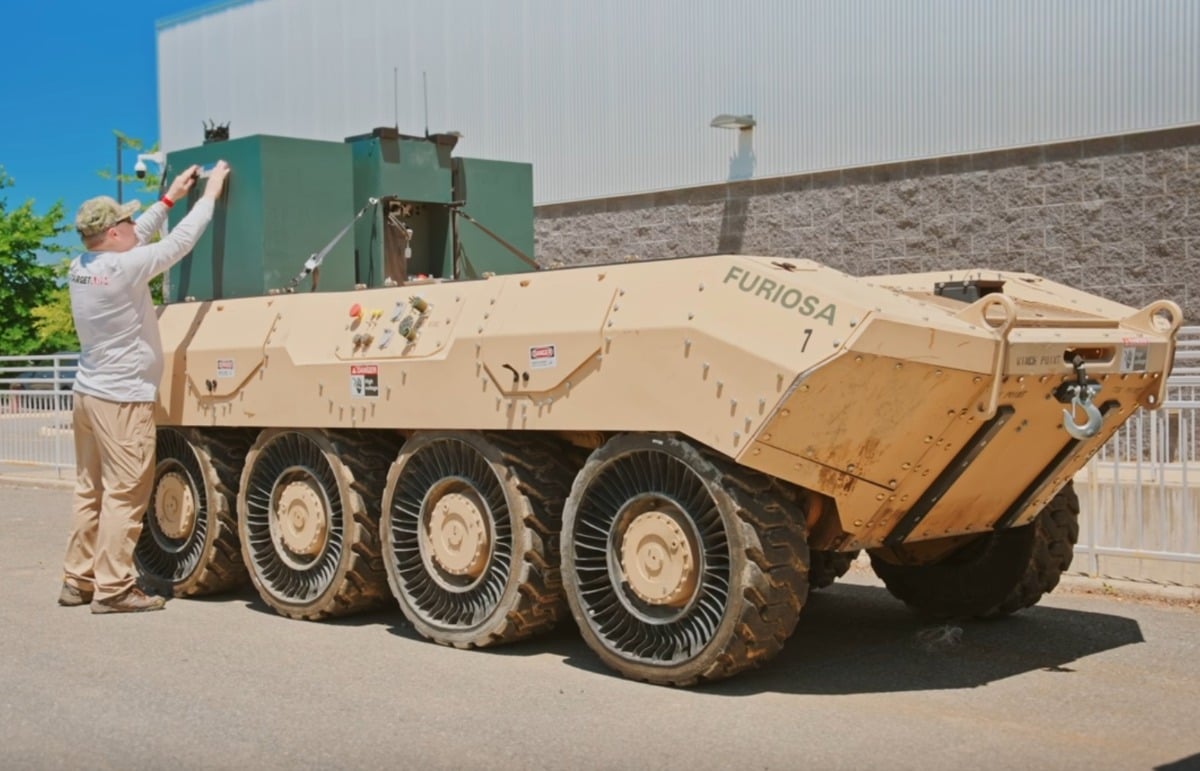
Footage released alongside the announcement show the system during a field demonstration. A technician works on equipment mounted to a tan-colored wheeled ground vehicle labeled “FURIOSA,” a low-slung robotic platform fitted with sensor and camera housings, built to move across rough terrain without a human inside directing its movement. The vehicle is compact, roughly the size of a small all-terrain machine rather than a dedicated aircraft carrier or command truck.
Unmanned ground vehicles like the Hunter WOLF and WOLF-X have become increasingly common in military logistics and reconnaissance, valued for their ability to haul equipment, scout terrain, or carry sensor payloads into positions considered too dangerous or impractical for soldiers to occupy directly. Turning one of those vehicles into a moving drone launchpad extends that capability significantly, giving a single unmanned ground vehicle the added function of an unmanned aerial system without requiring a separate team to manage the aircraft.
Target Arm says the technology applies broadly across sectors rather than to one battlefield use case. The company lists defense operations, public safety work such as search and rescue or surveillance, logistics and package delivery, maritime operations, and protection of critical infrastructure like power plants, pipelines, or water systems among the intended applications.
Ground robots and aerial drones have largely operated as separate systems, requiring separate teams, separate launch procedures, and separate windows of vulnerability where a vehicle must stop and expose itself just to get a drone airborne. Collapsing that separation, allowing one machine to launch, recover, and relaunch another without stopping or needing a human hand nearby, points toward a broader shift in how autonomous systems are expected to operate together. Whether this particular combination becomes a standard part of that future, or one early attempt among several competing approaches, remains to be seen.